








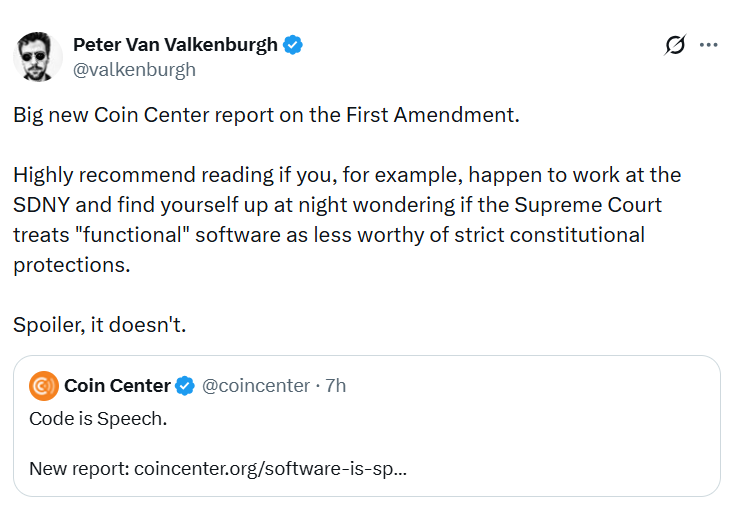
Crypto lobby Coin Center has expanded on its argument that software code is free speech and should be protected under the First Amendment of the US Constitution, amid continued uncertainty over whether crypto developers could be liable for how their inventions are used.
In a report published Monday, Coin Center Executive Director Peter Van Valkenburgh and Director of Research Lizandro Pieper said writing and publishing crypto software code is the same as writing a book or publishing a recipe.
The pair argued that the First Amendment, which protects individuals’ freedom of speech and expression, offers strict constitutional protection for developers who only publish and maintain software.
“They are speakers and inventors, not agents, custodians, or fiduciaries. Extending pre-registration or licensing requirements to this speech activity drops the historical logic of financial oversight and imposes a classic prior restraint on activities that are primarily speech and expression—which is almost always unconstitutional,” they added.

Crypto software developers have been seeking legal protections to shield themselves from criminal liability over the software they create. Last year saw several high-profile convictions of crypto developers based on how their software was used, including the trial of Tornado Cash developer Roman Storm.
Regulation applies when devs interact directly with users
Van Valkenburgh and Pieper said the paper is aimed at providing a framework for courts and regulators to distinguish between protected software publication and a developer’s professional conduct.
They argued that a developer crosses into regulatable conduct when controlling user assets, executing transactions for users or making decisions on users’ behalf.
“Lower court confusion over the distinction between conduct and speech naturally found in software publishing has fueled the development of what might be called a functional code theory of diminished First Amendment protection,” they said.

“Some courts have suggested that because software can be executed to produce real-world effects, it resembles conduct rather than speech,” they added.
“We argue that such activities are pure speech and that the Supreme Court’s existing jurisprudence insists on this interpretation even if some lower courts have gone astray.”
They cited the 1985 case of Lowe v. SEC, in which the Supreme Court found that a publisher that does not hold assets on behalf of a client or take action on the client’s behalf is protected by free speech and does not count as practicing a regulated profession.
Crypto developers can’t be used as scapegoats
In some cases, crypto software has eliminated certain traditional middlemen, with self-custody and peer-to-peer transactions removing the need for a central authority to send funds or hold them.
Traditionally, financial institutions acting on a user’s behalf as intermediaries are regulated by governments and required to hold licenses.
Related: Coin Center urges Senate not to axe crypto developer protection bill
Van Valkenburgh and Pieper said that while it is challenging to build regulatory frameworks around new technology, declaring software developers to be middlemen for “administrative convenience” is not the answer either.
“Crypto software does not necessitate the invention of new legal doctrines or novel carveouts. It requires the faithful application of settled First Amendment principles to a new technological context,” they added.
“In the age of computers, where software is the primary means for expressing ideas and organizing economic life, those principles matter more, not less. Writing and publishing code is speech. And in a free society, speech cannot be licensed into silence.”
Storm was convicted last year on charges of conspiracy to operate an unlicensed money-transmitting business, but his lawyers have been working on a motion to dismiss using the Supreme Court case, Cox Communications Inc. v. Sony Music Entertainment, to argue he had no intent to participate in the crimes of which he is accused
The co-founders of privacy-focused Bitcoin wallet Samourai Wallet were also found guilty on the same charge and were sentenced to between four and five years in prison.