







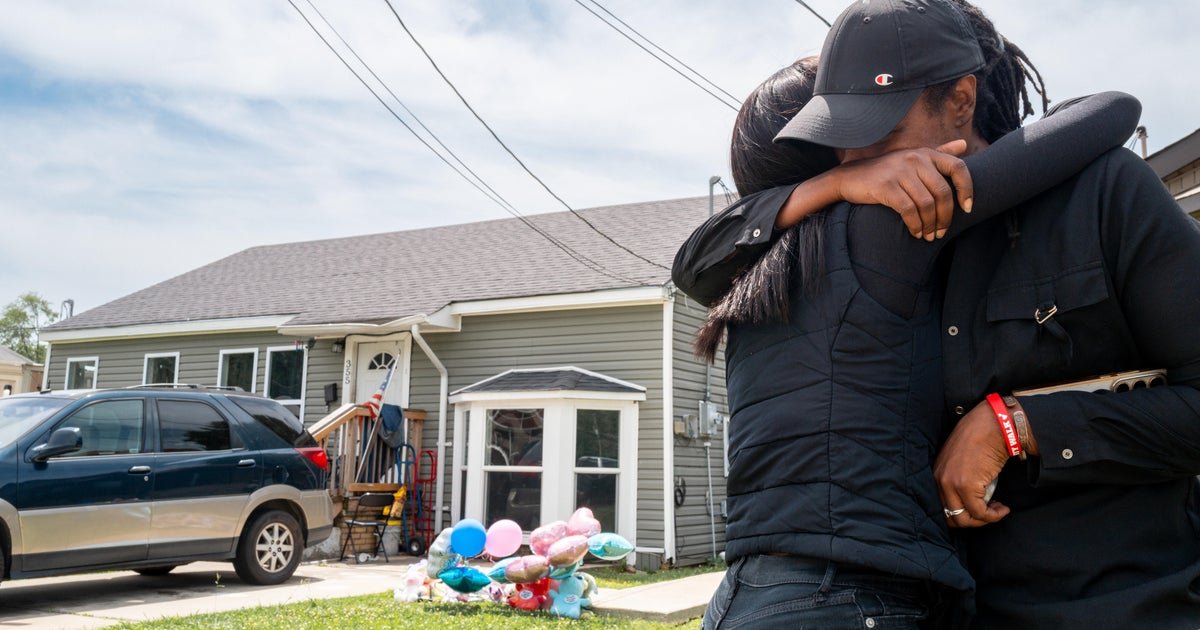
After a gunman killed eight children, seven of them his own kids, in Shreveport, Louisiana on Sunday, advocates are urging policymakers to close “dangerous gaps” in legislation aimed at preventing fatal domestic violence crimes. The tragedy has also brought a renewed focus to the ways in which domestic violence and firearm deaths are connected.
“The nexus between gun violence and domestic violence is one of the most well-established and horrific realities of America’s gun violence crisis,” said Sam Levy, director of policy advocacy at the nonprofit Everytown for Gun Safety.
Decades of research and data show a woman is five times more likely to be killed in a domestic violence situation if a gun is involved, with similar risks extending to kids. Firearm injuries are the leading cause of death among children and teens in the United States, according to statistics that are widely cited by organizations like the Children’s Hospital Association and the Johns Hopkins Center for Gun Violence Solutions, in addition to Everytown.
Police said the Shreveport attacker also seriously wounded two women, one of whom was his wife. A neighbor told The Associated Press that the women were the children’s mothers, and that the gunman and his wife had recently been arguing about their planned separation.
It was the nation’s deadliest shooting in more than two years, and local officials characterized it as one of the worst days Shreveport had ever experienced. They also acknowledged that the shooting exemplified the most devastating outcome of a known issue in the community.
Shreveport councilmember Grayson Boucher on Monday referred to “a true epidemic of domestic violence” in the city as “something that should be a top priority of the city’s administration, the city council and law enforcement.” Shreveport Mayor urged people to lean on community resources like a domestic violence shelter recently established by the sheriff’s office, while councilmember Tabatha Taylor stressed the need to take domestic violence seriously.
“These are the residual effects of what happens if we’re not paying attention,” Taylor said.
Almost 5.4 million Americans reported being victims of domestic violence over the last five years, according to the Bureau of Justice Statistics, and the vast majority were women, CBS News previously reported. In the United States, data also show that access to guns can make such incidents more likely to turn deadly.
Former congresswoman Gabby Giffords, who founded a gun violence prevention organization after she was severely wounded in a mass shooting in 2011, pressed leaders in Louisiana and Washington to “act now” to enact reforms. Her organization, which gave Louisiana a failing grade in its latest annual Gun Law Scorecard, noted that the state has some of the weakest gun laws in the nation — as well as some of the highest rates of deaths involving firearms.
Louisiana has enacted legislation in recent years to help protect survivors of domestic violence, including by banning people convicted of domestic abuse or battery from possessing firearms. Although federal law already prevented most people convicted of domestic abuse from owning guns, it did not cover all types of relationships, nor was it reliably enforceable without additional state-level policies, according to Everytown for Gun Safety.
“Unfortunately, Louisiana has other dangerous gaps that make those laws un-impactful,” Levy told CBS News, adding that the Shreveport shooting “is the cost” of lawmakers’ failure to fill them.
While a convicted abuser is legally barred from purchasing firearms in Louisiana, the state does not require gun sellers to be licensed, so those sellers are not required by federal law to conduct background checks on purchasers. Without a background check, a criminal conviction could go unnoticed and a sale could be made.
This particular law did not apply to the gunman in the Shreveport shooting, who did not have prior convictions for domestic abuse. He previously pleaded guilty to a weapons charge in 2019, which on its own did not permanently disqualify him from owning a gun.
But experts say other measures could be put in place to keep someone without criminal convictions from obtaining a firearm if they are in crisis.
Louisiana lacks an “extreme risk” law — also known as a “red flag” law — which would enable loved ones or police to seek a court order to temporarily bar a person’s access to guns. Such measures, Levy said, can “empower people who recognize dangerous warning signs” in someone they know to “take steps to ensure that person is prohibited from buying guns in the future, but also make sure they don’t have access to guns right now.”
Fewer than half of all U.S. states have adopted these laws, according to Everytown.
“This is the human toll, of lives lost and a whole community traumatized by failures to put even the most basic safeguards in place to ensure guns don’t end up in or stay in the hands of people who pose a threat to themselves or others, including their children and families,” said Levy.
Advocacy groups have repeatedly warned that women of color are targeted most often in deadly domestic violence incidents, and they are emphasizing the need for intervention that puts a stop to the pattern.
“Every day in America, domestic abusers are armed, and women and children — disproportionately Black — pay the cost with their lives,” Angela Ferrell-Zabala, the executive director of Moms Demand Action, said in a statement to CBS News. “Eight babies just had their futures stolen in an act of violence that should never have been possible.”