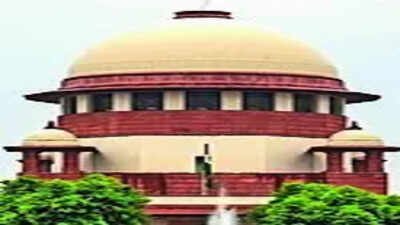









NEW DELHI: A governor has no option but to invite the single largest party or a post-poll alliance to form govt after elections and cannot inquire into how the majority support was garnered by the single largest party or the alliance – Supreme Court’s constitution benches have ruled consistently, from the landmark S R Bommai judgment in 1994 to Rameshwar Prasad in 2006. The Rameshwar Prasad judgment, had castigated UPA govt for dissolving the Bihar assembly and imposing President’s rule on a report from then governor Buta Singh that there was no pre-poll alliance between JDU and BJP and their coming together smacked of horse-trading in MLAs.Quoting the Bommai judgment, the majority in the 2006 ruling had said, “The action which results in preventing a political party from staking claim to form a govt after an election on such fanciful assumptions, if allowed to stand, would be destructive of the democratic fabric.” If fanciful claims of horse-trading are taken as the basis to deny the party exhibiting majority support of MLAs to stake claim to form a govt, then “it may also be a handle to reject post-poll alignments and realignments on grounds of the same being unethical, plunging the country or the state to another election,” SC had said.SC had said, “If, after polls, two or more parties come together, it may be difficult to deny their claim of majority on the stated grounds of such illegality. “These are the aspects better left to be determined by the political parties which, of course, must set healthy and ethical standards for themselves, but, in any case, the ultimate judgment has to be left to the electorate and the legislature comprising also of members of the opposition.“Laying emphasis on the floor test that must be faced by the party or coalition staking claim to form govt, SC had struck down President’s rule in Bihar and said, “Ultimately, majority shall have to be proved on the floor of the House.”In the Bommai case, a bench had cautioned against misuse of gubernatorial powers to dismiss elected govts or dissolve a duly elected assembly and said, “The very enormity of this power undoing the will of the people of a state by dismissing the duly constituted govt and dissolving the duly elected legislative assembly must itself act as a warning against its frequent use or misuse, as the case may be. Every misuse of this power has its consequences which may not be evident immediately but surface in a vicious form a few years later...”