







Monthly trading volume on the Polymarket prediction market fell by about 8.9% in April, the first decline in month-to-month activity since August as rivals like Kalshi increased their market share.
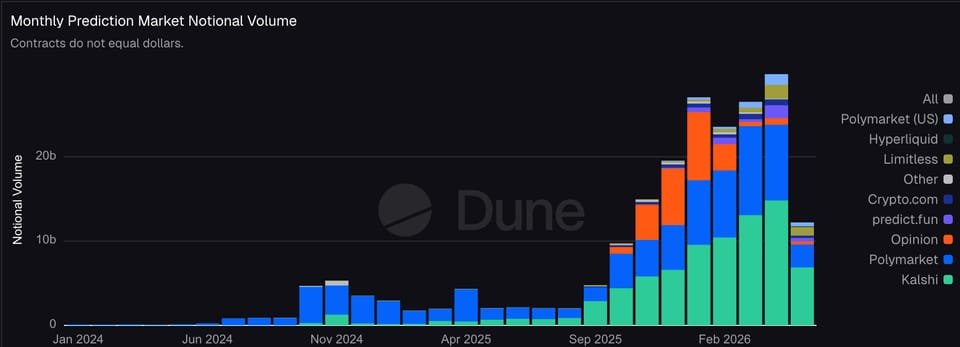
Polymarket and its US-based trading application collectively generated more than $10.2 billion in volume in April, compared to more than $11.2 billion in March, according to data from Dune Analytics.
However, rival Kalshi’s April trading volume surged by about 13%, climbing to about $14.8 billion, Dune data shows.
The total monthly trading volume for prediction markets also increased to about $29.8 billion in April from about $26.5 billion in March, an increase of about 12.4%.

Monthly volume figures for prediction markets. Source: Dune
Polymarket’s volume drop came as the company attempts to fully integrate US markets again, amid increased legal and regulatory scrutiny of prediction markets by US lawmakers after the sector experienced a meteoric growth during the 2024 elections.
To be sure, prediction markets are proving to be attractive to a slew of new competitors.
Prophet, an AI-native prediction market platform, last week launched its first live trading tranche, introducing a system where an AI model acts as the counterparty using real capital. Earlier this week, financial technology company MoonPay debuted an AI technology tool for trading strategies on prediction markets.
Related: Dutch users still access prediction markets despite Polymarket ban
Polymarket eyes US expansion as prediction markets come under fire
Polymarket is seeking to expand its presence in the US after exiting in 2022 as part of a settlement with the US Commodity Futures Trading Commission (CFTC), which barred the platform from allowing US residents on its main, global exchange.
In a bid to regain a foothold, the company launched a dedicated app for US customers in December 2025, albeit a platform that is siloed off from the Polymarket’s global platform and its liquidity.
Several US lawmakers and regulatory officials have raised concerns about insider trading on prediction markets, particularly in markets related to war, energy prices, and other geopolitically sensitive issues.

A letter from Senator Elizabeth Warren and other US lawmakers asks the CFTC to crack down on insider trading. Source: Senator Elizabeth Warren
In March, Senator Elizabeth Warren and more than 40 Congressional representatives wrote to the CFTC demanding a ban on government insiders using prediction market platforms to profit while in office or serving in an official capacity.
“The CFTC maintains that event contracts are a type of swap subject to its jurisdiction, and, therefore, it should ensure that federal employees understand existing restrictions on prediction market insider trading,” the lawmakers said.
Wisconsin Attorney General Josh Kaul also filed lawsuits against Kalshi, Polymarket, and other prediction markets in April, accusing the platforms of violating state sports betting laws.
Magazine: Should users be allowed to bet on war and death in prediction markets?