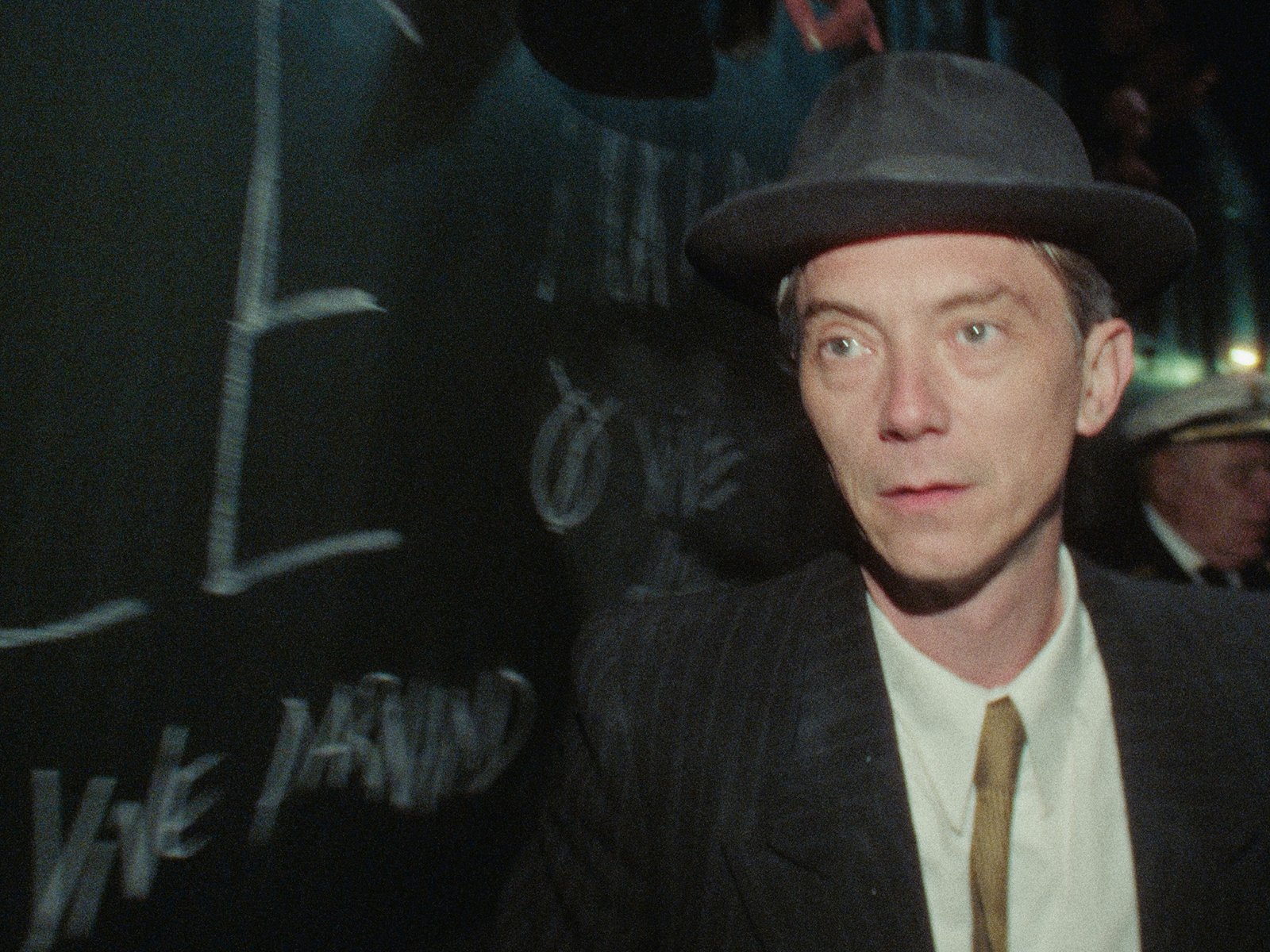








“The Man I Love” brings the director Ira Sachs to competition for the second time, after “Frankie” in 2019. It’s the sort of film that might sound familiar in a description, butit’s made with such detail and care that it feels lived in, not simply dramatized. It’s set in New York in the late 1980s, and there’s a causal confidence to the way the production design re-creates the era of videocassettes, “non-stop go-go bars,” and downtown experimental theater. (The movie was also shot on film, something that can’t be taken for granted these days.)
The story revolves around Jimmy George (Rami Malek), an exuberant theater artist—not performance artist, he insists—who, intentionally or not, has made himself the center of several people’s lives. Those people include Dennis (Tom Sturridge), his longtime partner, who views with him with a mixture of enduring tenderness and concern; Vincent (Luther Ford), a British newcomer to Jimmy’s building who is drawn to his magnetism; and Brenda (Rebecca Hall), Jimmy’s sister, who travels between Jimmy’s countercultural milieu and the more traditional world of their family. Early on, she apologizes to Dennis because her parents didn’t invite him to their anniversary party.
Jimmy’s volatility is on full display as he prepares for a new stage performance inspired by a 1970s French Canadian film. The rehearsal scenes (some other members of the group are played by Stephen Adly Guirgis and Sasha Lane) are depicted at length, and late in the film, Jimmy has something like a “Raging Bull” moment in his dressing room as he runs through lines for his big night.
Offstage, Jimmy bonds with Vincent, helping him carry a mattress up to his apartment. Dennis regards Vincent warily when he brings over a bottle of wine, perhaps because Dennis has seen all this before, but also because he is worried for both men.
Brenda is happy to see Jimmy in high spirits and wants her teenage son to get to know him: “It’s good for him to see his uncle up close, especially now when he’s busy and excited with a new show,” she tells her husband, Gene (Ebon Moss-Bachrach). Gene is more skeptical: Jimmy’s current state isn’t going to last, he says, and that’s going to be tough for the boy. There’s a powerful scene in which the son, Billy (Dennis Courtis), records Jimmy with a camcorder as Jimmy unapologetically delivers a private confession about his wild experiences with sex and drugs, addressed to his parents. There is a sense that it’s one of the last chances he’ll get to put his cards on the table.
Because the film is set in New York, with gay characters, in the 1980s, it should be no surprise that the story involves AIDS. But one of the strengths of “The Man I Love” is that it keeps AIDS in the background until relatively late in the going: The film is not simply an AIDS drama or a gay drama, but a drama about the process of making theater, the thorniness of familial and romantic relations, and caring for a loved one whose love for you isn’t—and maybe can’t be—symmetrical. (In that, it has echoes of Sachs’s “Passages” from three years ago; he wrote both films with Mauricio Zacharias.) The romances are depicted with considerable complexity: Jimmy and Vincent don’t avoid physical touch despite the danger, and there’s a sweatiness in the intimate scenes that is refreshing. The film’s worldview is best summarized by Brenda: “It’s a tough business, living,” she says.

The Cannes regular Christophe Honoré (“Marcello Mio”) is considerably less successful at evoking a past era in “Orange-Flavoured Wedding.” (I’m leaving that British “U” in “flavored,” per the film’s official materials, at least until the inevitable title change.) This unwieldy French ensemble drama, showing in the Cannes Premiere section, centers on a wedding on March 11, 1978—specifically, the day of the French singer Claude François’s death at 39 from electrocution, a bit of breaking news that casts a pall over what’s meant to be a joyous gathering.
If you handed me an “Orange-Flavoured” family tree and gave me a week in advance to study up on the more than dozen major characters, I’m still not sure I could follow everything. Never the most disciplined storyteller, Honoré, who wrote and directed, drops viewers into the dysfunctional family dynamics in medias res and never clarifies much from there. Although the bulk of the movie is set at the wedding party, the narrative abruptly flashes forward three times—once to show a ghost apologizing to his mother, in the sort of stylistic deviation that should have stayed on the page.
An absent father, mental instability, drug abuse, cancer, P.T.S.D. from wartime experiences in Algeria—they’re all mentioned in this film, but none is addressed with any depth. Only Adèle Exarchopoulos, as a troubled sister of the groom, manages to create a character who commands attention from scene to scene.