







Intercontinental Exchange (ICE), the owner of the New York Stock Exchange (NYSE), is working with crypto exchange OKX to launch trading of oil-linked perpetual futures.
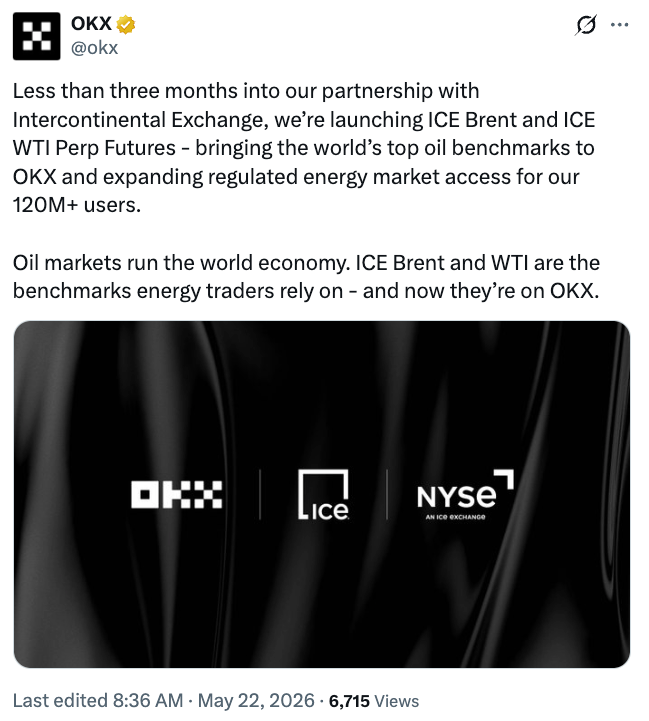
OKX said Friday it plans to introduce perpetual futures based on ICE’s Brent crude and West Texas Intermediate (WTI) crude benchmarks, two of the world’s most widely used oil price indicators, according to a release shared with Cointelegraph.
“These new OKX perpetual contracts, based on ICE’s deep, liquid, transparent, and global oil markets, allow OKX’s customer base […] to access energy benchmark products,” said Trabue Bland, ICE’s senior vice president of futures exchanges.
An OKX spokesperson told Cointelegraph the contracts represent the exchange’s first product collaboration with ICE and will settle against ICE’s Brent and WTI benchmark prices, which are widely used across traditional energy markets.
The collaboration is the first product announced under a broader partnership with ICE and OKX unveiled in March when ICE invested in the crypto exchange at a $25 billion valuation.
Availability limited to licensed jurisdictions
The oil-linked perpetual futures will only be available in jurisdictions where OKX is licensed to offer perpetual futures trading, the announcement said.
OKX global managing partner Haider Rafique said the products will be aimed at retail traders, giving them access to energy benchmarks in a regulated and transparent environment.
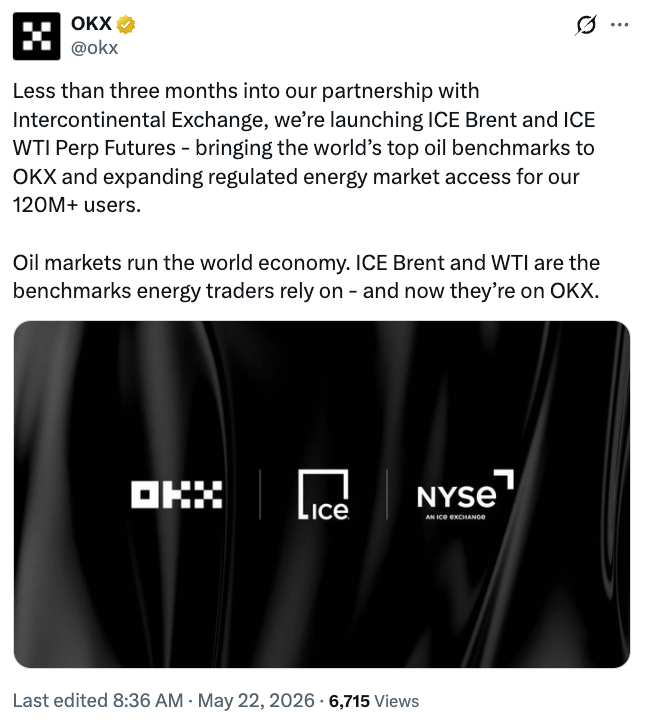
Source: OKX
Oil trading moves into crypto perps
Perpetual futures, often called “perps,” let traders bet on whether the price of an asset will go up or down without actually buying it. Unlike traditional futures, these contracts do not have an expiration date, allowing traders to keep positions open continuously.
Some centralized exchanges (CEXs) have expanded into oil-linked derivatives in recent months. Binance launched perpetual futures tied to WTI crude, Brent crude and natural gas in April, while Bybit also introduced oil perpetual contracts alongside other commodity-linked products for round-the-clock trading.
Related: Surging oil prices have been driving Ether selling pressure: Tom Lee
Activity has been particularly strong during periods of rising oil volatility linked to geopolitical tensions in the Strait of Hormuz.
ICE presses regulators to clamp down on oil trading on Hyperliquid
Decentralized derivatives exchange Hyperliquid has emerged as a notable venue for oil-linked perpetual trading amid the rapid growth of decentralized derivatives trading.
In the first quarter of 2026, Hyperliquid entered the top 10 derivatives exchanges by trading volume, recording roughly $500 billion in activity and ranking alongside major venues such as Binance and OKX.
According to Hyperliquid data, Brent crude oil contracts rank among the platform’s top five most traded markets over the past 24 hours, with about $352 million in daily volume at the time of publication.
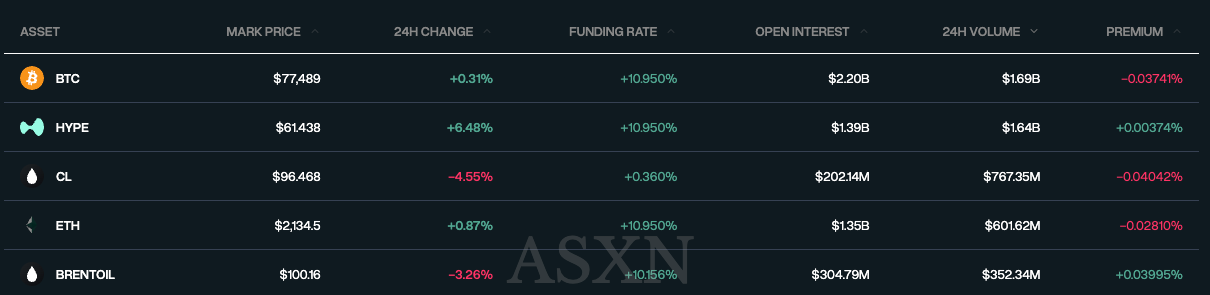
Top five most traded markets on Hyperliquid. Source: Hyperliquid
As the platform’s perpetual futures activity has expanded, ICE and the Chicago Mercantile Exchange (CME) have reportedly urged US regulators to take action against Hyperliquid over its expansion into commodity trading in mid-May.
The companies reportedly cited the platform’s “anonymous” and “unregulated” structure as a risk to critical energy markets such as oil and gas, warning it could potentially be used by state actors to bypass sanctions.
Magazine: 5 tech predictions the mainstream media got horribly wrong