





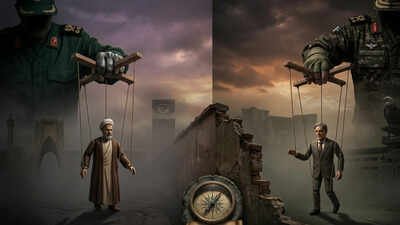
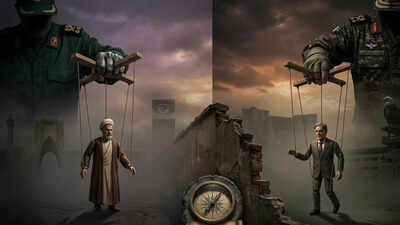
Iran may be edging toward Pakistan’s model of power concentration: A system where elected leaders remain in office, but the military-security establishment holds the real levers of authority.Reports of the Islamic Revolutionary Guard Corps (IRGC) tightening its grip on government functions, isolating President Masoud Pezeshkian, and controlling access to Supreme Leader Mojtaba Khamenei evokes an old pattern seen in Pakistan, where the army has long overshadowed civilian rule and turned elected governments into managed facades.In both cases, formal institutions still exist, but the decisive question is not who occupies the office — it is who controls the chain of command behind it.Iran’s political system was never designed to work like a normal Republic.Under its 1979 constitution, ultimate authority sits with the supreme leader, who appoints senior military and Revolutionary Guard commanders and sets the broad direction of the state, while the president handles day-to-day administration.But in practice, the balance between clerical authority, civilian government and military establishment has long been unstable, and several reports now suggest that the Islamic Revolutionary Guard Corps is pushing that imbalance further in its favour amid ongoing conflict with the US.
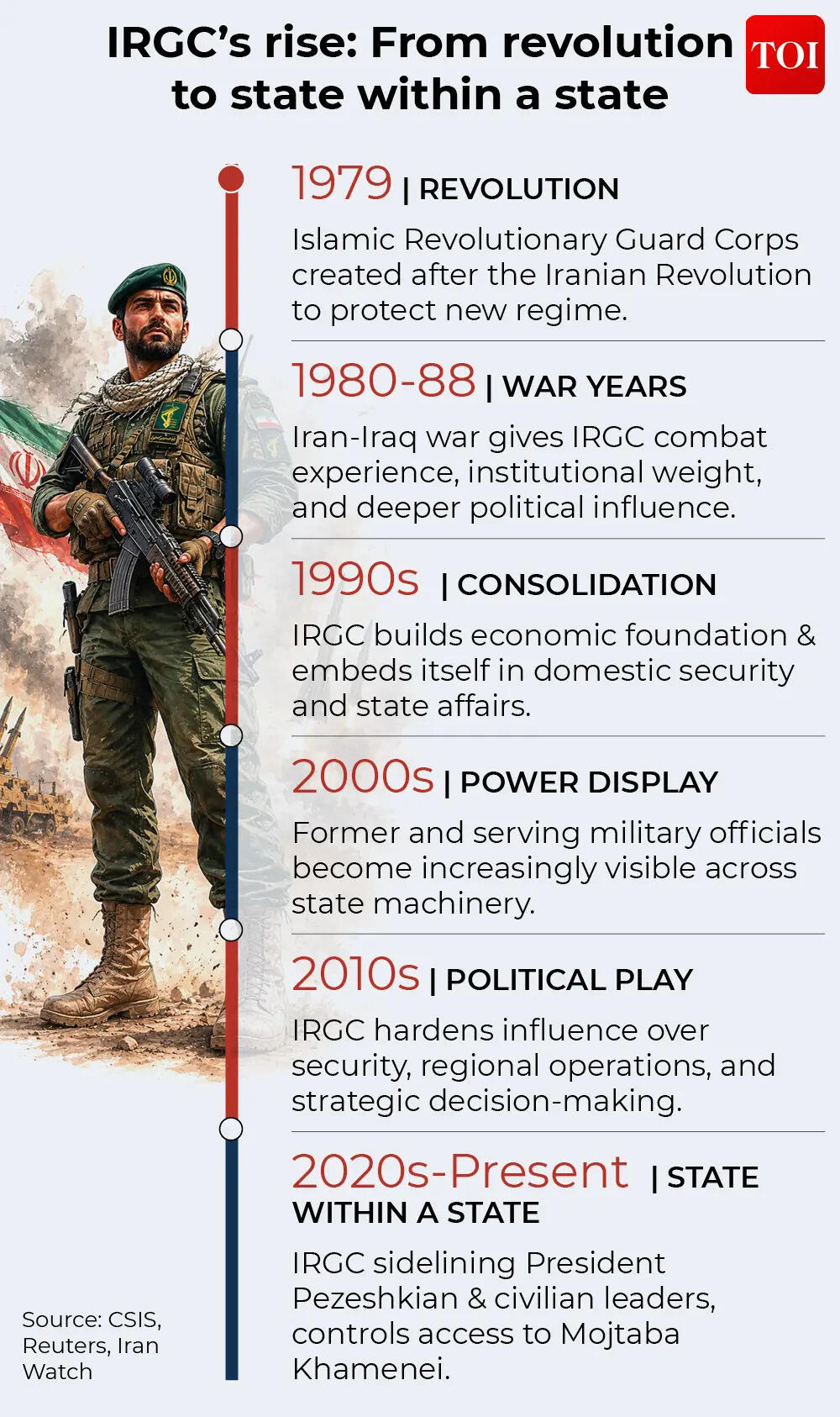
The immediate trigger to spectulation is a reported power struggle between President Pezeshkian and Iran’s military-security establishment (IRGC).Iran International reported on April 1, 2026, that the Revolutionary Guard had “effectively assumed control over key state functions”, while the president was pushed into a “complete political deadlock”.Other reports citing local Iranian sources carried the same broad line, stating the IRGC had sidelined the president and taken vital leadership calls amid uncertainty over Mojtaba Khamenei’s whereabouts.The Islamic Revolutionary Guard Corps, or IRGC, was created after the 1979 Islamic Revolution as a counterweight to Iran’s regular army and as a force meant to protect the new regime.It was rapidly expanded during the Iran-Iraq War, where it gained combat experience, manpower, and political prestige. The conflict also pushed the state to channel a growing share of military resources to the Guards, and by the mid-to-late 1980s they had become central to Iran’s war effort.The war did more than enlarge the IRGC’s battlefield role. It turned the force into a revolutionary institution with a loyal ideological identity, separate from the old army and closely tied to the new leadership’s survival. That gave it influence not only in combat, but also in internal security and postwar reconstruction.After the war, the IRGC’s engineering and infrastructure wings helped rebuild the country, which further deepened its reach into the economy and the state.By the end of its first few decades, the IRGC had become far more than a paramilitary guard. It was a battle-tested, politically trusted institution with money, networks, and a direct line to the regime’s core.The IRGC is not just Iran’s most powerful military force; it is also one of the country’s most important economic actors, with influence that reaches into construction, oil and gas, transportation, telecommunications, banking, real estate, and import-export networks.Over time, it has built a sprawling business empire through affiliated firms, foundations, and front companies, allowing it to capture major contracts, bypass oversight, and convert state power into financial power.A key pillar of this empire is Khatam al-Anbiya, the Guard’s engineering arm, which has been involved in large infrastructure projects such as refineries, dams, railways, and pipelines.The IRGC also benefits from Iran’s sanctions environment: as Western pressure narrowed normal trade channels, Guard-linked networks expanded through smuggling, sanctions evasion, and informal markets. That made the Corps not only a military actor but also a gatekeeper to access, licenses, contracts, and scarce foreign exchange.
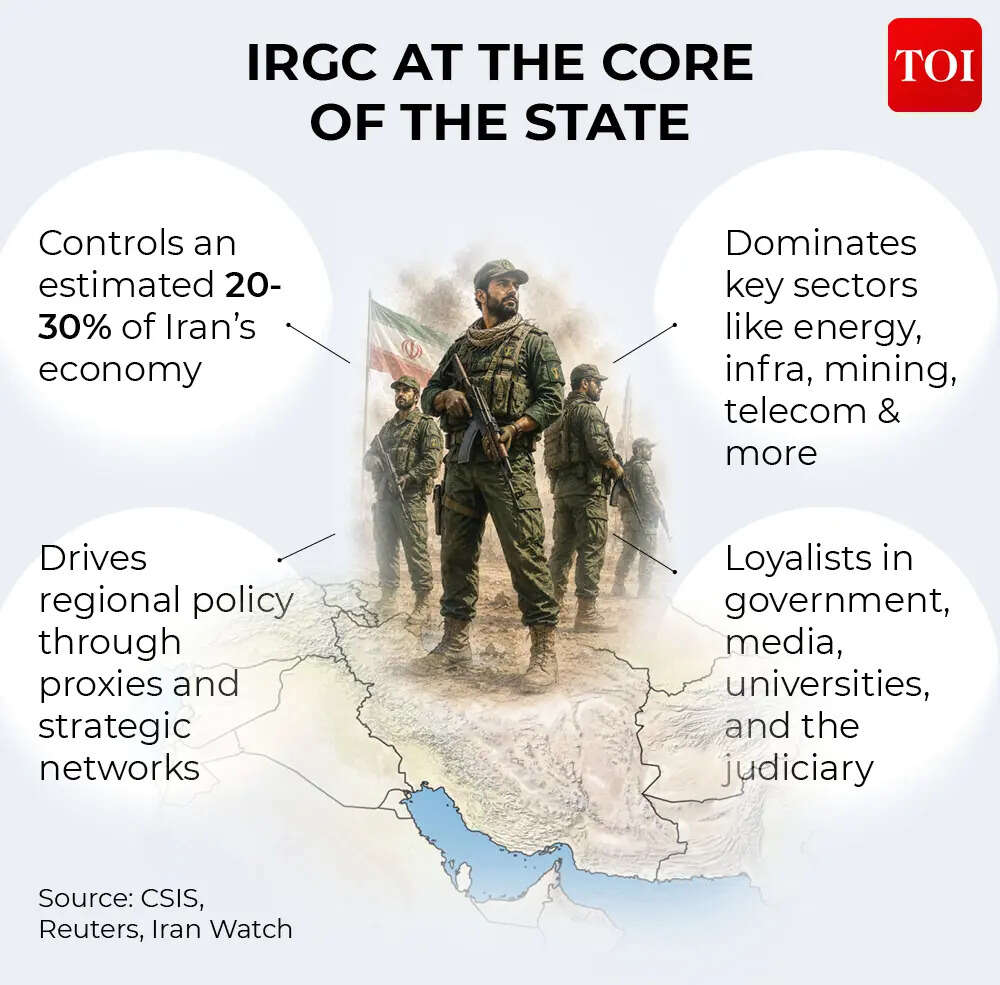
The result is a self-reinforcing system. Economic dominance finances political influence, and political influence protects economic dominance.Estimates vary widely, but multiple reports say IRGC-linked entities control a substantial share of Iran’s economy, enough to shape prices, employment, infrastructure, and the state’s ability to function.In practical terms, the IRGC has become a state within a state—one that can survive crisis better than civilian institutions because it controls both coercion and cash.Its economic reach is enormous, though exact numbers are hard to pin down because much of its activity runs through front companies, foundations, and opaque networks.Some estimates suggest IRGC-affiliated foundations account for 30-50% of Iran’s GDP, and control roughly 20-30% of the economy, including the oil trade.Politically, the IRGC is just as powerful. Former officers occupy key posts in the cabinet, judiciary, provincial administration, and security agencies, giving the Corps influence deep inside the state.In practice, that makes the IRGC not just a military institution, but a parallel power structure with the ability to shape government decisions, suppress dissent, and preserve the regime’s survival.The IRGC has long exercised influence through covert and indirect channels, shaping appointments, security policy, and state decisions without always appearing as the public face of power. But this power has become more open and visible after the killing of Supreme Leader Ali Khamenei.The Corps is now being described as the central decision-maker in Tehran, with major state functions increasingly shifting into its hands.Reports suggest that Mojtaba Khamenei lacks the broad clerical legitimacy of his father, making him more dependent on the security establishment to sustain authority. In that scenario, the IRGC not merely advises behind the scenes, it becomes the regime’s operational core, especially on security, nuclear, and succession questions.This is a change in style as much as in substance. The IRGC was already deeply embedded in Iran’s economy and bureaucracy, but war and succession pressure appears to have pushed it from shadow influence towards overt control.In effect, the IRGC is moving from being the regime’s hidden enforcer to its most visible manager.Several reports have suggested that the IRGC is now blocking appointments, tightening access around the core of power, and centralising decisions on security and sensitive state functions.That fits a wider pattern that has been visible for years: the IRGC is not just a military force, but a political and economic network embedded across institutions, with a long history of placing former officers in cabinet posts, provincial positions, and other parts of the state.In other words, the Guard does not need to formally overthrow the system to dominate it; it can hollow out the civilian side from inside.The most striking element in the latest reporting is the role of Mojtaba Khamenei.US intelligence suggests Khamenei is hidden in a secret location and reachable only through a “labyrinth” of couriers, leaving even senior government officials uncertain about direct access.If that picture is accurate, it matters because in a system built on personal authority, control of access is control of power.A leader who cannot be directly approached, or whose circle is tightly sealed by the security apparatus, becomes increasingly dependent on intermediaries for information, enforcement, and political survival.That dynamic helps explain why the comparison with Pakistan keeps coming up.Pakistan’s history is a case study in how a formally civilian political order can become permanently subordinate to the military.The Pakistani army has repeatedly shaped governments, constrained prime ministers, and preserved a decisive role in national security, foreign policy, and internal order.Even when civilians remain in office, the army often functions as the real veto player, and the elected leadership can look more like a civilian facade than an autonomous center of power.
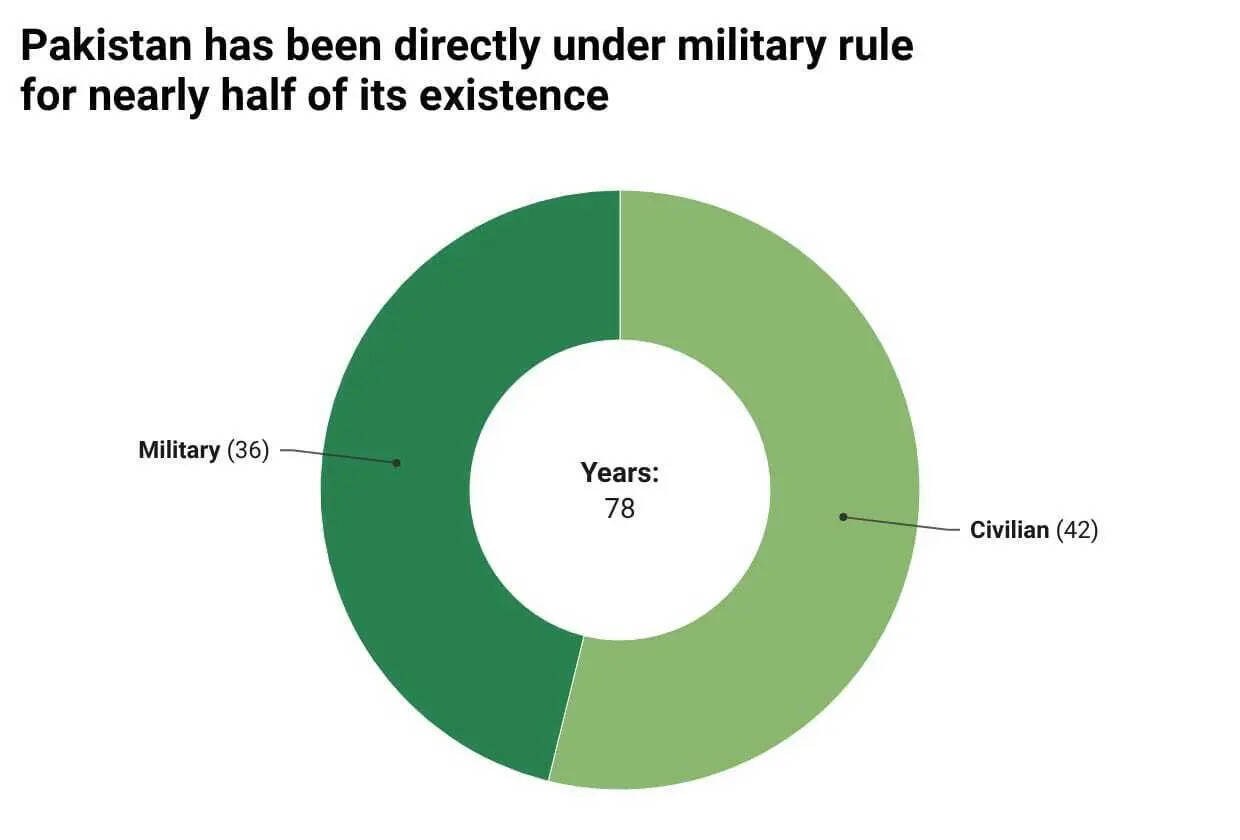
Field Marshal Asim Munir is the latest and, by many accounts, the strongest embodiment of that pattern.Pakistan elevated him to field marshal in 2025, the highest military rank in the country, in a move that symbolised his extraordinary standing within the system.The title gives Munir lifelong authority and shields him from ordinary civilian accountability, while his earlier rise from intelligence chief to army chief showed how tightly power in Pakistan remains concentrated in the military chain of command. A Carnegie analysis in May 2026 also described the military under Munir as having entrenched its dominance through a weak and constrained civilian structure.
A system already in place
Iran’s command structure differs from Pakistan: the supreme leader, not the president, is the apex authority, and the Guards are formally subordinate to that office.Yet the reported IRGC takeover dynamics resemble Pakistan’s civil-military imbalance in one crucial way: formal institutions remain in place while real authority migrates to an unelected coercive elite.If the president is isolated, appointments are filtered through the Guard, and access to the top is controlled by security operatives, the civilian government can become as performative as Pakistan’s cabinet.But, there is a key difference.In Pakistan, the army historically operated as the dominant institution over an otherwise civilian constitutional framework.In Iran, the IRGC is not merely a military headquarters; it is part of the revolutionary state architecture and has long been intertwined with ideology, patronage, and repression.That makes an Iran-like “Pakistanization” both more and less likely at the same time: more likely because the Guards already possess the tools to dominate, and less likely because the supreme-leader system was built to fuse religion, security, and sovereignty from the start.If the current reports are accurate, the most consequential shift is not that Iran is suddenly becoming a military dictatorship. It is that the Guard may be transforming the supreme leadership into a managed symbol rather than an active center of command.The supreme leader is supposed to appoint top military figures, supervise key oversight bodies, and define national strategy. But if IRGC officers increasingly determine who gets through the door, who receives information, and which decisions are implementable, then the supreme leader’s constitutional authority could survive while its operational substance erodes.That is the most plausible version of “going the Pakistan way”.Not a formal copy, but a convergence: a system where civilian faces remain visible, important decisions are made elsewhere, and the political class learns to operate within boundaries set by the uniformed elite.In Pakistan, that arrangement has produced recurring cycles of elected government under heavy military shadow.In Iran, it could produce something harsher: a clerical state in which the leader is still revered, but the Guard effectively governs.What makes this moment especially significant is the possibility that succession politics and security politics are now merging.If Mojtaba Khamenei is indeed operating under restricted access, and if the IRGC is consolidating control around the state core, then the struggle is no longer only about policy. It is about who becomes the gatekeeper of the Islamic Republic’s next phase.A system that once claimed clerical primacy may be drifting toward a security state in which the clergy legitimises power, but the Guards administer it.That would not mean Iran has become Pakistan. It would mean it has found its own version of the same disease: a permanent imbalance in which the civilian sphere is too weak to govern, and the coercive apparatus becomes the real state.