







The post-trade giant plans to make DTC-custodied assets available on the Stellar public blockchain in the first half of 2027, adding a second network to its growing tokenization strategy
The Depository Trust & Clearing Corporation, the post-trade infrastructure firm whose subsidiaries processed $4.7 quadrillion in securities transactions in 2025, plans to connect its tokenization service to the Stellar public blockchain. Both firms announced the deal Wednesday, with DTC-tokenized assets expected to go live on Stellar’s network in the first half of 2027.
The partnership would allow DTC-custodied assets — real-world securities held at DTCC’s depositary subsidiary, which provides custody and asset servicing for securities from over 150 countries valued at $114 trillion — to be tokenized and made available on the Stellar network, a public, configurable blockchain used across securities, payments, and remittance applications.
The deal is a significant step toward connecting the regulated core of U.S. capital markets to public blockchain infrastructure, and reinforces DTCC’s stated strategy of building across multiple Layer 1 and Layer 2 networks.
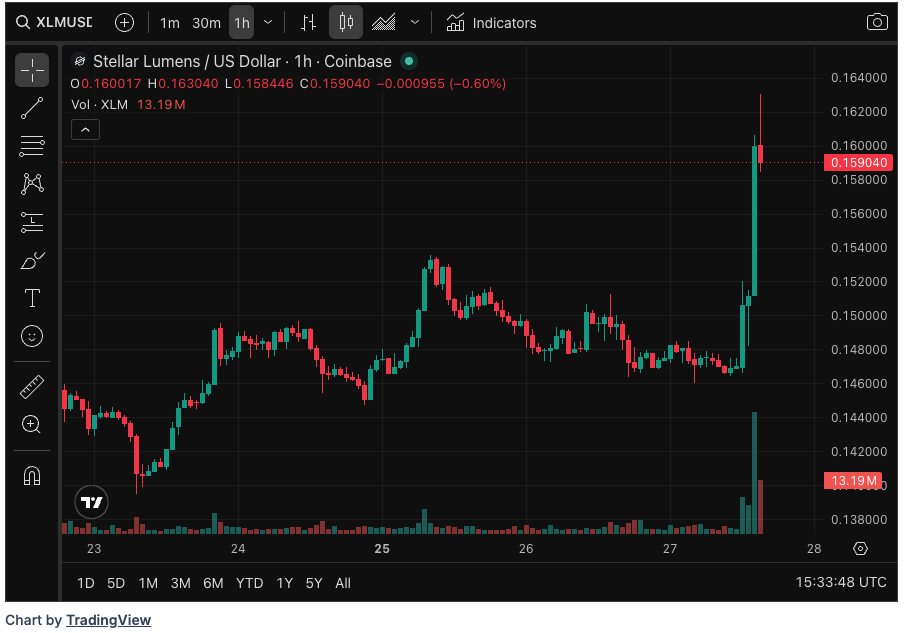
Stellar’s XLM token jumped roughly 8% in the 24 hours following the announcement, outperforming a largely flat broader crypto market, according to CoinGecko data. XLM carries a market cap of approximately $5.3 billion, making it the 22nd largest cryptocurrency by that measure.

Built on an SEC Green Light
The announcement follows a December 2025 SEC No-Action Letter authorizing DTC to implement and operate a tokenization service for DTC-custodied assets — a three-year pilot covering highly liquid assets including stocks in the Russell 1000, major index-tracking ETFs, and U.S. Treasury bills, bonds, and notes. DTC-tokenized assets will carry the same investor protections, entitlements, and safeguards as traditionally held securities, according to DTCC.
“This collaboration represents another step forward in DTCC’s efforts to build an open, interoperable digital infrastructure that bridges traditional and digital markets,” DTCC President and CEO Frank La Salla said in the announcement. “Tokenization can enable new levels of transaction and capital efficiency, observability and collateral mobility as well as support extended trading hours.”
Why Stellar
DTCC said its blockchain selection criteria centered on three factors: compliance-minded architecture, open and configurable infrastructure, and risk management capabilities. Stellar was said to meet all three.
“Stellar’s proven track record with institutional assets onchain is an important factor in our evaluation of blockchain networks,” said Nadine Chakar, DTCC’s Managing Director and Global Head of Digital Assets. “Its emphasis on compliance, transaction throughput and low-cost operations meets our rigorous standards and will help ensure we’re ready for growth as usage of blockchain networks for real-world asset transactions increases.”
Stellar’s DeFi ecosystem currently holds around $170 million in total value locked, according to DeFiLlama. The Stellar Development Foundation has positioned the network as a compliance-first infrastructure for institutional asset issuance, with real-world asset value on the network having crossed $1.3 billion earlier this year.
“DTCC is the backbone of global capital markets, and integrating their tokenization service with Stellar connects public blockchain networks to regulated market infrastructure,” said Stellar Development Foundation CEO Denelle Dixon. “Our network was built for this moment — we have always believed that blockchain’s utility for finance is to be the rail that institutional-grade markets can depend on.”
Part of a Broader Multi-Chain Strategy
Stellar is not DTCC’s only blockchain bet. In December 2025, DTCC tapped the Canton Network to tokenize a subset of U.S. Treasury securities, citing the institution-focused L1’s privacy features. Earlier this month, DTCC named Chainlink as the data and orchestration layer for its forthcoming tokenized collateral platform.
Chakar said DTCC intends to “integrate multiple L1 and L2 networks to ensure interoperability and open access” for users of its tokenization service, though the firm has not disclosed which other networks are under evaluation. A March 2026 report co-authored by DTCC, Clearstream, Euroclear, and Boston Consulting Group argued interoperability is “essential” for digital assets to reach their full potential in capital markets.
DTCC’s tokenization service itself is already on a concrete launch timeline: limited production trades are planned for July, with a broader commercial launch slated for October. More than 50 financial firms — including BlackRock, Goldman Sachs, JPMorgan, and Ondo Finance — are part of the industry working group shaping the rollout.
What’s Next
DTCC and SDF said they will continue to evaluate specific tokenization use cases between now and the 2027 target.
The two firms plan to focus initially on highly liquid assets — Russell 1000 constituents, major ETFs, and U.S. Treasuries — with all use cases subject to further evaluation consistent with DTC’s regulatory obligations. DTCC has not disclosed a timeline for announcing additional blockchain network connections.