









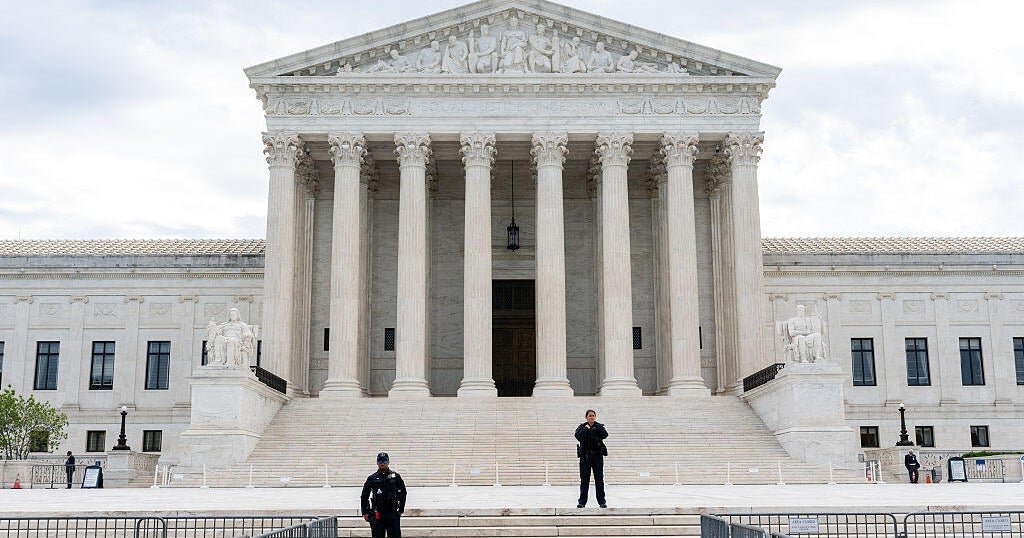
Washington — The Supreme Court on Thursday ruled in favor of a Black death row inmate from Mississippi who argued racial discrimination during the jury-selection process before his trial.
The high court divided 5-4 in siding with Terry Pitchford, with Chief Justice John Roberts and Justice Brett Kavanaugh joining the three liberal justices in the majority. Kavanaugh authored the opinion for the majority in the case, known as Pitchford v. Cain.
Justices Clarence Thomas, Samuel Alito, Neil Gorsuch and Amy Coney Barrett dissented.
The case arose from the 2004 robbery of a grocery store in Grenada, Mississippi, by two Black teenagers, Pitchford and Eric Bullins, in which the owner of the store, a White man, was killed. Bullins fired the shots that killed the owner, Reuben Britt, but because he was 16 at the time of the robbery, he was not eligible for the death penalty. Bullins was sentenced to 20 years in prison.
Pitchford, who was 18 at the time, was charged with capital murder, and the state sought the death penalty.
During jury selection in Mississippi state court, then-District Attorney Doug Evans used what’s known as a peremptory strike to reject four of five potential Black jurors, which Pitchford’s defense lawyers objected to under a Supreme Court decision called Batson v. Kentucky. In that case from 1986, the high court held that prospective jurors cannot be excluded based on their race. In that ruling and in subsequent cases, the Supreme Court laid out a series of steps for how trial courts should determine whether prosecutors’ use of a peremptory strike was based on race.
Evans provided several reasons for excluding the four Black potential jurors in Pitchford’s case, arguing that one returned 15 minutes late to court from a lunch break, two others had brothers convicted of violent crimes and the fourth was similar to Pitchford in that he was young, unmarried and a father.
The trial judge accepted these reasons as race-neutral. But Pitchford’s lawyers argued they were not given the chance to rebut the prosecutors’ reasons as pretextual, as required under Batson’s three-step framework.
A jury composed of 11 White jurors and one Black juror ultimately convicted Pitchford of capital murder and sentenced him to death.
Evans also served as the top prosecutor in the high-profile case of Curtis Flowers, whose murder conviction was overturned by the Supreme Court in 2019. Evans was accused of consistently striking prospective Black jurors from the jury pool.
Pitchford first appealed his conviction and death sentence to the Mississippi Supreme Court, and then sought relief from the federal district court in Mississippi. That court ruled in favor of Pitchford and overturned his conviction.
“The trial court, seemingly eager to proceed to the case itself, quickly deemed the reasons as race-neutral and moved on,” the district court found.
That decision was reversed by the U.S. Court of Appeals for the 5th Circuit. But in its ruling, the Supreme Court sided with Pitchford, invalidating his conviction. He can be retried by the state.
“In this case, whether due to confusion, oversight, an overly hurried jury selection process, or some other cause, things broke down, and the ordinary trial-court procedure for resolving Batson claims at step three never occurred — notwithstanding the repeated efforts of Pitchford’s counsel to pursue and preserve the Batson objection,” Kavanaugh wrote.
In a dissenting opinion, Gorsuch argued that Pitchford failed to clear the high bar for securing relief under federal law.
The court’s opinion, he said, “errs on the law and the factual record alike.” Still, Gorsuch wrote that the Supreme Court’s decision is a narrow one, applying only to Pitchford.