





Hawthorne, California — It was 1971 when America’s love affair with the car went lunar. The Apollo Lunar Rover turned American moon-walkers into moon-drivers, allowing astronauts to explore more than 50 miles of lunar crust and craters.
“The Apollo Lunar Rover was a phenomenal machine, but fundamentally it had a very different job to do than the one we’re doing,” Jaret Matthews, CEO and founder of Astrolab, told CBS News.
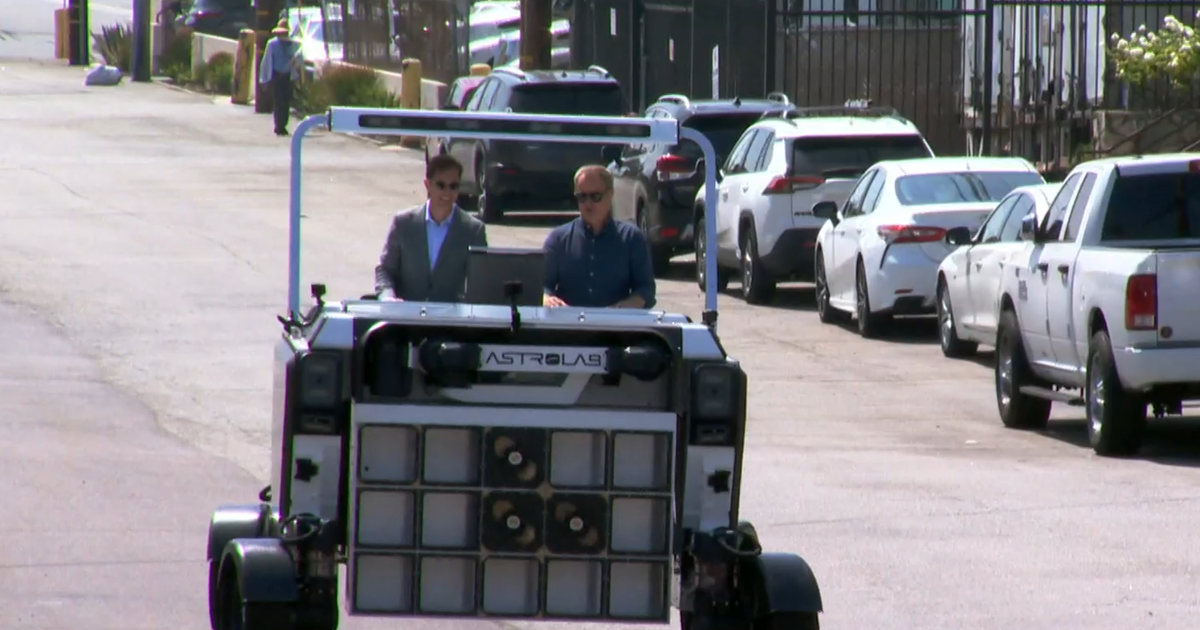
On a back street in Hawthorne, California, Matthews took CBS News for a spin in a Zamboni-looking prototype of his company’s 21st-century lunar rover, which it calls FLEX.
The final design for NASA will look like a four-wheel drive electric vehicle that can either rove on its own or carry two astronauts and supplies.
It will be designed to operate for a year, traversing hundreds of miles across the lunar terrain.
“The lunar terrain vehicles have to be a mash-up of the Apollo Lunar Rover to carry two suited astronauts, as well as something more modern like the Perseverance Rover on Mars, and can be operated remotely from Earth,” Matthews said.
Astrolab is one of two companies NASA picked to build the first moon buggies for the moon base it plans to spend the next seven years developing near the lunar south pole. NASA also tapped Colorado-based Lunar Outpost to build a moon buggy called Pegasus.
NASA is paying Astrolab and Lunar Outpost about $220 million each for the project.
NASA announced its $20 billion plans for the moon base on Tuesday. Two days later, Jeff Bezos’ Blue Origin New Glenn Rocket exploded during a test at Cape Canaveral Space Force Station.
The New Glenn Rocket plays a major role in NASA’s Artemis moon program, and Blue Origin is developing a lunar lander that will deliver each rover to the lunar surface. It’s unclear how big a setback the explosion will prove to be to NASA’s moon base plans.
Meanwhile, Lunar Outpost CEO Justin Cyrus told CBS News he sees an opportunity on the moon that goes beyond NASA.
“NASA wants to be one of many customers,” Cyrus said. “NASA doesn’t want to be the only customer. And the only way you can do that is creating a vehicle that is truly capable enough to allow for new activities on the lunar surface.”