








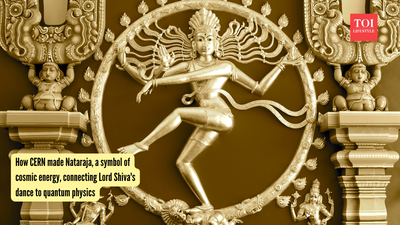
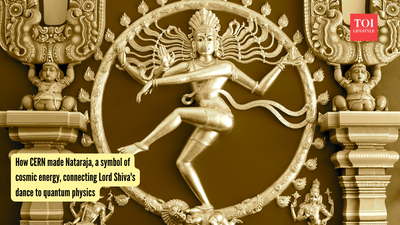
Lord Shiva has many forms, he is the creator and the destroyer, the Neelkantha with poison held in his throat, and Natraja as the Cosmic Dancer.But his Nataraja form is fascinating and philosophical as Shiva becomes the cosmic dancer, performing the Tandava, or the rhythm of existence itself.His form is depicted as a bronze figure surrounded by a ring of fire, one foot pressing down on ignorance, the other lifted in grace. In one hand, he holds a drum, beating the sound of creation, and in the other, a flame dancing with the power of destruction. His hair flows wild, his earrings differ, depicting the male and female, showing that the divine is beyond gender.Something that makes his form more significant beyond mythology is that in the heart of Switzerland, at CERN, the world’s premier particle physics laboratory, stands a bronze statue of Lord Shiva in his Nataraja form.Some have questioned its presence, seeing it as an odd addition to a place dedicated to rational inquiry. But nothing could be further from the truth. In fact, the dance of Shiva and the mysteries of quantum physics share a profound connection that bridges science, philosophy, and art.
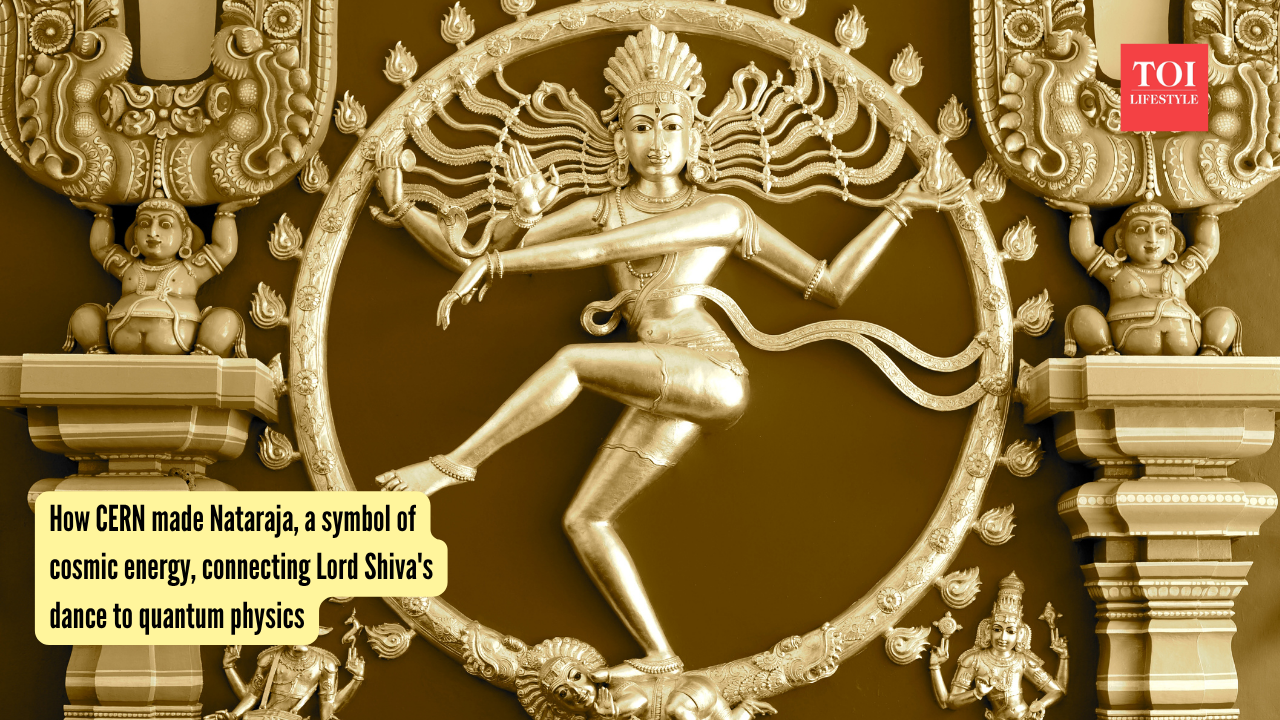
Shiva in Nataraja form (Photo: Canva)
How is Nataraja a symbol of cosmic energy ?
Quantum physics, with its wave-particle duality and unpredictable behaviour, has often been at odds with Western thought, which seeks clear-cut distinctions. How can something be both a particle and a wave? How can reality be probabilistic rather than deterministic?For the western thought, it’s hard to understand these ideas because the language and way of thinking are built on either-or logic, not on flowing, flexible thinking.That’s why many of the greatest scientists, from Robert Oppenheimer to Erwin Schrödinger, turned to Eastern philosophy for answers. Vedanta, a school of Hindu philosophy that accepts paradox and sees everything as connected, gives a way to understand how creation and destruction work together.It believes that creation and destruction can happen at the same time, and it also matches how quantum mechanics describes the universe. At the subatomic level, particles are interconnected and influence each other instantaneously..
What role does CERN play, and how did the statue reach there?
On June 18, 2004, the Indian government gifted the statue of Lord Shiva to CERN, where it was unveiled with great reverence. The presence of this statue is not an intrusion of religion into science; rather, it is an acknowledgment that art, philosophy, and science are interconnected ways of understanding existence.The statue, depicting Shiva’s Tandava, represents the eternal cycle of creation and destruction, which is also a process that physicists study when examining subatomic particles colliding and changing.A plaque at the site bears a quote from physicist and philosopher Fritjof Capra, whose book The Tao of Physics explores parallels between Eastern mysticism and modern physics. Capra identified that fundamental forces influencing the universe were the same as depicted in the dance of Shiva, seeing in particle interactions the same rhythmic energy described in Hindu scriptures.
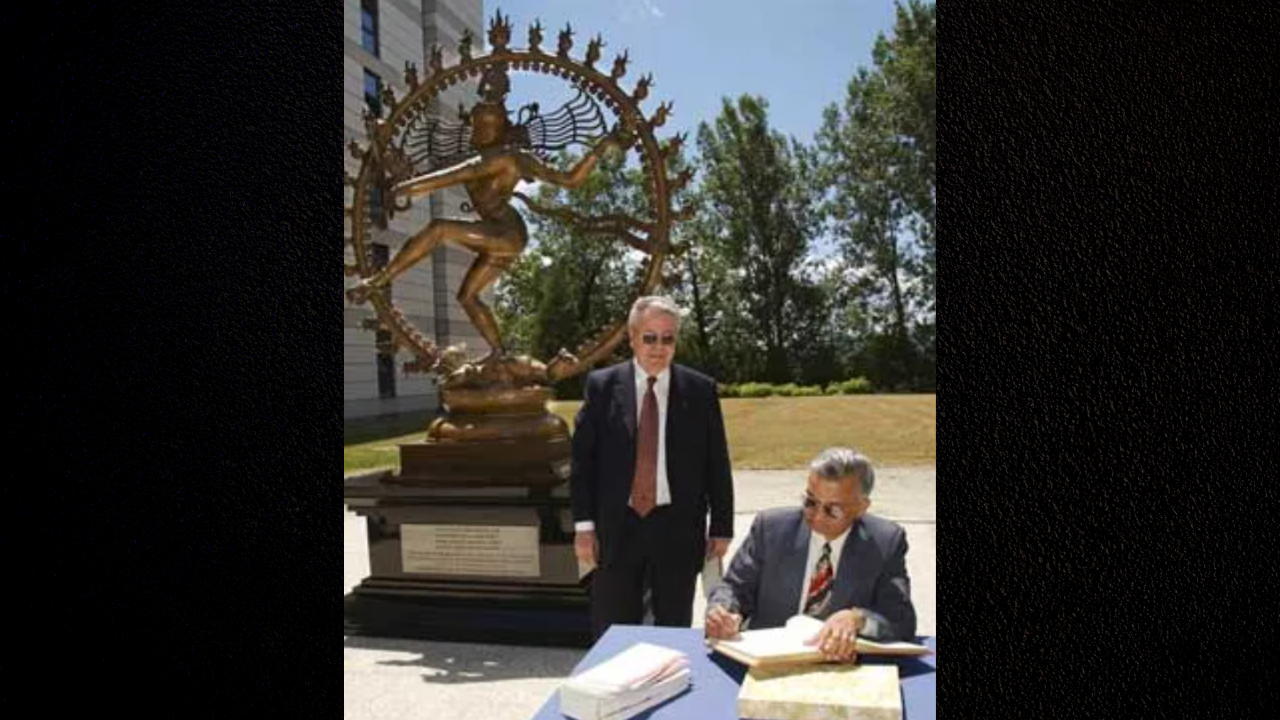
Lord Shiva- Nataraja statue at CERN (Photo: CERN official website)
Shiva’s dance represents five concepts of cosmic existence
Within the cosmos represented by the ring of fire, Nataraja’s form comprises five concepts: Srishti, Sthiti, Samhara, Tirobhava, and Anugraha. His upper right hand holds a small hourglass-shaped damaru, making primal sounds of creation or Srishti.There’s an interesting idea in Hinduism that creation originates as sound, as vibration. Fritjof Capra found echoes of quantum theory in this, where all matter vibrates at the atomic level. His lower right hand makes abhaya mudra, the gesture of fearlessness, meaning preservation. His upper left hand holds blazing flame or agni, meaning destruction power.
The Shiva statue at CERN recognises that art and science are interconnected
The presence of the Shiva statue at CERN signifies that philosophy and science are not separate domains but interconnected ways of understanding existence. Just as Shiva’s dance represents the rhythm of existence, physicists explore the ever-changing, dynamic nature of reality through their experiments. When they study particle interactions, they witness a dance of energy at the most fundamental level