









NEW DELHI: India’s estimated nuclear arsenal has increased from 180 warheads to 190 warheads, according to the latest assessment by the Stockholm International Peace Research Institute (SIPRI), reflecting New Delhi’s continued efforts to modernise its strategic deterrent amid a rapidly evolving security environment. The findings were released as part of SIPRI Yearbook 2026, which warns that the world is entering a new era of nuclear competition, with major powers increasingly relying on atomic weapons as instruments of national power.SIPRI estimated that the nine nuclear-armed states—the United States, Russia, the United Kingdom, France, China, India, Pakistan, North Korea and Israel—continued to upgrade and expand their nuclear capabilities during 2025. The report noted that global nuclear arsenals are no longer shrinking at the pace seen after the Cold War, and may begin growing again as disarmament slows and deployment of new weapons accelerates.
For India, the increase of 10 warheads over the previous estimate comes alongside the development of longer-range delivery systems, sea-based deterrent capabilities and technologies such as Multiple Independently Targetable Re-entry Vehicles (MIRVs). SIPRI said India is believed to have “once again slightly expanded its nuclear arsenal in 2025 and continued development of new types of nuclear delivery systems”.Also read – Head to head: India and Pakistan’s nuclear missile arsenalThe expansion comes against the backdrop of rising tensions in Asia, growing strategic competition with China, and continued rivalry with Pakistan. SIPRI’s assessment suggests that India’s nuclear modernisation programme is increasingly orientated towards strengthening deterrence against China, while maintaining readiness in relation to Pakistan.
SIPRI warns of a dangerous new nuclear age
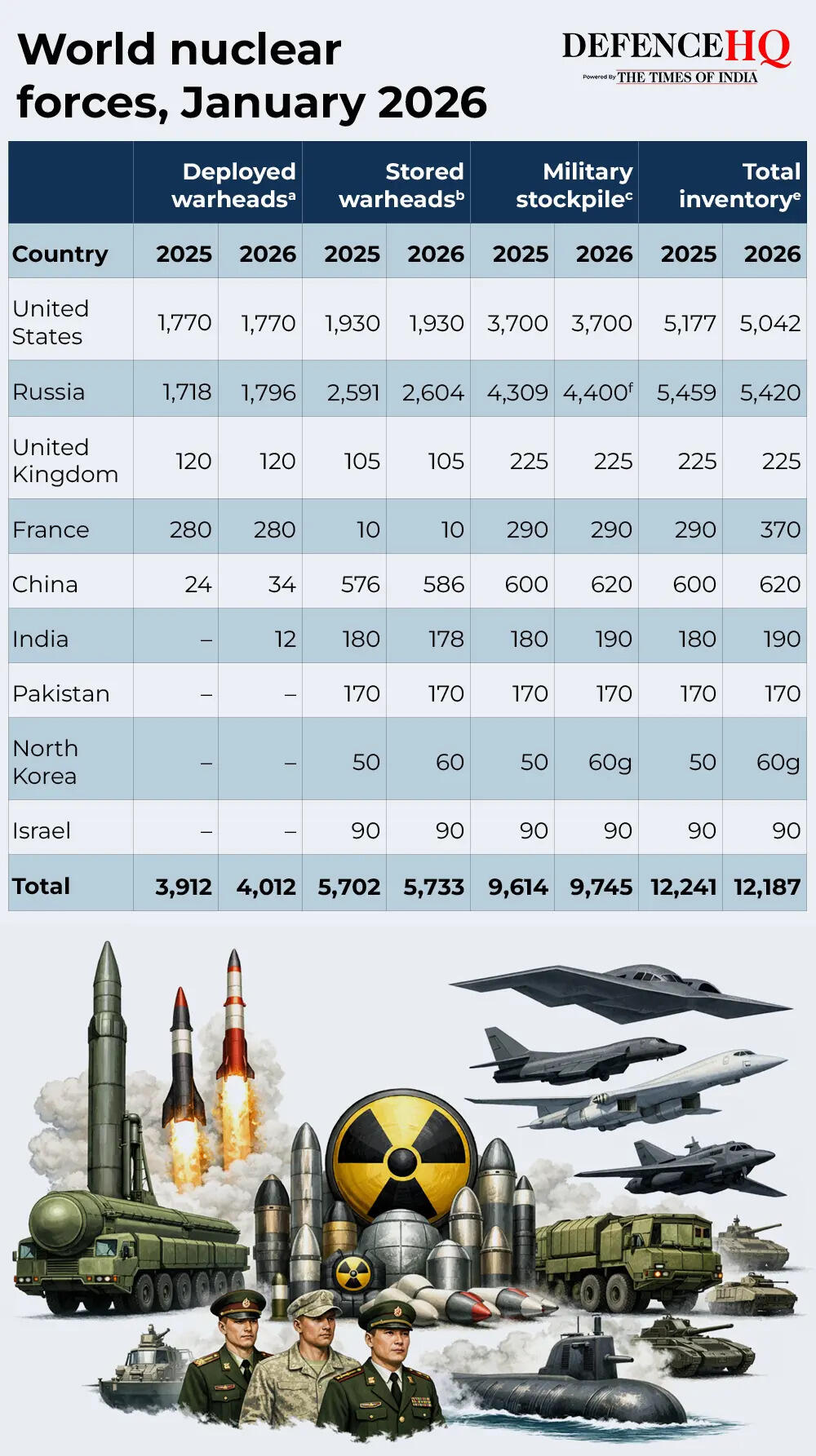
The SIPRI Yearbook paints a concerning picture of the global security environment. Of the world’s estimated 12,187 nuclear warheads in January 2026, around 9,745 were held in military stockpiles for potential use. Approximately 4,012 warheads were already deployed with operational missile and aircraft systems, while between 2,100 and 2,200 remained on high operational alert.SIPRI Director Karim Haggag warned that the growing reliance on nuclear weapons could increase the risk of catastrophic miscalculation.“Influential voices, including some world leaders, are advocating nuclear weapons as a guarantee against attack by a hostile state. But making national defence and security strategies dependent—or more dependent—on nuclear weapons could significantly increase nuclear risks,” said SIPRI Director Karim Haggag.He added: “The dangers associated with nuclear weapons are growing due to advances in weapon technology, the breakdown of nuclear arms control and heightened geopolitical tensions, among a range of other factors. At the same time, world events—not least the outbreak of conflict between nuclear-armed India and Pakistan—are challenging nuclear deterrence logic.”SIPRI researchers argue that decades of gradual nuclear reductions led by the United States and Russia may now be ending. As older warheads are retired more slowly and new systems enter service more rapidly, global stockpiles could begin rising in the coming years.
India’s modernisation increasingly focused on China
According to SIPRI, India’s nuclear modernisation programme is increasingly geared towards developing long-range systems capable of reaching targets throughout China. While Pakistan remains a critical component of India’s strategic planning, Beijing’s growing military capabilities and expanding nuclear arsenal are influencing Indian force development.China remains the fastest-growing nuclear power among the nine nuclear-armed states. SIPRI estimates that China now possesses around 620 nuclear warheads and continues expanding missile silo fields and strategic missile deployments at a pace unmatched by any other country. By the end of the decade, China could potentially field as many intercontinental ballistic missiles as either the United States or Russia.Against this backdrop, India has accelerated efforts to strengthen all three legs of its nuclear triad—land, air and sea-based delivery systems.India continues to adhere officially to a doctrine of minimum credible deterrence and a No First Use policy. However, maintaining credible deterrence increasingly requires improvements in survivability, mobility and second-strike capability as regional threats evolve.
MIRVs, canisterised missiles and longer-range weapons
A major component of India’s modernisation drive is the development of MIRV technology. Multiple Independently Targetable Re-entry Vehicles allow a single ballistic missile to carry several nuclear warheads capable of striking different targets.The technology dramatically enhances the effectiveness of strategic missiles by enabling a single launch platform to engage multiple targets simultaneously or overwhelm missile defence systems.India is also advancing canisterised missile systems. Unlike older missiles that require lengthy preparation before launch, canisterised missiles are stored within sealed launch containers, improving survivability and reducing launch times. These systems also provide greater mobility and operational flexibility.The country’s ballistic missile inventory includes the short-range Prithvi-II and Agni-I systems, medium-range Agni-II and Agni-III missiles, and longer-range Agni-IV and Agni-V platforms. The newer Agni-P missile is viewed as a more accurate and survivable system, while work is believed to be continuing on future long-range capabilities.Together, these programmes indicate a shift towards a more sophisticated and flexible deterrent posture capable of addressing multiple strategic contingencies.
Sea-based deterrent emerges as cornerstone of survivability
One of the most important developments highlighted by SIPRI is India’s growing sea-based nuclear deterrent.The institute estimates that India may now occasionally deploy a small number of nuclear warheads on board a ballistic missile submarine during peacetime patrols. This represents an important step in operationalising the sea leg of India’s nuclear triad.India’s nuclear-powered ballistic missile submarines (SSBNs), led by INS Arihant, are designed to provide assured second-strike capability even if land-based and air-based assets are targeted.These submarines are equipped with submarine-launched ballistic missiles including the K-15 and K-4 systems, while future programmes such as the K-5 missile are under development. A sea-based deterrent is widely considered the most survivable component of any nuclear force because submarines can remain hidden underwater for extended periods.For India, strengthening SSBN operations is increasingly viewed as essential given the expanding missile capabilities of both China and Pakistan.
India-Pakistan rivalry remains central to nuclear planning
Despite the growing focus on China, Pakistan continues to play a major role in India’s nuclear calculations.SIPRI noted that Pakistan continued developing new delivery systems and accumulating fissile material during 2025, indicating that its nuclear arsenal may expand over the coming decade.The report also referenced the brief armed conflict between India and Pakistan in May 2025, during which India attacked Pakistani air and missile bases believed to have nuclear-related roles. According to SIPRI, both countries took steps to avoid escalation despite the intensity of the confrontation.The conflict served as a reminder of the risks associated with nuclear deterrence in South Asia, where two nuclear-armed neighbours maintain active territorial disputes and frequently experience periods of military tension.According to assessments cited in recent analyses, Pakistan’s arsenal is estimated at around 170 warheads, while India now possesses approximately 190 warheads. Although the numbers remain relatively close, the strategic emphasis of the two programmes differs.Pakistan has invested heavily in tactical nuclear weapons and shorter-range systems intended to offset India’s conventional military advantages. India, meanwhile, has focused more on developing survivable long-range deterrent capabilities and strengthening its second-strike posture.
Global arms control architecture under strain
SIPRI’s report also warns that the broader international nuclear order is weakening.The 2026 Review Conference of the Nuclear Non-Proliferation Treaty ended without agreement on a final outcome document, marking the third consecutive review conference to fail in reaching consensus.At the same time, transparency surrounding nuclear arsenals is declining. Several nuclear-armed states are increasingly withholding information about stockpile sizes and deployment patterns while modernising their forces.SIPRI researcher Matt Korda cautioned that reduced transparency and deteriorating diplomatic communication channels are making nuclear crises more unpredictable.“Along with the reduction in transparency and the loss of diplomatic channels for crisis management, the drift towards authoritarianism in some nuclear-armed states is contributing to even greater unpredictability,” said Matt Korda.“We can no longer assume that leaders operating within such systems will receive accurate data during nuclear crises, nor that they will act rationally during periods of heightened tension.”As the United States, Russia, China, India and Pakistan continue expanding or modernising their arsenals, experts increasingly fear the emergence of a new global arms race.For India, SIPRI’s latest estimate reflects not only a modest increase in warhead numbers but also a broader transformation of its strategic deterrent. With China rapidly expanding its nuclear forces, Pakistan continuing to modernise its arsenal and global arms-control mechanisms under strain, New Delhi’s nuclear posture appears set to remain a key element of its national security strategy in the years ahead.