









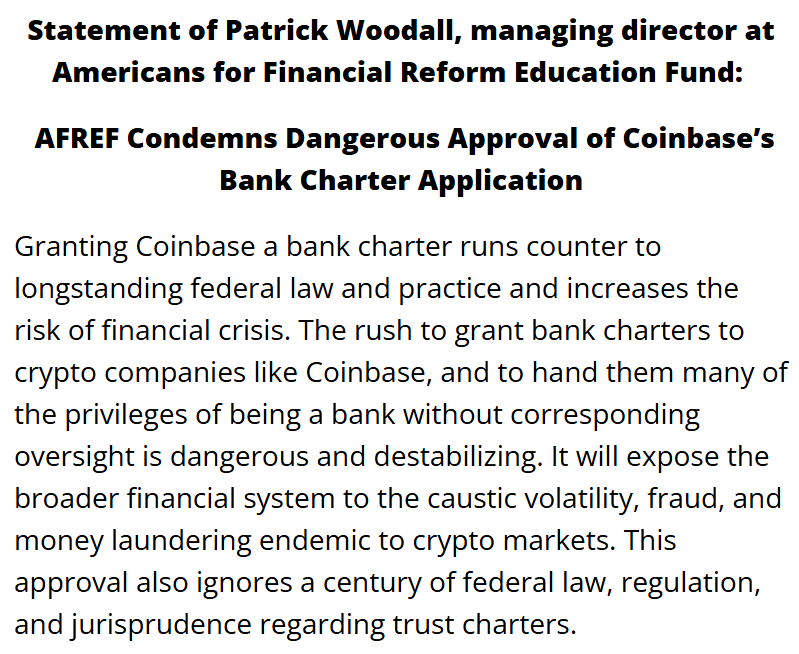
Today in crypto, community banking groups pushed back against the approval of Coinbase’s national bank charter, arguing that it falls short of the industry’s regulatory standards. Meanwhile, the fallout from the Drift Protocol exploit continues and the International Monetary Fund (IMF) said tokenization in finance removes friction but introduces risks.
Community banks oppose Coinbase trust charter approval
US community banking groups are pushing back against the Office of the Comptroller of the Currency’s (OCC) conditional approval of a national trust charter for Coinbase, arguing the decision could weaken regulatory standards. The Independent Community Bankers of America (ICBA) said the move may allow crypto companies to operate under a different framework than traditional banks.
The group raised concerns that granting a trust charter to a crypto company could blur the lines between banking and digital asset services. According to the ICBA, Coinbase’s business model does not align with the legal requirements for institutions seeking such approval.
Community banks also warned that the decision could create an uneven playing field, where crypto companies gain access to bank-like privileges without being subject to the same level of oversight. This, they argue, could introduce new risks to the broader financial system.
The opposition highlights ongoing friction between traditional financial institutions and crypto companies as regulators continue shaping how digital asset companies fit within the US banking system.

Drift sends onchain message to wallets tied to $280 million exploit
Drift Protocol, a Solana-based decentralized exchange (DEX), said Friday it had opened onchain contact with wallets tied to funds stolen in the exploit that outside firms have estimated at roughly $280 million to $286 million.
Drift said on X that it had initiated onchain contact with wallets holding the stolen Ether (ETH), seeking to open a line of communication.
The team sent onchain messages from its Ethereum address (0x0934faC) to four wallets linked to the exploiter at the time of publication, urging the attacker to reach out via Blockscan chat. “We are ready to speak,” Drift said.
Onchain messaging has become a common tactic in exploit response, allowing protocols to communicate directly with attackers while preserving anonymity. In past cases, such as the Euler Finance hack, similar outreach led to the partial recovery of funds.

Tokenization makes finance more efficient but introduces risks: IMF
The International Monetary Fund said tokenization has the potential to remove friction and boost transparency in finance, but warned that the technology could also create challenges that affect financial stability.
“The net effect of tokenization on financial stability is uncertain,” the IMF said in a 23-page report on Thursday, stating that “atomic settlement and enhanced transparency reduce some traditional risks, but speed and automation introduce new ones.”

More than $27.6 billion worth of real-world assets, minus stablecoins, is currently tokenized onchain, data from RWA.xyz shows. Boston Consulting Group estimated in 2022 that the tokenization market could rise to $16 trillion by 2030, while McKinsey & Co in 2024 predicted a more conservative $2 trillion over the same time frame.
The IMF acknowledged that tokenization expands how securities and other financial products are issued, traded, settled and managed but said it shifts risks from the banking system to shared ledgers and smart contract code.
“Stress events in tokenized markets are likely to unfold faster than in traditional systems, leaving less time for discretionary intervention.”
The agency also said tokenization offers opportunities in emerging markets, such as faster cross-border payments and financial inclusion but added that it “raises the risk of volatile capital flows, rapid currency substitution, and erosion of monetary sovereignty.”