









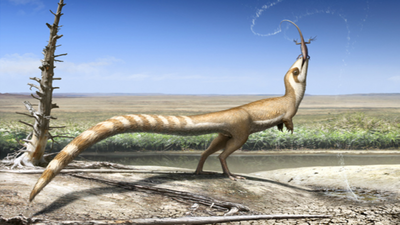
For decades, the standard pictures of dinosaurs in books, documentaries and movies were largely based on educated guesswork. Palaeontologists could painstakingly reconstruct the skeleton of a creature and estimate its muscle mass, but when it came to the colour of its skin or feathers, artists were pretty much left to their own devices. Dinosaurs were always painted in drab greys, dull greens, or make-believe bright colours for the cinema.But that all changed when scientists started to take a closer look at what had long been ignored. Exceptionally well-preserved fossils bearing dark smudges and carbonaceous residue, long dismissed by many as mere stains or the remains of ancient environmental bacteria, turned out to be microscopic treasure maps. Using powerful electron microscopes, scientists have shown that the marks are the actual fossilised cellular structures that are responsible for pigmentation, the first evidence of dinosaur colouration that can be empirically tested.Secrets hidden in microscopic structuresThe key to this paleontological revolution lies in a tiny organelle known as a melanosome. Melanosomes are melanin-containing structures responsible for the colour and patterns of skin, hair and feathers in modern birds and mammals.In a landmark Nature paper, Fucheng Zhang and colleagues showed that these pigmented packets, which are on the order of a sub-micrometre in size, could survive millions of years of fossilisation inside ancient feathers and filamentous body coverings. By using scanning electron microscopy, researchers identified both elongated eumelanosomes, which are associated with black and grey tones, and spherical phaeomelanosomes, which are responsible for reddish-brown or chestnut shades.This discovery completely changed the way scientists think about ancient plumage. Palaeontologists realised they were looking at a preserved biological blueprint, not dark fossil carbon layers to be ignored as background noise. We were able to reconstruct clear colour boundaries and distinct colour gradients directly from the stone by mapping the distribution, shapes and structural arrangements of these microbodies across a specimen.How to paint the first evidence-based dinosaurOne of the earliest and most famous beneficiaries of this microscopic analysis was Sinosauropteryx, a small predatory theropod dinosaur of the Early Cretaceous. In the study, published in Nature, the researchers used extensive microscopic analysis of the filamentous structures along the dinosaur’s spine and tail to find distinct populations of phaeomelanosomes.The distribution of these spherical organelles provided hard evidence that Sinosauropteryx had an alternating arrangement of dark and light bands along its tail, with the darker bands showing prominent tones of chestnut to reddish brown. This was a landmark moment, the first time that the colour scheme of a dinosaur was subjected to empirical observation rather than artistic licence.In another study published in the journal Science, Quanguo Li and an international team of researchers reconstructed the complete plumage pattern of Anchiornis, a feathered troodontid dinosaur. Their microscopic mapping revealed a striking animal with a dark grey and black body, white wing patches with black tips and a bright reddish-brown crest on its head.
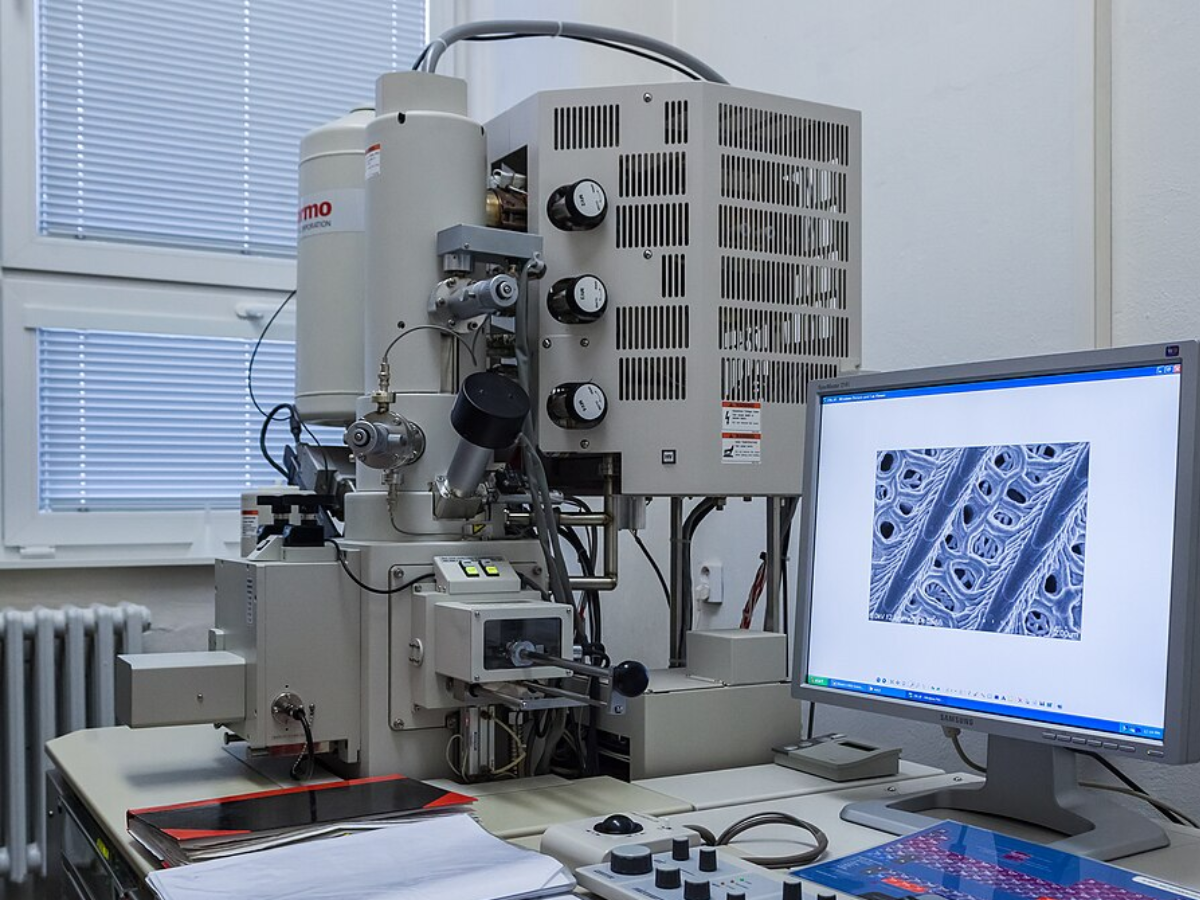
Laboratory of electron microscopy, Image Credit: Wikimedia Commons
The complex link to modern birdsThe presence of melanosomes provides a rigorous basis for colour inference, but scientists are cautious, saying that reading ancient biological structures is far more nuanced than developing a colour photograph. In life, the colours of plumage that we see are influenced not only by the shape of individual melanosomes, but also by interactions with carotenoids in the diet (which produce bright yellows and oranges), chemical differences in the keratin matrix, and complex structural arrangements that scatter light to produce iridescence.To map out these evolutionary relationships, an expansive comparative study evaluated melanosomes across 181 living amniote taxa alongside 13 ancient lizard, turtle, dinosaur, and pterosaur fossils. Researchers found that there was an explosion in melanosome diversity in the theropod lineage near the origin of pinnate (vaned) feathers in maniraptoran dinosaurs.This morphological shift indicates that with the evolution of complex feathers, they became closely linked to visual signalling, camouflage and sexual display. This close evolutionary convergence between non-avian dinosaurs and modern birds gives scientists more confidence when using living avian analogues to infer ancient colour patterns.Bringing a grey world back to lifeThe continued study of fossil colour is just one example of how advances in technology can tease out bright ecological narratives from visually bland specimens. This work offers an immediate emotional and visual reward for general readers and palaeontology enthusiasts. Knowing that a creature possessed a striped tail or a contrasting head crest transforms dinosaurs from abstract museum icons or cinematic monsters into real, living animals that navigated complex visual landscapes.Uncertainty has not been eliminated from the process, but it has been tightly organised. They can now define where the microscopic evidence for colouration is unambiguous, where it is still limited by environmental degradation, and where the palette is still open to interpretation. By transforming ancient smudges into biological data, microscopy has managed to inject a vivid reality into what had been a permanently grey world.