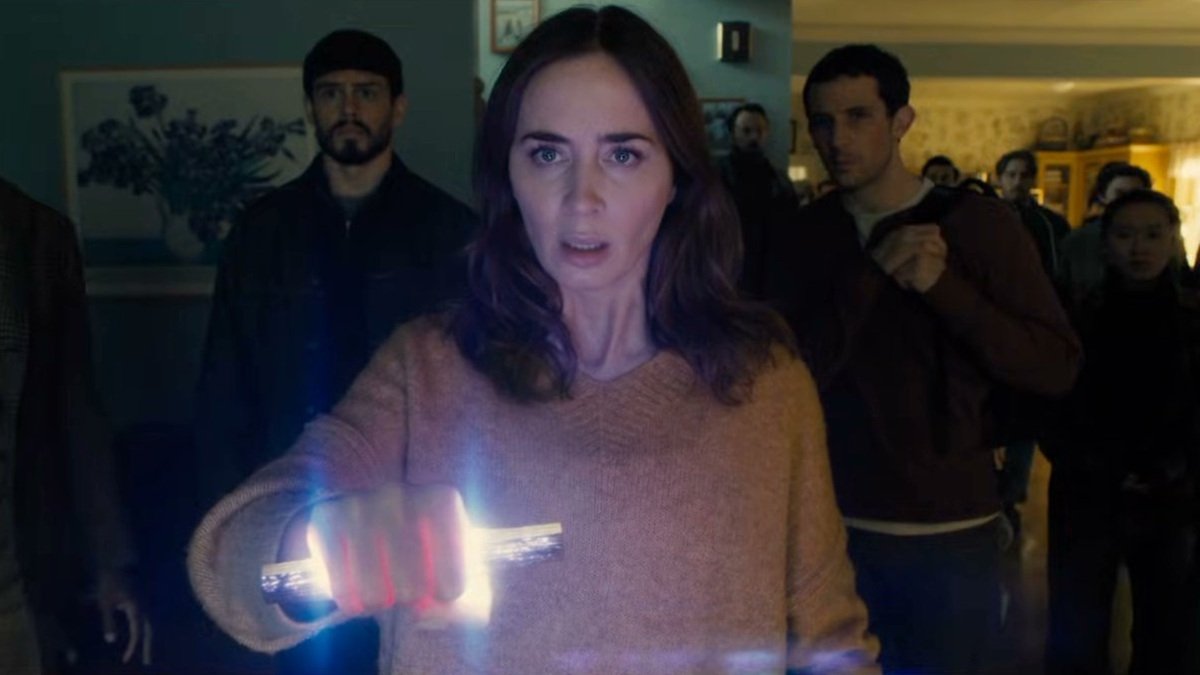









One of the first things I thought while watching Backrooms had very little to do with horror, internet folklore, or Kane Parsons’ unlikely leap from YouTube to A24. It was this: what is it with Renate Reinsve and emotionally loaded furniture?
In Sentimental Value, she moved through what I once thought of as the IKEA-ification of complex family relationships, where couches, rooms, and old domestic spaces seemed to carry more history than some people knew what to do with. In Backrooms, the furniture gets cranked up to crazy 11. Discount-store bedroom sets. Fake living rooms. Pirate-themed sales gimmicks. Chairs stacked into impossible heaps. A showroom that looks like capitalism had a nervous breakdown and tried to decorate its way through it.
That may be a silly thing to begin with, but silly thoughts sometimes unlock the right door. Because Backrooms is, in part, a movie about spaces that remember us badly. It takes the places we barely respect—storage rooms, basements, showrooms, corridors, makeshift displays of middle-class comfort—and turns them into something hostile. Not haunted, exactly. Something worse: indifferent.
I walked into the film with only broad familiarity with the original Backrooms mythos. I knew about the creepypasta, along with the basic image: the sickly yellow, the endless empty rooms, the idea of “noclipping” out of reality into somewhere you were never meant to enter. And I knew Kane Parsons had built a web series out of that image, but I didn’t come in with the kind of lore-heavy investment that can turn adaptation into an audit.
That probably helped. I wasn’t watching the film with a checklist. I wasn’t waiting for it to honor this level, that entity, this rule, that piece of canon. Like with Exit 8, another recent film about a repeating, unnatural space, I entered as a casual traveler. Broad strokes only. No baggage. That can be freeing. It also sharpens the basic question: does this work as a movie?
For much of its running time, yes. Sometimes, emphatically.
The Horror of a Room That Shouldn’t Be There
The first stretch of Backrooms is close to pure horror cinema. No over-explaining, no mythology lecture, and no need for characters to tell us what kind of film we’re watching. The found-footage texture, the old-ad grain, the silence, the grainy camcorder unease, the suggestion of something unseen rather than the blunt reveal of it—Parsons understands how frightening a space can become before anything jumps out from it.
Clark, played by Chiwetel Ejiofor, owns a struggling furniture store called Cap’n Clark’s Ottoman Empire, which is both a good joke and a sad one. The store is a monument to tackiness: a pirate-themed retail graveyard where domestic comfort has been reduced to staged rooms, discount signs, and sad little arrangements pretending to be homes. Clark has been separated from his wife, he’s sleeping in his own store, and he carries himself like a man who has confused grievance with personality. Then he finds the wall.
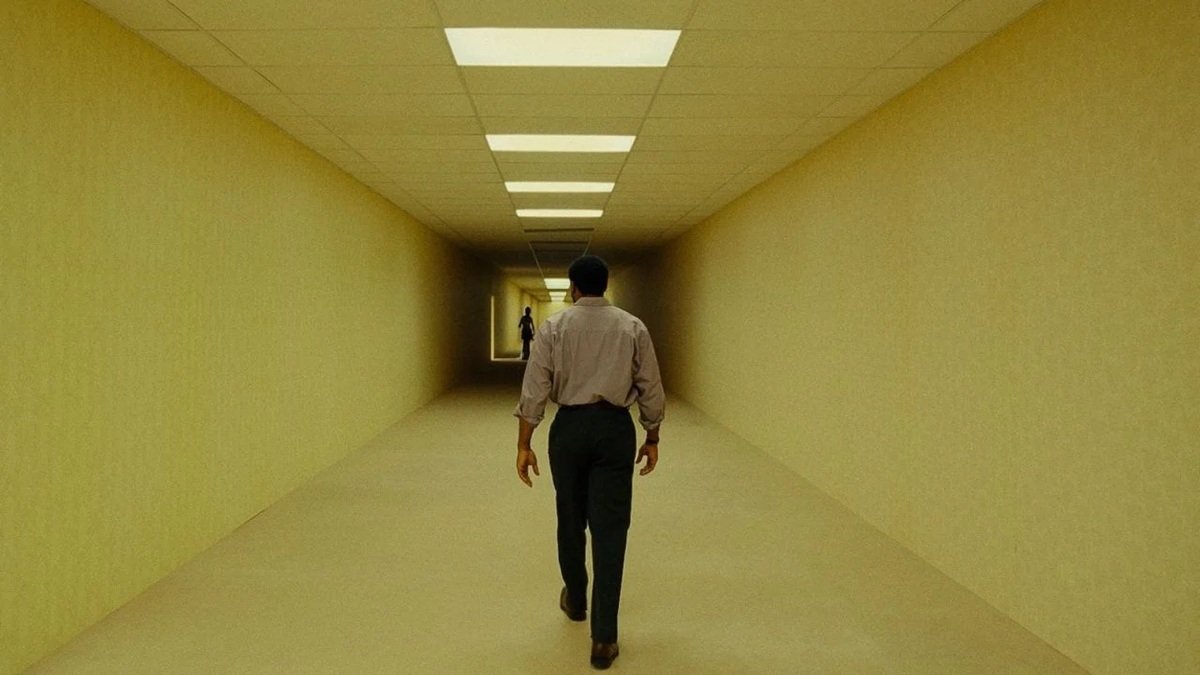
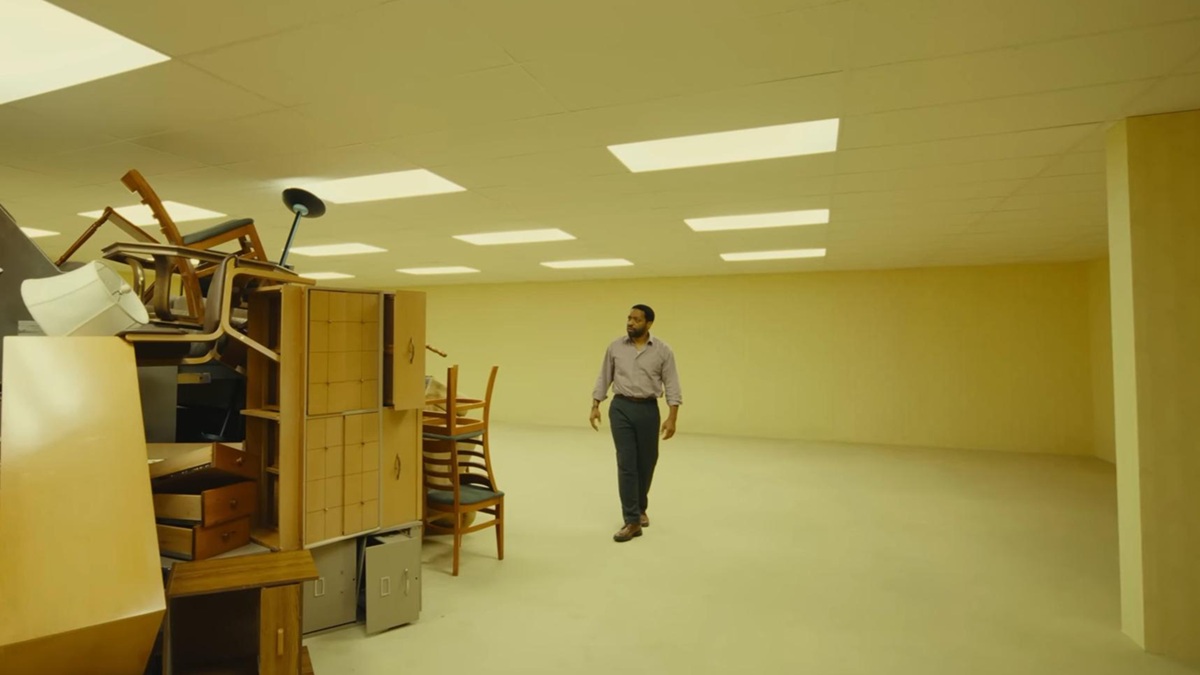
That first discovery of the Backrooms is the film at its cleanest and most unnerving. Clark steps through what should be solid and enters a dimension that looks less like hell than a poorly remembered office building. It’s too bright, but not comforting. Too empty, but not peaceful. The yellow light does something ugly to the eye. It’s not the darkness of Skinamarink, where childhood fear seems to drip out of the shadows. Instead, think of Backrooms as almost the anti-Skinamarink: well-lit, visible, exposed. And yet both films understand claustrophobia as something more psychological than architectural. The walls aren’t closing in. They don’t have to. The rooms already know you can’t leave.
That’s where Parsons’ control is most impressive. He doesn’t treat atmosphere as decoration. He instead builds anxiety out of duration, sound, silence, and the awful blandness of the environment. The fluorescent hum becomes its own kind of threat. Empty rooms start to feel crowded. The silence seems occupied.
I don’t know if Backrooms is always scary in the conventional sense. It didn’t make me leap out of my seat every five minutes. But the film knows the difference between a scare and a sustained state of unease. One is mechanical. The other is harder to shake because it enters the body more quietly. Parsons is good at the latter. He creates that low, stubborn anxiety of standing somewhere familiar and realizing that familiarity has turned against you.
This is one reason the movie’s best passages don’t need much dialogue. The rooms do the talking: the wallpaper, the fluorescent light, the carpet, the awkward geometry of hallways that almost make sense until they don’t. The Backrooms are frightening because they resemble places we’ve all passed through without wanting to remember them: office corridors, school basements, empty retail floors, airport-adjacent hotels, bargain furniture showrooms with no customers. Places designed by no one in particular, for people who are only meant to pass through.
Parsons takes that disposable architecture and gives it a life of its own.
Trauma, Furniture, and the Rooms We Keep Locked
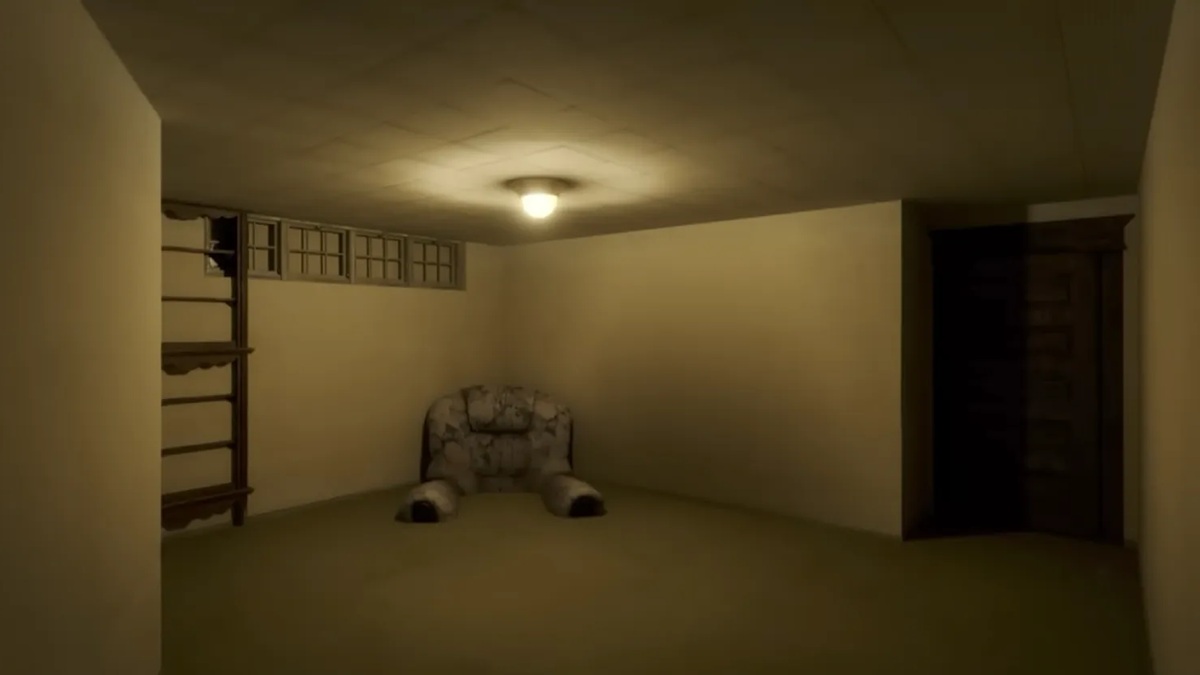
The more Backrooms reveals itself, the more it starts to look like a film about trauma. Not neatly, and not always with the confidence to let the idea sit without explanation. But with enough force to make the reading difficult to ignore.
Clark’s version of the Backrooms doesn’t simply trap him in random architecture. It absorbs fragments of his life. It mutates his failures, his memories, his resentments, his self-image. The space becomes less a maze than an excavation site, and what it digs up is not flattering. He wants meaning. He wants control, and he wants to map the impossible because mapping it would turn mystery into property. It’s such a male impulse, really: to enter a place you don’t understand and immediately behave as though your job is to conquer it.
That impulse gives the film some of its nastiest humor. Clark’s store is already a kind of self-portrait before the Backrooms distort it further. The pirate theme, the forced whimsy, the furniture arranged into imaginary rooms for imaginary buyers. He’s selling comfort while living inside a failure of his own making. The business isn’t just failing financially. It’s spiritually bankrupt, too. It’s a place full of beds nobody sleeps in, tables nobody gathers around, sofas nobody sinks into at the end of the day. Everything has the shape of home and none of the life.
That’s why the furniture matters. It’s not merely production design. It’s Clark’s vocabulary. He understands the world through objects he can arrange, price, display, and sell. So when the Backrooms begin bending space around him, the movie turns that vocabulary against him. The showroom becomes confession. The inventory becomes punishment. He’s surrounded by the very things he thought he controlled.
When the Therapist Gets a Dose of Her Therapy
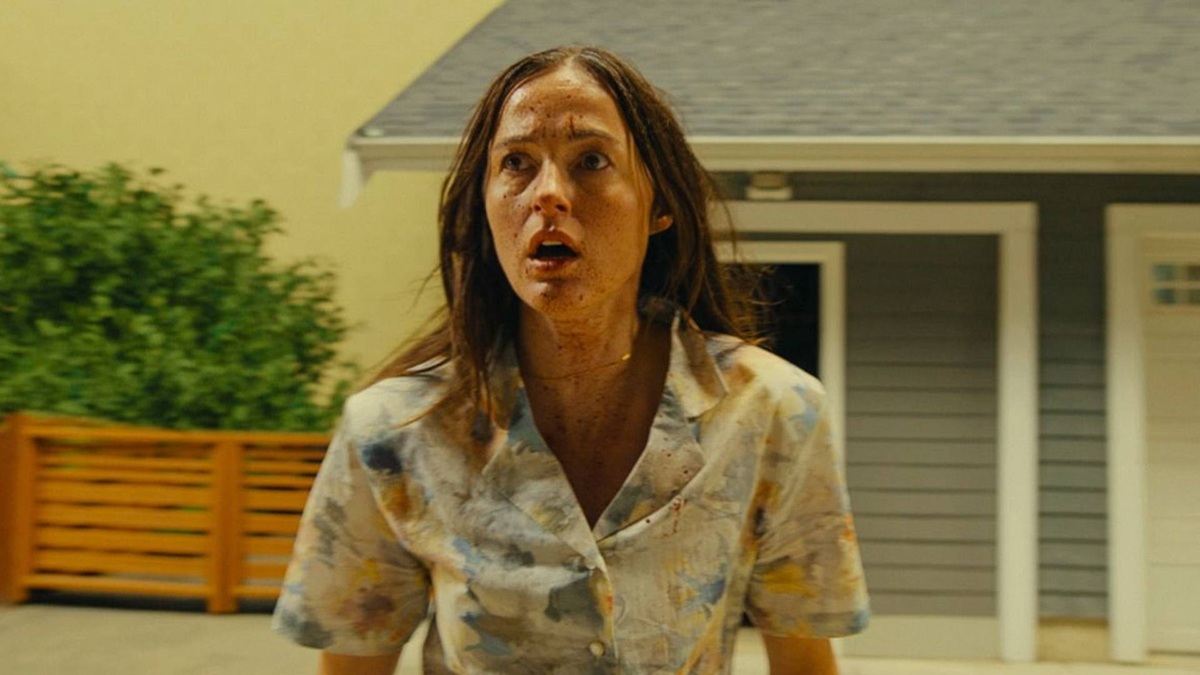
Mary (Reinsve) gives the film a different charge. As Clark’s therapist, she begins on the outside, the one person trying to listen professionally to a man who is already halfway lost in his own bitterness. Reinsve has a gift for looking as if she’s absorbing more than she’s willing to say. It makes Mary’s calmness feel less like detachment than self-protection. She has the difficult job of grounding a film that keeps threatening to dissolve into architecture, and she gives it a human counterweight without softening its strangeness.
When the film pulls her closer to the Backrooms, the nightmare stops feeling like Clark’s private breakdown and starts becoming something more contagious. That’s the point where the movie’s psychological reading becomes harder to dismiss. Everyone has a version of the room. Everyone has something hidden beneath the floor. And everyone, at some point, mistakes containment for healing.
That’s an idea I like more than the film always knows how to dramatize. The suggestion that the Backrooms are made from whatever we repress—shame, fear, old wounds, private loops—gives the movie a charge beyond internet aesthetics. Late in the film, Mary’s connection to the place takes on a strange, unsettling meaning tied to her role as someone trained to help people process what they can’t face. It’s a bold idea, maybe even a clumsy one in execution, but it stayed with me. The person assigned to guide someone through damage becomes implicated in the damage herself.
The problem is that the film sometimes underlines what it should let fester. Once the Backrooms become too readable as trauma architecture, some of their danger gets domesticated. Mystery doesn’t need to be total, but it does need room to breathe. A movie like this loses something when the unknown starts behaving like a diagnosis.
That’s where my admiration for Backrooms begins to split. I’m drawn to its psychological frame. However, I’m also wary of how neatly it sometimes wants that frame to explain the nightmare.
When the Maze Gets Smaller
The challenge with Backrooms is the same one I had with Exit 8: how do you stretch an experience built on repetition, dread, and spatial wrongness into a feature without thinning it out?
Both films are based on concepts that are immediately legible and immediately powerful. A corridor that loops. A room that never ends. And a place that looks ordinary until it isn’t. These are terrific ideas because they work fast. You feel them before you understand them. But features need escalation, variation, character, rhythm. They need to do more than hold a pose.
Backrooms does more than hold a pose, but you can feel the strain. The characterizations are thin. The story is basic. Some of the plot logic feels half-baked, not in the enjoyable dream-logic way, but in the “wait, why does that work like that?” way. Kat (Lukita Maxwell) and Bobby (Finn Bennett) are useful in moving the film into found-footage territory, but they never become as interesting as the space around them. The film’s human material can’t always match the force of its design.
That may sound like a more damaging problem than it is. Horror has survived weaker characters than these, and Backrooms is not trying to be a chamber drama with fluorescent lighting. Still, the thinness matters because the film keeps asking us to carry emotional and psychological weight across a structure that sometimes feels more conceptual than lived-in. Clark has shape. Mary has presence. Everyone else can feel like a function.
The early passages don’t suffer much from this because the film is still operating on discovery. We’re learning the rules, or at least learning that the rules don’t want to be learned. But as the movie goes on, the need for narrative machinery becomes more obvious. Characters investigate. Information accumulates. The mythology expands. The more we learn, the more ordinary some of the film’s movements become. That’s not fatal, but it is a little disappointing. The first five minutes promise terror that seems to come from nowhere. The later stretches occasionally reduce that terror to a system with levers and consequences.
A Reveal That Threatens to Undermine Everything Else
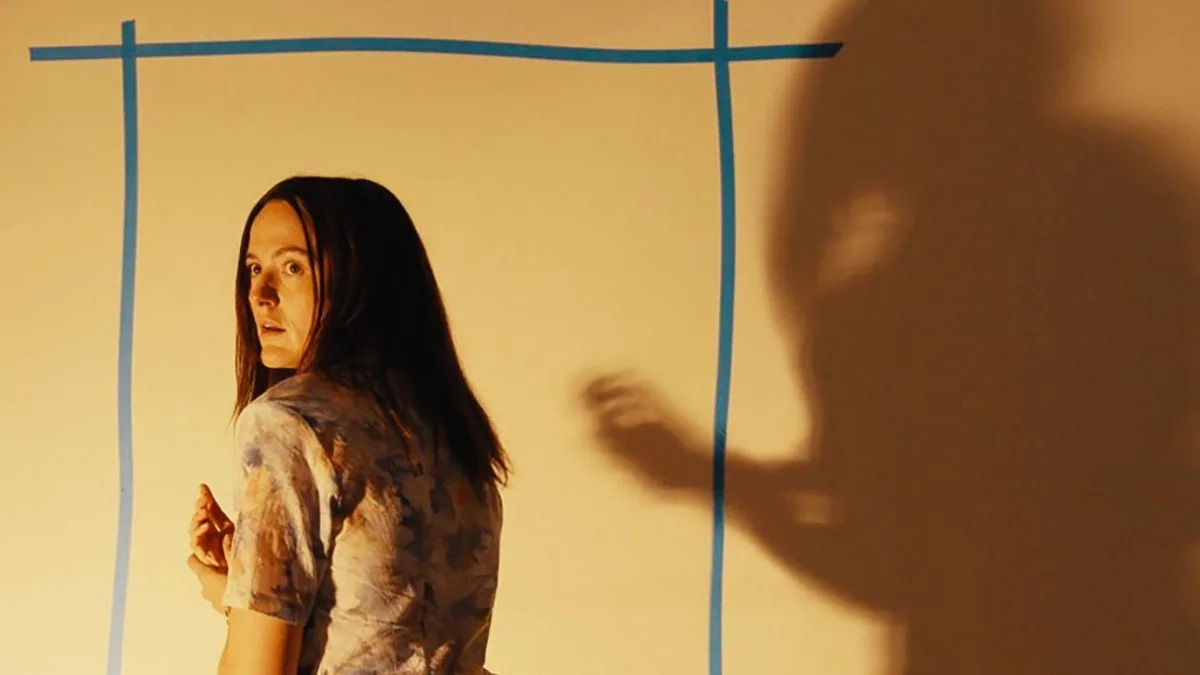
There’s also the matter of the film’s physical threat, which I’ll discuss carefully because the reveal is better left discovered in the dark. Or in this case, under too much light. Once the movie gives the danger a clearer shape, I found myself less frightened by it. The design has some unnerving qualities, especially in the way it distorts something already artificial, but the effect doesn’t fully match the menace of the unseen. The early fear comes from not knowing what shares the space with you. Later, the film asks us to respond to something more concrete, and concreteness is not always this movie’s friend.
The visual effects are hit-and-miss, too. Some of the wall-phasing moments, with Clark and Mary slipping into the Backrooms, have a cheapness that looks oddly ’90s. That’s unintentionally funny given the film’s early-’90s setting, though I can’t say the effect always works in the film’s favor. At times the roughness adds texture. At others, it pulls the movie closer to dated CGI than uncanny unreality.
Still, even the weaker effects don’t break the spell completely. Parsons has too strong an eye for that. He knows where to place a figure in a room. He knows when to let a hallway sit there and rot in our imagination. And he understands that horror can come from bad lighting, bad carpeting, and the awful suspicion that a familiar place has no interest in being understood.
What he’s less sure of, at least here, is how much explanation the film can survive. That’s a hard balance for any horror movie, especially one adapted from a communal internet nightmare that thrives on fragments, rumors, and incomplete images. The original Backrooms idea doesn’t require much plot because it’s terrifying as a premise. Meanwhile, feature filmmaking asks for more. More cause and effect, more emotional payoff, more architecture behind the architecture. Some of that expansion works. Some of it feels like the movie sanding down its own weirdness to fit a shape audiences know how to watch.
Horror’s Nostalgia Problem
There’s another question I kept circling: why are horror films so obsessed with the past?
Analog textures. VHS grain. Pre-smartphone settings. Production design that screams: don’t worry, nobody can Google their way out of this. Some of this has become a lazy convenience. Put the story in the late ’80s or early ’90s and you’ve solved a dozen modern plot problems before they appear. No phones, no GPS, no livestream. No easy record of what happened.
To be fair, Backrooms has a better excuse than most. The whole project is tied to analog horror, false memory, and internet-born nostalgia for spaces that look like they belong to a time before many of its fans were even alive. Parsons’ Backrooms have always felt less like an actual place than a corrupted memory of late-20th-century blandness: office parks, empty malls, dated showrooms, civic buildings, and rental-car carpeting. The past isn’t just a setting here. It’s the texture of the nightmare.
Even so, the film made me think about how much contemporary horror depends on nostalgia as both mood and mechanism. We keep returning to the old technologies because they fail beautifully. Camcorders degrade images. VHS eats detail. Fluorescent lights flicker with a sickly rhythm that digital clarity can’t quite reproduce. There’s romance in that decay, but also calculation. Horror has learned that the pre-social-media world photographs better as fear.
Backrooms gets away with it because its nostalgia feels diseased rather than cute. This isn’t a movie winking at the audience with retro props. It’s a movie that makes the old world look infected: the fax machines, the bulky televisions, the fake living rooms, the display furniture no one really lives with. The film isn’t saying the past was better. It’s saying the past had storage space, and something may still be inside it.
Kane Parsons, and the Current Crop of Internet-Native Filmmakers
The movie also speaks of how strange this current moment in filmmaking has become, where internet-native artists are no longer just making calling cards online. They’re shaping the language of studio-backed genre films. That doesn’t automatically make Backrooms new or radical, and it doesn’t excuse its thin spots. But it does make the film’s texture feel distinct. Parsons isn’t an outsider trying to explain internet horror to a mainstream audience. He comes from inside the phenomenon. He understands the appeal of a half-glimpsed image, a degraded file, a clip that looks as though it was found in the wrong folder of someone else’s computer. His challenge is learning what to add without killing the thing that made it eerie in the first place.
He doesn’t always solve that problem. The film’s people are not always as vivid as its rooms. Its logic can feel more suggested than worked through. Its physical threat is less frightening than the emptiness around it. The film’s best stretch is still its earliest one, when Clark first steps into a place that shouldn’t exist and the movie trusts silence, space, and light to do the work.
And yet I enjoyed it. More than that, I admired the particular shape of its imagination. Backrooms is strongest when it understands that the scariest thing isn’t death, possession, or even being chased. It’s the possibility that somewhere beneath ordinary life, there’s a room built out of everything you didn’t process, every memory you misfiled, every failure you tried to furnish into something presentable.
That’s why the furniture matters. The ugly sofas, the staged beds, the fake rooms, the discount domesticity of Clark’s store. They’re not just jokes or props. They’re promises of comfort stripped of life. Rooms without people. Homes without intimacy. Places designed to be entered but never inhabited.
‘Backrooms’: A Worthy Trip, Even When the Walls Don’t Hold
By the third act, Backrooms becomes more conventional than I wanted. There are explanations, revelations, franchise gestures, and a sense that the film is setting up a larger mythology when I might have preferred a stranger, sharper collapse. Part of me wanted wilder choices. Not just “here’s what the Backrooms mean,” but something more deranged, less tidy, less interested in turning the unknown into a diagram.
At one point, the film comes dangerously close to feeling like Skinamarink meets The Cabin in the Woods, which is both a joke and not really a joke. It wants the pure dread of abstraction, but it also wants a machinery behind the abstraction. It wants trauma horror, monster horror, liminal horror, found footage, psychological breakdown, and franchise architecture. That mixture is exciting. It’s also why the movie occasionally wobbles.
But I’d rather watch a film wobble while reaching for something strange than glide smoothly toward nothing.
And that’s probably the fairest way to talk about Backrooms: not as a perfect expansion of an internet phenomenon, and not as a failed experiment either. It sits in the uneasy middle, where the best parts are good enough to make the weaker ones more frustrating. Parsons has a real command of mood, and there are stretches here that suggest a filmmaker who knows instinctively how to make negative space feel aggressive. That’s not nothing. Many horror directors spend entire careers mistaking noise for terror. Parsons knows the room matters before the thing inside it does.


A self-described cinephile who can’t stop talking—and writing—about films. Paul also moonlights as ghostwriter and editor for a few memoirs. He currently resides in the Philippines.