







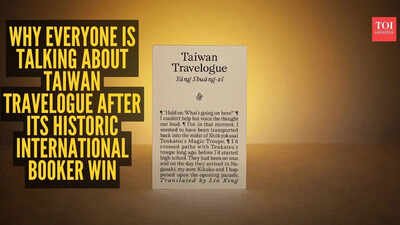
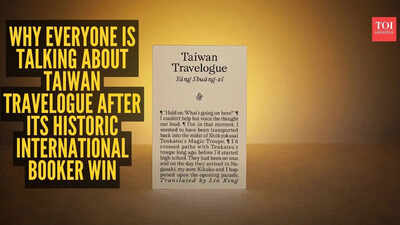
The literary world has officially found its newest obsession, and it’s called Taiwan Travelogue. After winning the International Booker Prize, the novel by Yáng Shuāng-zǐ and translated by Lin King has suddenly become one of the most discussed books online – and honestly, it’s not hard to see why.The win itself was already historic. Taiwan Travelogue became the first novel translated from Mandarin Chinese to ever win the International Booker Prize. On top of that, Yáng and Lin King are also the first Taiwanese and Taiwanese-American winners in the award’s history. That alone made headlines globally. But what’s really pulling readers in is the story behind the book – and the layered conversations both women have had about identity, colonialism, romance, language, and memory.Because this isn’t just another historical novel.It’s queer romance, political commentary, metafiction, travel writing, food literature, and emotional drama all wrapped into one incredibly atmospheric story.
So, what is Taiwan travelogue actually about?
At first glance, the novel presents itself as a rediscovered Japanese travel memoir from the 1930s. The story follows Aoyama Chizuko, a Japanese writer who travels through Taiwan during the period of Japanese colonial rule. She’s accompanied by a Taiwanese interpreter named Chizuru, and together they move across the island sharing meals, conversations, train rides, and slowly developing feelings for each other.But beneath that relatively simple setup is something far more emotionally complicated.The romance between the two women unfolds against a clear imbalance of power. One comes from the colonising nation, while the other belongs to the colonised land. That tension quietly shapes almost every interaction in the book. And according to the Booker judges, that’s exactly what makes the novel so special.Judge Natasha Brown described it as a book that somehow works both as a love story and as a sharp postcolonial novel at the same time. That balancing act is a huge reason readers are calling it one of the smartest literary releases in recent years.
Yáng Shuāng-zǐ wanted to explore Taiwan’s complicated past
One of the most interesting things Yáng has said in interviews is that she specifically wanted to explore how Taiwan remembers Japanese colonial rule differently from other countries.She pointed out that Korea’s relationship with Japanese occupation is often viewed through straightforward anger and resentment, while Taiwan’s historical memory is much more conflicted. There’s pain there, obviously, but also nostalgia, cultural overlap, and lingering emotional complexity.That tension became the emotional backbone of Taiwan Travelogue. Instead of writing a neat “good versus bad” historical narrative, Yáng wanted to show how ordinary people actually lived during that era – how they navigated identity, survival, language, relationships, and even desire under colonial systems.That’s part of why the novel feels so modern despite being set in 1938. It understands that history is messy. People are contradictory. And emotional truth doesn’t always fit clean political narratives.
Lin King didn’t want historical fiction that was only about suffering
Translator Lin King has also become a huge part of the conversation surrounding the book, especially because of how openly she’s discussed her approach to historical fiction. In interviews after the Booker win, King explained that she personally dislikes historical stories that reduce characters entirely to pain and trauma.Her point was simple but powerful: even during dark political periods, people still flirted, laughed, watched movies, fought with friends, ate good food, and fell in love. That philosophy completely shapes the atmosphere of Taiwan Travelogue.Yes, colonialism hangs over the story constantly. The imbalance of power never disappears. But the book also leaves room for pleasure, humor, curiosity, and intimacy. It allows its characters to feel fully alive rather than existing only as symbols of suffering.And honestly, that emotional richness is probably why readers are connecting with it so intensely right now.
The food descriptions are apparently incredible
One thing almost everyone mentions after reading the novel is the food.Seriously – readers online are talking about this book the same way people talk about food documentaries.Braised pork rice, winter melon tea, regional dishes, train snacks – meals become central emotional moments throughout the story. Food isn’t just decorative detail here. It becomes a way to discuss class, identity, colonial influence, memory, and affection.Yáng herself joked in an interview that researching the book caused two problems in her life: she lost money and gained weight. That line has already become a fan-favorite quote because it perfectly captures the novel’s sensory world. You can tell the author genuinely cared about making Taiwan feel tangible and lived-in rather than purely historical.
The translation is getting almost as much praise as the novel
Another reason the book has become such a major literary moment is the translation itself. Lin King’s English version has been praised for preserving the novel’s layered structure and multiple narrative voices without flattening them for international audiences. And the structure really is unusual.The novel includes fake footnotes, introductions, metafictional commentary, afterwords, and shifting narrative layers that blur the line between fiction, translation, and historical documentation. At times, it almost tricks readers into wondering whether the “original” text actually existed.That complexity could easily have become confusing in translation, but critics say King managed to keep the book elegant, readable, and emotionally immersive.King has described the translation process as intentionally “maximalist,” explaining that she and her editors avoided simplifying cultural or linguistic details too aggressively for English-speaking readers. Instead, they leaned into the richness of the text. That choice seems to have paid off in a huge way.
Why this Booker win feels bigger than just one book
The excitement around Taiwan Travelogue also comes from what the win represents culturally. Taiwanese literature rarely gets this level of global visibility, especially in English-language publishing. Translation itself remains a surprisingly small corner of the Western literary market, so for a Taiwanese novel translated from Mandarin Chinese to win one of the world’s biggest literary prizes feels genuinely significant. And people online seem very aware of that. For many readers, this isn’t just about discovering a great novel. It feels like discovering an entire literary tradition that hasn’t always received mainstream international attention.The book’s success is also arriving during a moment when readers seem increasingly interested in stories about identity, migration, language, and cultural memory. Taiwan Travelogue taps into all of those conversations while still remaining deeply emotional and character-driven. That’s a difficult balance to pull off.
At its core, it’s still a love story
Despite all the political and literary analysis surrounding the novel, what seems to stay with readers most is the relationship between Chizuko and Chizuru. Their connection is tender, awkward, intelligent, restrained, and constantly shaped by things left unsaid. The emotional tension between them quietly carries the entire book forward.
Can genuine love exist inside unequal systems of power?
That’s the central question the novel keeps circling. And instead of offering easy answers, Taiwan Travelogue chooses ambiguity – which is probably why it lingers in people’s minds long after they finish it. The novel understands that relationships, like history itself, are rarely simple. That emotional honesty may be the biggest reason the book is suddenly everywhere.