








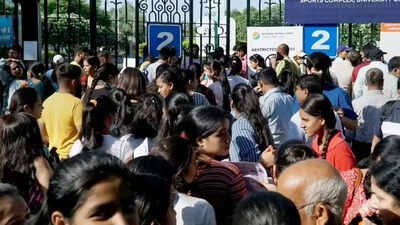
NEW DELHI: The National Testing Agency has opened a small correction window that would allow students to change in their CUET-UG 2026 examination state, date and shift after widespread complaints that they were allotted centres hundreds of kilometres away from their preferred cities.In a notice on Tuesday, the agency said candidates can opt for a change in the examination state, date and/or shift “as per availability of slots” for their subject combination. The window of opportunity opened on May 5 and will remain so till May 7, 11.50 pm. Allotments will be made on a “first come first served basis”.
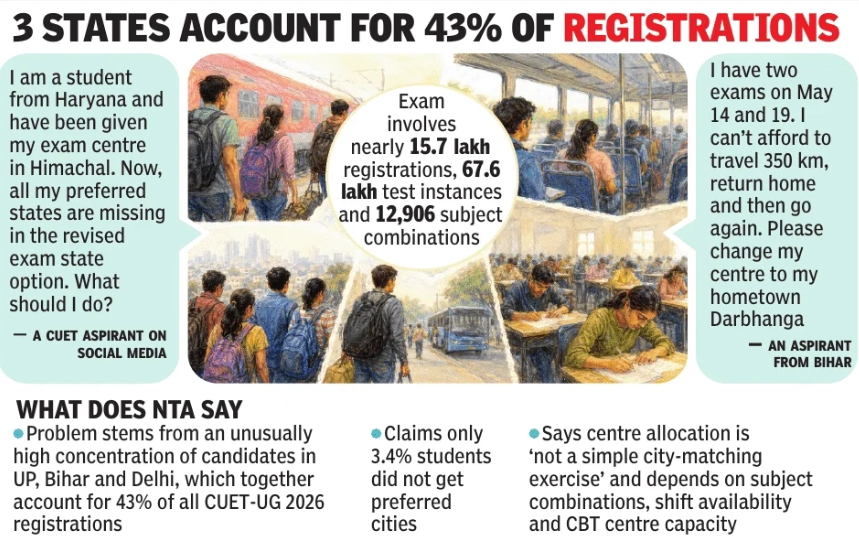
Several aspirants across the country have flagged logistical difficulties, the requirement for repeated inter-state travel and rising accommodation costs after being assigned centres outside their chosen cities.The agency said revised admit cards would be issued to candidates using the facility, while those who do not exercise the option within the stipulated period will have to appear as per their already allotted examination city, date and shift.The decision follows days of criticism on social media, with students from Delhi, Haryana, Bihar and other states sharing instances of being assigned centres far from their homes during the month-long examination cycle from May 11 to May 31.Among them is Garv Mendiratta, a Delhi resident who said he had selected Delhi and NCR cities as preferences but was allotted Agra for his examinations scheduled on May 11, May 13 and May 30, requiring repeated travel.Another Delhi candidate, Sunil Sah, said he had been allotted Jaipur as his centre, while Dewansh Solanki from Delhi was assigned a centre in Mohali.Some candidates also complained of being allotted multiple examinations in different shifts on the same day, raising concerns over travel feasibility and exam fatigue.Students said the scattered schedule and outstation allotments had increased travel and accommodation expenses, disrupted preparation and created uncertainty during one of the country’s biggest entrance examinations.“I am a student from Haryana and you gave my centre in Himachal. Now all my preferred states are missing in this revised exam state option. What should I do?” an aspirant wrote on social media.Another student from Bihar wrote: “I have two exams on May 14 and 19. I can’t afford to travel 350 km, return home and then travel again. Please change my centre to my hometown Darbhanga.”Responding to the criticism, NTA said on social media that the situation was largely due to a “high concentration of candidates in a few cities and limited CBT test centre availability”, while assuring students that concerns were being reviewed to minimise inconvenience.In a separate press release, the agency said CUET-UG 2026 had received 15.6 lakh registrations, which will lead to 67.6 lakh tests. Candidates have opted for an average of four subjects each.It said the examination was being conducted across 35 shifts nationwide and involved 12,906 distinct subject combinations, making centre allocation operationally complex.Explaining the challenge, NTA said around 43% of the total candidates originated from three states — Uttar Pradesh, Bihar and Delhi — which together accounted for nearly 29.9 lakh effective test instances across 9,922 subject combinations.The agency said allotment was not merely a city-matching exercise, as it had to simultaneously balance a candidate’s preferred city, subject combination and shift availability while working within the limits of secure CBT infrastructure, trained invigilation staff and examination integrity requirements.According to the agency, 79% of the candidates received their first-choice city, while 96.6% were allotted one of their preferred cities. The remaining 3.4% candidates were assigned centres outside their selected preferences, primarily in regions where registration volumes exceeded available CBT capacity.Students and parents questioned the explanation, pointing out that such large-scale outstation allotments were not seen in previous CUET cycles.Many described the issue as a planning failure.