







Scribner 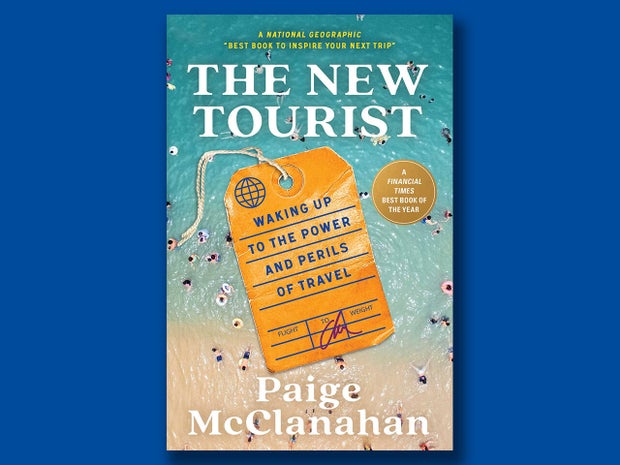
We may receive an affiliate commission from anything you buy from this article.
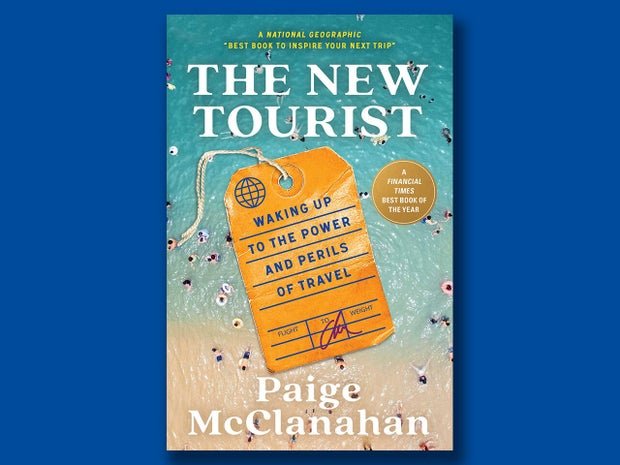
In “The New Tourist: Waking Up to the Power and Perils of Travel” (available from Scribner), journalist Paige McClanahan writes about how tourism shapes societies and individuals, and about the need to redefine the meaning of “tourist” in today’s shrinking world.
Read an excerpt below, and don’t miss Seth Doane’s interview with Paige McClanahan on “CBS Sunday Morning” May 3!
“The New Tourist” by Paige McClanahan
Prefer to listen? Audible has a 30-day free trial available right now.
Introduction
About nine hundred years ago, a group of monks built a stone abbey along the banks of a cold, clear river in a steep-sided valley high in the Alps. The religious men took up residence among the locals—people who spent their days tending cows and sheep, churning butter, weeding onions and turnips, scouring the forests for mushrooms, and chiseling sculptures from the local limestone. Centuries passed, and the abbey went through the typical cycles of decline and renewal, fire and renovation, until 1792, when an invading army (the French) claimed the monks’ worldly possessions as their own—and kicked them out. Stripped of its holy residents, the abbey took on a new life as the headquarters of a company that mined the local iron ore, which was destined for the infrastructure of a rapidly industrializing Europe. Later, as wealthy Europeans began to seek out the restorative powers of alpine air, the abbey went through another reinvention: it became a hotel.
In the summer of 2018, my family and I moved to a house that sits a few miles from that abbey, whose tidy lawn now hosts a popular outdoor concert series every summer. The abbey’s hotel closed in the nineties—a casualty of the rise in the popularity of chalet rentals over hotel rooms—but tourism in the valley is going strong. So much so that the people who live along the banks of the valley’s cold, clear river now spend their days driving tourists to and from the airport; serving them espressos and blueberry tarts; cleaning their bathrooms and changing their sheets; and leading them along hiking trails, up rock-climbing routes, and down wide slopes of fresh, untracked snow. For the past fifty years, tourism has been the cornerstone of the local economy. It’s also the main reason why the local village hasn’t gone the way of so many villages across Western Europe since the end of the Second World War—and disappeared entirely.
My boyfriend and I first visited the valley as tourists, back in 2007. We were weekenders coming up with friends from Geneva, where we lived and worked. We fell in love with that cold, clear river and the high, jagged peaks, spliced with waterfalls, that soared above it. We returned to the valley eleven years later— now married and with two small children and having lived in three other countries in Africa and Europe. We moved into our house, applied for our residence permits and driver’s licenses, and enrolled our children in the local school. We had spent most of our lives as visitors to tourist destinations. Now we were residents.
As we settled into life in the valley, we learned to adapt to the comings and goings of the tourists, a seasonal migration as predictable as the public holidays and school vacation schedules that dictate their movements. I came to love how tourists brought energy and life—as well as jobs and income—into our beautiful, sleepy corner of the world. I happily shared the local hiking trails and ski slopes with tourists, and enjoyed eating at our many local restaurants, most of which wouldn’t survive without tourists’ patronage.
But it wasn’t all fun and games, as I discovered the first time I showed up at the local supermarket on a Saturday afternoon in August. Or the time my children were late for school because our usual parking lot was overflowing at 8:00 a.m. on a weekday. Or the times when I sat in bumper-to-bumper traffic on our rural, two-lane road—which leads both to our house and to a nature reserve that attracts a few hundred thousand visitors every year. Within weeks of moving to the valley, I began to appreciate—for the first time in my life—the depth, nuance, and significance of a phenomenon in which I had always, and usually unwittingly, played a part.
* * *
Tourism shapes our world—by which I mean it alters our economies and cultures, as well as our physical environments—in profound and surprising ways. The numbers are astonishing: in 2019, travel and tourism generated more than 10 percent of global economic output, which makes it more than double the size of the global agriculture industry. It also accounted for about one in ten jobs around the world, and one in five jobs created in the previous five years. In 2019, international visitors spent $1.9 trillion while traveling, which was well over double U.S. federal defense spending the same year. And the numbers are only getting bigger: the global economic value of travel and tourism is expected to rise by an average of 5.8 percent per year until 2032, compared to a 2.7 percent predicted growth rate for the global economy overall.
But the impacts of tourism go far beyond jobs and GDP. In many places, tourism is a significant source of funding for wildlife conservation; tourism also generates about 8 percent of our greenhouse gas emissions. And with roughly a billion international tourist arrivals every year, tourism has become humanity’s most important means of conversation across cultures. You don’t even have to cross a border to feel the impact. If you’ve ever seen a hula girl on the dashboard of a taxi and thought of Hawai’i, you’ve felt tourism’s influence. Thee same is probably true if an image of a flamenco dancer makes you think of Spain, or if you can name the capital of Iceland without consulting your phone.
Tourism shapes national narratives, creates national symbols, and frames our perceptions of other societies. It also intensifies the commodification of our cultures, even as it sometimes helps to sustain them. Tourism provides a powerful economic incentive to protect the world’s natural wonders; it can also threaten their very existence. Tourism transforms villages like our own into vibrant places that are, for the most part, agreeable and welcoming to visitors and residents alike. But tourism can also destroy places’ souls, hollowing out city centers and leaving empty urban shells whose most striking feature is sheer commercialism.
Governments, particularly local governments, have an enormous influence over whether the net impact of tourism in a place is positive or negative, though many governments have only recently woken up to this fact. Tourism businesses also affect the vitality of the places that underwrite their profits, and these profit-seeking ventures vary widely in terms of their self-awareness and willingness to ensure that their operations do more good than harm. But tourists play a role, too. Those of us who are privileged enough to fall into this category wield significant power, individually and collectively, in determining tourism’s impact—both on the places we visit, and on ourselves.
* * *
Before we go any further, I should take a moment to define my terms here. Because while dictionary definitions of “tourism” tend to focus on the business side of accommodating people when they go on vacation, I have a broader understanding of the word. The UN World Tourism Organization tells us that tourism is “a social, cultural, and economic phenomenon which entails the movement of people to countries or places outside their usual environment for personal or business/professional purposes.” My understanding of tourism aligns with that one, although I would add a temporal component: tourist movements are for finite periods; we’re not talking about immigration here.
A lot of people are uncomfortable with the word “tourist,” at least when it’s aimed in their direction. I’m hoping this book will help shake loose some of that stigma, because I don’t think it’s helpful. It irks me that some people insist on a distinction between “travelers” and “tourists,” where the former are explorer types who are unsatisfied with anything short of an “authentic” experience, while the latter are philistines who are content with clichéd, mass-market experiences. In practice, I find that the biggest difference between the terms is that we use “traveler” when referring to ourselves and people close to us, while “tourist” is reserved for everyone else. I don’t deny that people travel for a huge range of reasons, some higher-minded than others. So sure, call yourself a traveler, but never forget that you’re a tourist, too. Our redemption as tourists lies not in wallowing in a sense of superiority over the people standing in line ahead of us as we wait to get into the Louvre. It lies in elevating our understanding of what tourists are, and the important role that they—that we—play in the world.
So how do we do that? Where do we begin? I find it helpful to imagine two tourist archetypes that lie at either end of a spectrum. On one side, we have the new tourist, who is a tourist in her most evolved state, her highest manifestation. This is in contrast to what we find at the other end of the spectrum—the old tourist, who represents an approach to tourism that we would all do well to leave behind. We might like to think of an old tourist as a loud-talking, gum-smacking, sneakers-wearing American who seeks out Starbucks abroad like a heat-seeking missile. But I have a somewhat more nuanced definition. The old tourist, in my view, is a pure consumer who sees the people and places he encounters when he travels as nothing more than a means to some self-serving end: an item crossed off a bucket list, a fun shot for his Instagram grid, one more thing to brag about to his peers. The old tourist confines his destination and its inhabitants to a preconceived story, which makes it impossible for him to consider the people or places he visits in any depth or with any real empathy. He projects his fantasies onto his destination of choice, and he reacts with disappointment or even outrage when the reality fails to match his notion of the ideal.
But I believe there’s such a thing as a new tourist, too, which is the whole reason I wrote this book—and chose the title I did. In my view, it’s entirely possible that the new tourist is an American who talks loudly, chews gum, wears sneakers, and sometimes likes to get a coffee at Starbucks when she’s overseas. Those kinds of details don’t matter much in the end. Here’s what does: Even if, like all of us, she sometimes takes comfort in the familiar, the new tourist is humbled by her travels, which open her eyes to her smallness in the great stretch of history and the vast sea of humanity. The new tourist embraces the chance to encounter people whose backgrounds are very different from her own, and to learn from cultures or religions that she might otherwise fear or regard with contempt. The new tourist returns from her travels with a degree of skepticism for her native land that may not have occurred to her had she never left home. Because of her travels, the new tourist is inoculated against anyone who might try to convince her to hate or look down on people who look different from her, who speak a language other than her own, who pray to a different god, or who happen to live on the other side of a border. Because of her travels, the new tourist is a more open and generous human being.
All of us who travel fall somewhere between the old and new tourist archetypes, and we probably find ourselves sliding along the spectrum at different points in our travels. Rest assured, I’m somewhere in the middle with you. But if we understand what the new tourist looks like, we can at least aspire to reach her heights. I’ve been trying to find my way to the land of the new tourist for a while now. This book, as I see it, is my best and biggest effort to finally get there myself.
* * *
Travel presents us with a dizzying array of choices: where to go, when to go, how to go, what to do while we’re there. Many books have been written about how to travel “sustainably,” “responsibly,” or “mindfully.” I see this book as a sort of prequel to those. My goal here isn’t to give you a list of dos and don’ts for your next vacation, because there’s no way that I could provide an answer for every situation you might encounter. Only you can make those choices—in the moment, and within whatever constraints you happen to find yourself. Instead of prescribing, my aim here is twofold: to provide you with a framework that will help you come up with your own questions, and to inspire you to ask those questions—of yourself, of the companies you patronize, of your governments, and of the symbols and narratives that you encounter when you travel. Because that is the way of the new tourist.
My goal here is to tell the whole truth, messy as it may be, and to show how we tourists help to shape the phenomenon of tourism itself. Each chapter explores a complex question about tourism and its players, its impacts, its levers of power, and its stakes. How did a handful of young baby boomers transform the way millions of Westerners view the world? Is social media changing the way we see ourselves in relation to other cultures and landscapes? How does tourism influence a nation’s image—and influence—on the world stage? When does tourism destroy the soul of a city, and when does it offer a place a new lease on life? Is “last-chance tourism” prompting a powerful change in perspective, or obliterating places we cherish? Is it possible to strike a balance between tourist fantasies of a place and the realities of everyday local life? Given all the negative headlines about tourists these days, would it be better for all of us just to stay at home?
To wake up to the consequences of our travels might sound like a lot of work, but doing so can bring deep and lasting rewards—for us as individuals, as well as for our societies. Some people are happy to roam the world as old tourists, pure consumers who remain willfully blind to the impacts of their wanderings. But I know that many of you are ready to join me in striving for a new, and better, way of doing things. I hope this book helps us get there together. Because to be a tourist is a privilege and, for many of us, it’s one of life’s great pleasures. With the right approach, which begins with a deep understanding of what’s at stake, tourism can also be a powerful force for good.
Excerpted from “The New Tourist” by Paige McClanahan. Copyright © 2024, 2025 by Paige McClanahan. Excerpted with permission by Scribner, a division of Simon & Schuster, Inc.
Get the book here:
“The New Tourist” by Paige McClanahan
Buy locally from Bookshop.org
For more info: