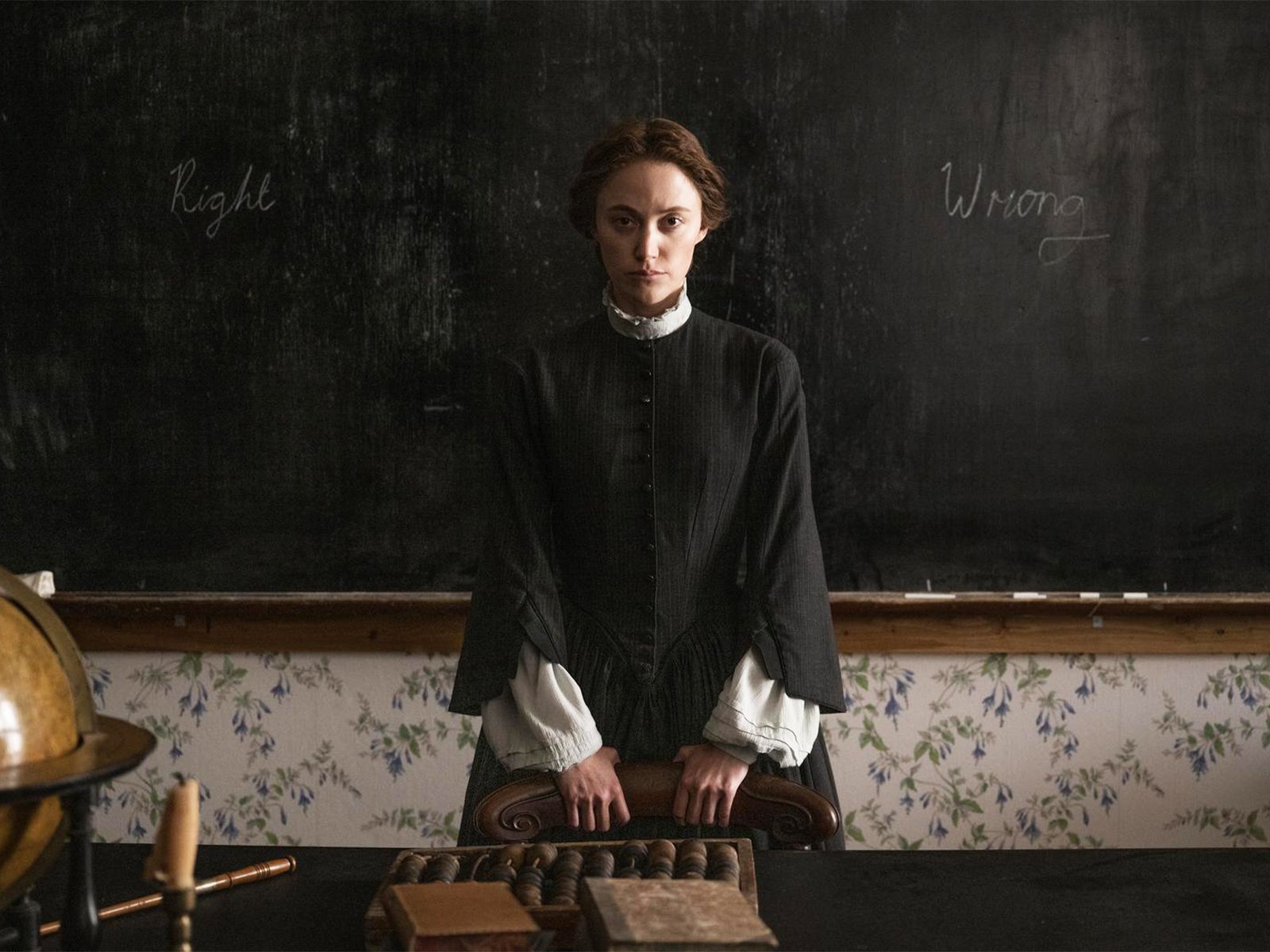










There’s a documentary at Cannes this year about the work of David Lean that spends time noting how he may be known for vistas like those in “Bridge on the River Kwai” and “Lawrence of Arabia,” but that he also could capture the human face like a landscape, making the intimate feel epic. I thought of that while watching Javier Calvo and Javier Ambrossi’s phenomenal “The Black Ball,” a movie that takes an unfinished work by Federico Garcia Lorca and spins it off into a generations-spanning study of war, sexuality, homophobia, and doomed love.
The directors known as “Los Javis” take a novelistic approach to their adaptation of the play La piedra oscura by Alberto Conejero, delivering one of the few films at Cannes this year that feels like it’s painting on a broad canvas. There’s nothing wrong with an excess of tight chamber pieces, but there’s something so invigorating about seeing a work with this kind of expansive cinematography, swooping score, remarkable production & costume design, and ambitious editing. David Lean would get it.
“La Bola Negra” opens by introducing us to a musician named Sebastian, played by soon-to-breakout Guitarricadelafuente, a famous Barcelona singer-songwriter with one of the most emotionally heartbreaking faces you’ve seen in years. Sebastian is playing a concert in a crowded rural square in his town in 1937 to celebrate what they think is the welcome arrival of their Italian allies when gunfire strafes the street. Before he knows it, he’s been swept up, thrown on a truck, given a gun, and forced into the army.
Los Javis then zip back a few years to 1932, where we meet a man named Carlos (Milo Quifes), who is trying to join a casino, which appears to be a process not unlike joining a country club today, complete with a tense approval process involving the dropping of white balls for yes and black balls for no. He gets more of the latter thanks to rumors around town about his homosexuality, unacceptable in that time and place.
Finally, we jump to 2017, where a writer named Alberto Azcuna (Carlos Gonzalez) learns that his estranged grandfather has just passed, leaving him something in his will. What he’s left Alberto will connect this triptych of stories using elements of the mystery genre but remaining most true to the human drama of these three characters.
While “The Black Ball” deftly jumps in and out of each timeline, Sebastian’s arc becomes the foundation of the piece—it’s really the reason we’re watching the other two stories, even if they’re equally well-crafted. Sebastian meets and falls in love with a prisoner named Rafael (Miguel Bernardeau), who will be executed before long. Gris Jordana’s camera glides over Bernardeau’s body and Guitarricadeelafuente’s face in a manner that’s sensual and timeless. They become both grounded characters but also stand-ins for so many doomed romances over the generations. Their story alone makes for riveting cinema, but it’s how it’s anchored to the other two that turns this into such an exceptional piece of writing, a screenplay that reminded me of some of my favorite novels in its delicate character detail and graceful emotion.
I didn’t even mention that Julio Torres plays Alberto’s partner, Penelope Cruz pops up to sing two incredible cabaret numbers, and Glenn Close whips out fluent Spanish as an expert on Lorca who ties some threads together for Alberto. It’s a film with an abundance of riches that make up for what could be called self-indulgent length and a few scenes late with an imagined Lorca that arguably underline the film’s themes too boldly.
By that point, I didn’t care. It’s a melodrama that earns its excess. And it will have millions of fans who see themselves or someone they know in it, or at least the kind of filmmaking they wish we saw more of these days.

I can’t say for sure, but I’m almost positive that Pedro Almodovar will like “The Black Ball.” Not only does it feature one of his most loyal collaborators in Cruz, it speaks to his melodramatic tendencies and thematic concerns in a way that makes it feel Los Javis are disciples of the Spanish master. So it’s kind of wonderful that Almodovar is back at Cannes and also in Competition with his intriguing “Bitter Christmas,” a dramedy that again sees the master in a confessional mode, wondering about the emotional betrayal that comes with turning your life and the lives of people you know into art. The French title is “Autofiction,” which should prepare you for a movie that’s very much about Pedro specifically while also being about all aging artists who wonder how their work has had a personal impact to match the professional one.
In 2004, we meet a filmmaker named Elsa (the excellent Barbara Lennie, giving yet another phenomenal Pedro Leading Lady performance). She’s been having intense migraines while working on a new project, shortly after the death of her mother. Her lover Bonifacio (Patrick Criado), who also happens to be a stripper and a firefighter—you have to love Pedro giving his stand-in a gorgeous, life-saving, erotic dancer of a boyfriend—is by her side, but the migraines are the product of a panic attack. She goes on vacation, and we learn about two of her friends and their troubles: Patricia (Victoria Luengo), who believes her husband is cheating, and Natalia (Milena Smit), who is facing unimaginable grief.
From the beginning, it’s clear that this movie within a movie is being written in present day by Raul (an excellent Leonardo Sbaraglia), an aging filmmaker trying to find his voice again. He has a younger partner named Santi (Quim Guiterrez) and an assistant named Monica (Aitana Sanchez-Gijon), who he is using for creative inspiration. Let’s just say: She doesn’t take that well.
“Bitter Christmas” culminates in a conversational showdown between Raul and Monica that plays out almost like a conversation between the angel and the devil on Almodovar’s shoulder when he sits down to write a movie. Raul admits to feeling like he’s run out of ideas, and worried that the movie within a movie will be seen as a minor work. The truth is that it is, at least in the scope of one of the world’s best auteurs, but if “Bitter Christmas” is merely a clever experiment in the legacy of a still-vibrant creator, Almodovar has earned the diversion.