








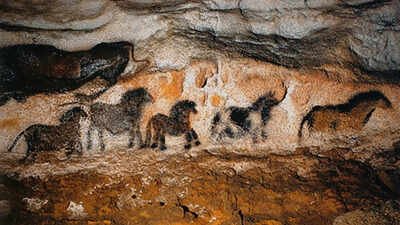
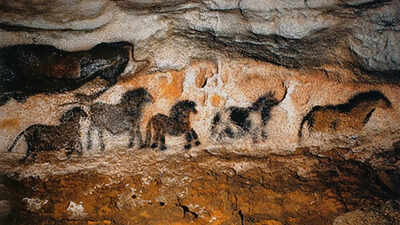
This may sound *wild* and for all the right reasons, but most people don’t know that one of the greatest archaeological finds of the 20th century was actually discovered by a few teenagers, and their dog named Robot!Yes — you heard that right.It all started in southwestern France in 1940, right in the middle of WWII. Four local boys were out in the woods when one of them lost his dog. Looking for him, they stumbled onto a hole in the ground no one knew was there. What they found on the other side changed history: Lascaux Cave, with its walls covered in stunning prehistoric paintings nearly 17,000 years old.Let’s get into the details behind one of the greatest and epic-est discoveries in the history of art and civilization.
Inside the 17,000-YO Lascaux Cave Gallery discovery
As reported by The Guardian, the walls of the Lascaux Cave are packed with images: huge bulls, wild horses, deer, and strange symbols, all painted long before anyone ever built a city or drew up a map. Historians call it the “Sistine Chapel of Prehistory,” and when you see the drawings, you get it. The paintings move; they have power. You can almost imagine the people who painted them all those thousands of years ago.The way Lascaux got discovered is almost as wild as the paintings. This wasn’t a careful dig by seasoned archaeologists. It was a total fluke. One of the boys, Marcel Ravidat, was walking his dog, Robot, who vanished into a hole near a fallen tree. Marcel went back the next day with his friends, named Jacques Marsal, Georges Agnel, and Simon Coencas, to check it out. At first, they thought the hole might lead to some secret tunnel from the local chateau. It was WWII, so stories about treasures and hidden passages were everywhere.They rigged up some makeshift ropes and lamps, squeezed themselves into the shaft, and what they saw was mind-blowing. Giant black bulls faded in and out of their torchlight, horses and deer ran along the walls, some of them in colors still bright after all those years. Jacques Marsal later said he felt like the walls themselves were coming to life. That’s how vivid it was.Once they realized what they’d found, they ran to tell their teacher, Léon Laval. Soon, local experts and archaeologists showed up, like Henri Breuil, who immediately grasped how incredible the discovery was.Scientists later confirmed these paintings dated back about 17,000 years, to the time of the Magdalenian people. There are nearly 2,000 images inside — animals, abstract shapes, and even a few human forms. The most famous spot is the Hall of the Bulls, where you find giant wild cattle, some stretching five meters nose to tail.What’s really amazing isn’t just the pictures themselves, but the technique. The people who painted Lascaux used minerals like charcoal, manganese, and iron oxide to get black, red, and yellow pigments. They even used the natural bulges and dips in the walls to make the animals look like they’re moving. In some spots, it looks like they set up little scaffolds to reach high places.All this forces historians to rethink what ancient people were capable of. The paintings are more than decoration — they make you wonder what they meant. Maybe they had something to do with hunting rituals or spirituality. Maybe they told stories. Maybe they were just marking their world in a way that would last.And among all the mysterious images, one stands out: a scene with a wounded bison, a bird-headed figure, and a spear. Nobody’s really sure what it’s about, but archaeologists can’t stop talking about it.After the war, word spread and Lascaux suddenly became a must-see spot. People poured in, thousands every year. The problem? Human breath, heat, and even sweat started wrecking the art. Carbon dioxide built up. Algae and fungus took hold. By 1963, France had to make a tough call and close the cave to the public to save what was left.
Where the Lascaux Cave stands today
Today, the real Lascaux is sealed off; only a few scientists get in under strict supervision. Most visitors experience replicas called Lascaux II, III, and IV instead, which are so detailed you almost forget they’re copies.It’s hard to sum up what Lascaux means. Before discoveries like this, a lot of people pictured Stone Age humans as dull, clumsy, struggling just to survive. But these caves flip that idea. They show creativity, a keen eye for observation, and even a talent for storytelling, all tens of thousands of years ago.And then there’s the story of those boys. They went looking for a lost dog and wound up making history. Jacques Marsal grew up and became a guide at Lascaux, telling the story over and over. Simon Coencas, for years, said he still couldn’t believe what happened.In the end, that’s probably the best part. It wasn’t scientists or technology that cracked open the past. Just a group of kids, some homemade ropes, and a dog named Robot.