







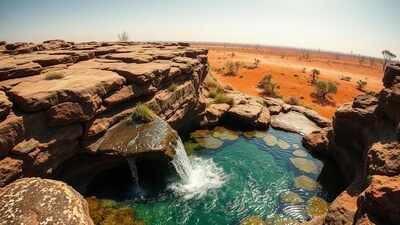
What comes to mind for most people when thinking of the outback? It is an image of a parched landscape featuring dusty, rocky expanses dotted with sparse vegetation. It is a terrain characterised by aridity and where finding water is nothing less than miraculous. However, as some of Australia’s foremost scientific authorities claim, the outstanding feature of the outback is not to be found in the terrain above ground. It is a hidden underground world of water covering an area of more than 1.7 million sq km.In other words, this underground ocean has an area which is larger than that of Alaska itself. The Great Artesian Basin is one of the biggest subterranean sources of fresh water around the world. Lying underneath regions such as Queensland, New South Wales, South Australia, and the Northern Territory, this giant, layered construction consists of sandstone and age-old waters. Although you cannot see it from an aeroplane, this “ocean” provides the necessary conditions for the existence of life in the dry, rusty interior of the Australian continent.The ancient clock of the artesian systemHowever, the water in this underground reservoir is not just water – it is geological time. According to scientists at the CSIRO in their article Groundwater: how scientists explore the mysteries of ancient aquifers, the water of Australia’s deep aquifers can be extremely old. For example, in some regions of the artesian basin, the age of water can reach two million years. Therefore, water which comes out of bores today can contain water that fell down as rain millions of years ago when man was only starting his evolutionary journey.It is because of this process that the basin is referred to as “artesian.” The water is contained under intense pressure, between layers of impermeable rock called aquitards. When the well is bored in the correct formation of sandstone, the pressure forces the water upwards, often resulting in a fountain-type flow without the aid of pumps. This physical phenomenon helped convert the arid wasteland into a green pasture, with an adequate supply of water in a land where rainfall is nonexistent.
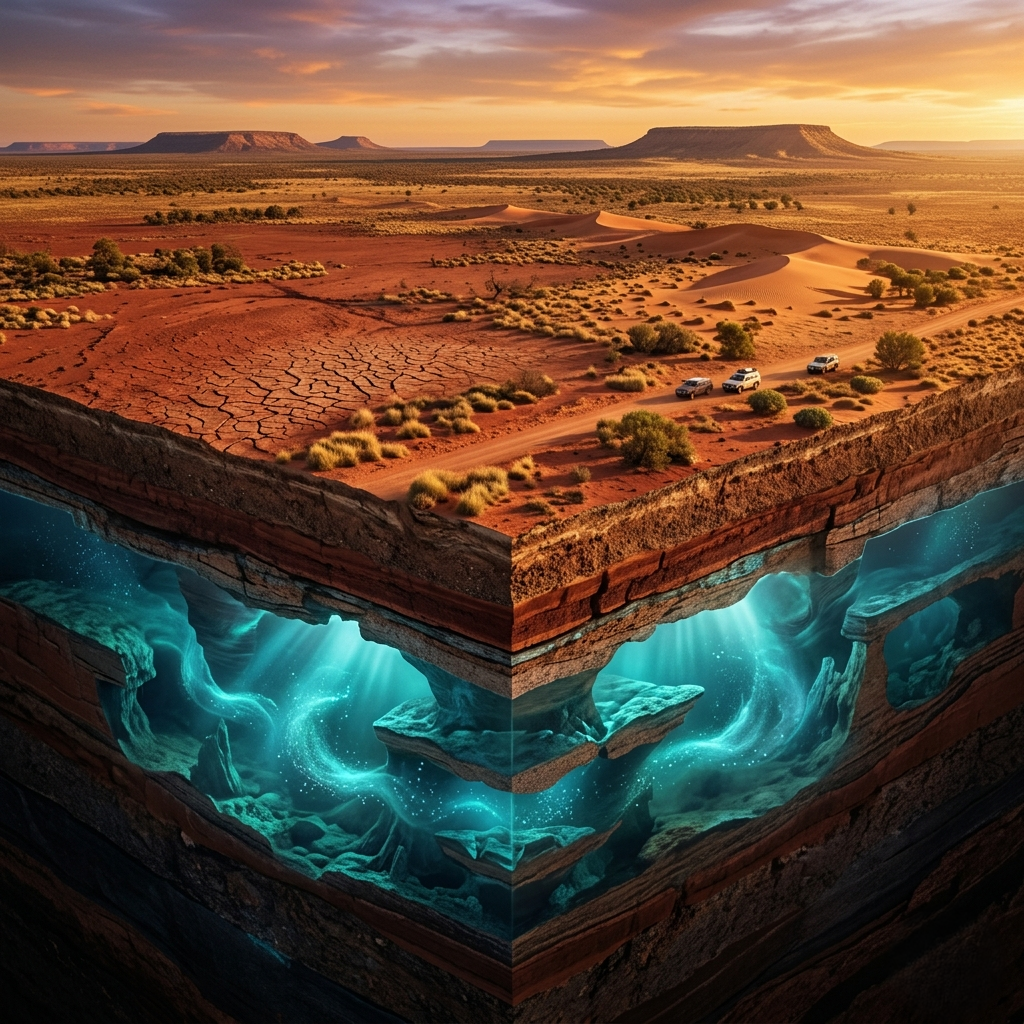
Beneath Australia’s arid outback lies a vast, hidden underground ocean, the Great Artesian Basin, larger than Alaska. This ancient water source, some two million years old, is under immense pressure, naturally flowing to the surface through bores. Image Credits: Google Gemini
An underground infrastructure serving the surface worldIn order to map such a massive network, not only do you need a shovel but a thorough knowledge of science as well. In terms of mapping a hydraulic network as extensive as the one within the Great Artesian Basin, it takes a combination of chemical and physical analysis. In accordance with the Hydrogeological Atlas of the Great Artesian Basin conducted by Geoscience Australia, scientists utilise the groundwater chemistry and bore records to “see” underground.This hidden architecture is responsible for sustaining at least 12.8 billion dollars in economic activity every year. It supports entire towns, massive agricultural projects, and unique ecosystems like “mound springs,” where the underground pressure is so high that water leaks to the surface, creating a lush oasis in the middle of the desert. These springs are the only places where the buried giant reveals itself to the naked eye.While decades have passed since its initial discovery, researchers concede that there remains much that is not known about the recharge speed of this system. It is simply too immense for anyone to ever completely control and forecast its behaviour. Nevertheless, the main takeaway from this discussion on the Great Artesian Basin is evident: the most crucial aspects of any continent are those that remain invisible to the eye. There is a gigantic underground pressurised support system waiting under the dust of the outback, ready to support life overhead.