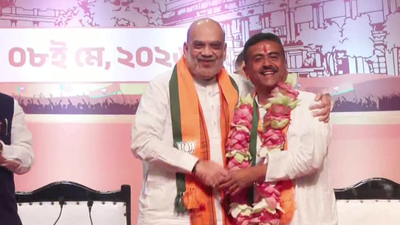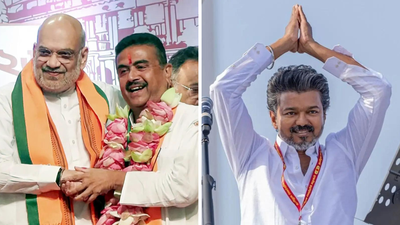






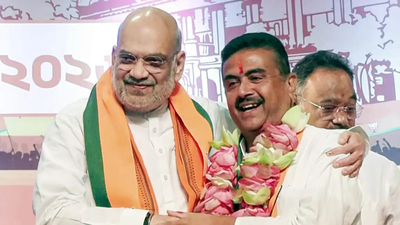
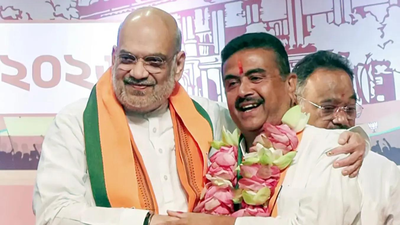
NEW DELHI: Suvendu Adhikari’s rise as BJP’s choice for chief minister in West Bengal comes after years of positioning himself as the party’s most formidable anti-Mamata Banerjee face in the state. From defeating the Trinamool Congress supremo in her own den to leading the BJP’s aggressive Hindutva-driven campaign, Adhikari steadily emerged as the saffron party’s strongest leader in Bengal. The BJP’s sweeping victory in the state, winning 207 seats in the 294-member assembly and ending the TMC’s 15-year rule, further cemented Adhikari’s stature within the party. His electoral success, grassroots influence, insider understanding of the TMC and ability to consolidate anti-Trinamool votes ultimately made him the BJP leadership’s natural choice to head its first government in West Bengal.
Giant slayer: Man who defeated Mamata from her own fortress twice
One of the biggest reasons behind the BJP choosing Suvendu Adhikari as the face of its first government in West Bengal is his stunning victory over Mamata Banerjee in Bhabanipur, a constituency long regarded as the Trinamool Congress supremo’s political fortress. Defeating a sitting chief minister on her home turf gave Adhikari unmatched political weight within the BJP and instantly elevated him as the party’s strongest leader in the state.A former close aide of Mamata Banerjee who later switched to the BJP, Adhikari emerged as the saffron party’s most aggressive anti-TMC face in Bengal. In the high-stakes Bhabanipur contest, he secured 73,917 votes against Mamata Banerjee’s 58,812, defeating her by a margin of 15,105 votes in what became the closely watched battle of the elections.The result carried enormous symbolic value because Bhabanipur has historically remained deeply associated with Mamata Banerjee’s political identity. Located in Kolkata district and part of the Kolkata Dakshin parliamentary constituency, the seat has long been considered one of the safest strongholds of the Trinamool Congress. After losing Nandigram in the 2021 assembly elections to Adhikari, Mamata had returned to the assembly by comfortably winning the Bhabanipur bypoll later that year with more than 65,000 votes.For the BJP leadership, Adhikari’s victory proved that he was capable of directly challenging Mamata Banerjee in areas where the opposition had traditionally struggled, not once, but twice.
No alternative, at least for now
Though there were a few suitors for the top post, there was no one who could come as close to Adhikari, at least for now. While several BJP leaders strengthened their position in the elections, none matched Adhikari’s electoral impact. His victories in both Nandigram and Bhabanipur established him as the party’s strongest anti-TMC face and the leader most capable of directly challenging Mamata Banerjee.Agnimitra Paul retained the Asansol Dakshin Assembly seat by defeating Trinamool Congress candidate Tapas Banerjee by over 40,000 votes, further cementing her position as one of BJP’s emerging leaders in Bengal. Senior leader Dilip Ghosh also won the Kharagpur Sadar Assembly constituency, reaffirming his hold within the party organisation.However, despite the presence of leaders like Paul and Ghosh, the BJP leadership saw no one who could match Adhikari’s grassroots influence, organisational control and political stature in Bengal. Though there were a few contenders for the top post, none came as close to Adhikari — at least for now.
Insider on TMC playbook
The BJP also viewed Suvendu Adhikari as a leader who understands the Trinamool Congress from the inside, having spent more than two decades within the party before switching sides in 2020.Adhikari began his political career with the Congress and became a councillor in Kanthi municipality in 1995 before joining the Trinamool Congress in 1998. Over the years, he emerged as one of the party’s most influential grassroots organisers and played a crucial role in the 2007 Nandigram land agitation against the Left Front government, a movement that eventually helped Mamata Banerjee come to power in Bengal.He went on to become a Lok Sabha MP from Tamluk in 2009 and retained the seat in 2014 before returning to state politics in 2016 as a Trinamool MLA from Nandigram and a cabinet minister in the Mamata Banerjee government. His long association with the TMC gave him deep insight into the party’s organisational structure, electoral strategies and voter networks.After leaving the TMC in December 2020 and joining the BJP, Adhikari quickly became the saffron party’s sharpest weapon against Mamata Banerjee. His victory over her in Nandigram in the 2021 assembly elections further strengthened his stature and eventually led to him becoming the leader of the opposition in West Bengal.
Hindutva appeal which aligns with BJP’s core politics
Another major factor behind Suvendu Adhikari’s rise as the BJP’s chief ministerial face was his ability to consolidate Hindu votes, a strategy that closely aligns with the BJP’s broader political identity and electoral approach in Bengal.After winning both Nandigram and Bhabanipur, Adhikari openly credited Hindu voters for his victory, particularly in Nandigram where he defeated TMC candidate Pabitra Kar by 9,665 votes. “This time I won the election with almost ten thousand votes. The Hindu people of Nandigram made me win again. There, the entire Muslim vote went to TMC. I will work for the Hindus of Nandigram,” ANI quoted Adhikari saying a day after assembly election results.For the BJP leadership, Adhikari’s success reinforced the party’s belief that he could emerge as the central face of Hindu consolidation in Bengal politics. His aggressive attacks on the TMC, combined with strong messaging around ideology and identity politics, resonated with the BJP’s core support base in the state.
Vocal agressive leader
Suvendu Adhikari’s emergence as the BJP’s choice for chief minister was also driven by his image as the party’s most vocal and aggressive leader of opposition in West Bengal, a politician who consistently took the fight directly to Mamata Banerjee and the TMC both politically and ideologically.Throughout the campaign, Adhikari projected himself as the BJP’s strongest Hindutva voice in the state. From leading Ram Navami rallies in Bhabanipur and calling for “Ram Rajya” in Bengal to openly crediting Hindu voters for his victories, he aligned himself closely with the BJP’s core ideological messaging. He repeatedly attacked the TMC over infiltration, minority appeasement and law and order issues, positioning himself as the face of an aggressive anti-TMC movement.His combative style became even more visible after the election results. The BJP’s sweeping victory, winning 207 seats in the 294-member assembly while the TMC was reduced to 80 after ruling Bengal for 15 years, further cemented Adhikari’s stature as the undisputed face of the party in the state.