








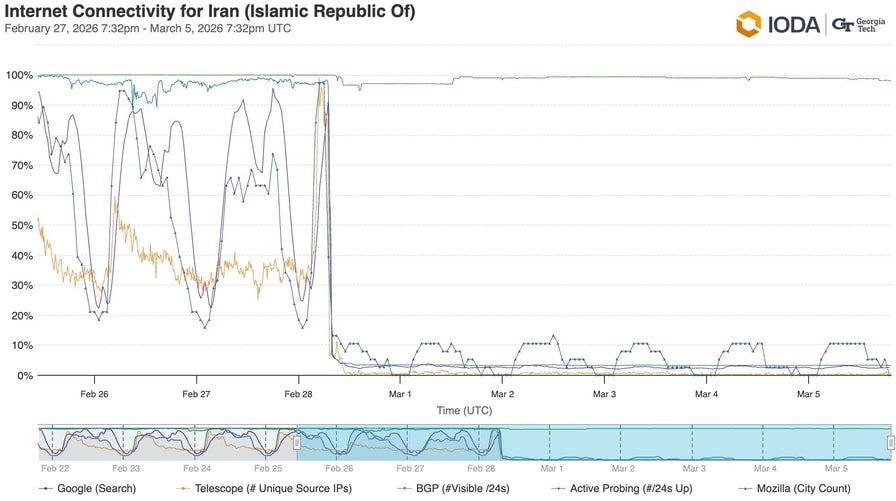

Iran’s internet formally remained part of global routing, but user activity fell almost to zero. That points to a managed restriction on citizens’ access to the external network. Source: IODA.
But in that digital darkness, one vital financial service continued to operate without interruption: Nobitex, a cryptocurrency exchange linked to Iran’s ruling elite.
We compiled the available information about the platform and tried to understand how Iranian authorities use it, what investigations by analytics firms have revealed, and why, despite all these findings, the exchange is still not on OFAC’s SDN List.
The scale and scope of Iran’s crypto giant
Nobitex is far from a niche platform. While estimates vary, analysts agree that the asset flows moving through the exchange are measured in the billions of dollars. For instance, TRM Labs recorded an observed volume of approximately $5 billion between 2025 and March 2026.

Earlier, Chainalysis noted that asset inflows to Nobitex addresses exceeded the combined figure for Iran’s 10 other largest exchanges. Source: Chainalysis.
Nobitex has an extensive retail user base. According to the platform’s own figures, it serves about 11 million Iranians — almost 12% of the country’s population.
The exchange offers a suite of services typical for the industry: spot and margin trading, yield-bearing products, liquidity pools, digital gift cards, and even crypto-collateralized lending.
Nobitex also caters to professional market participants and institutional players. These entities are provided with specialized terms, such as increased limits and high-speed APIs.
What drew attention to the platform, however, wasn’t its retail operations. It was information suggesting Nobitex functions as a national currency gateway for a country cut off from SWIFT.
Shadow banking network
A series of investigations available online focus on how Nobitex helps the Iranian leadership evade economic sanctions.
In January 2026, Elliptic published a report detailing systematic purchases of the USDT stablecoin by Iran’s central bank. According to the company, transactions totaling at least $507 million were carried out through a broker in the UAE, with the assets sent “primarily” to Nobitex.
Since the stablecoins could be sold for rials, the regulator was effectively carrying out a foreign exchange intervention outside the international banking system.
This is far from the only use case for the exchange by the state. A recent Reuters investigation linked the platform’s founders — brothers Ali and Mohammad Kharrazi — to one of the country’s most influential political and clerical families.
The agency also established that one of the largest early investors in the exchange was Mohammad Baqer Nahvi, vice president of Safiran Airport Services — a company placed on the OFAC SDN List in September 2022 for organizing flights to supply Iranian drones to Russia.
Separately, Elliptic and Chainalysis have documented Nobitex’s links to wallets associated with Hamas, the Houthi Ansar Allah movement, the propaganda outlet Gaza Now and the sanctioned Russian exchange Garantex.
The exchange itself appears to have built its infrastructure from the outset for operating under sanctions.
In June 2025, the platform’s source code and portions of its internal documentation were leaked online. According to this data, the code contained modules for generating stealth addresses, transaction batching and splitting, endpoint switching, and specific logic designed to bypass compliance checks. A document titled “Nobitex Privacy” was also made public, explicitly describing a strategy to evade FinCEN tools and Western blockchain analytics.
Half measures or strategic restraint?
In April 2026, reports surfaced that Iranian entities were charging vessel operators fees in cryptocurrency for unobstructed passage through the Strait of Hormuz. Cryptocurrency has reportedly become one of the primary payment options for these transactions.
The practice appears to have been quite successful, suggesting that digital assets will continue to be used for similar purposes.
Against this backdrop, adding Nobitex to the SDN List by analogy with Garantex may seem like a logical step, even though such flows usually don’t pass through retail platforms. Yet that hasn’t happened.
The U.S. Treasury Department has previously sanctioned Iran-linked cryptocurrency exchanges, but those platforms were registered in the United Kingdom. Nobitex, by contrast, is incorporated in Iran as a purely local company.
Crucially, on the same day Reuters published its investigation into Nobitex, OFAC clarified that Iranian digital asset exchanges are already considered blocked financial institutions, regardless of whether they are individually named on the SDN List.
For a platform physically based in Iran, however, this has little practical effect: its core operations revolve around Iranian users and neutral foreign intermediaries.
An SDN listing functions differently. It triggers secondary sanctions against any non-U.S. counterparties worldwide, provides direct justification for bulk asset freezes by stablecoin issuers, and compels foreign exchanges and OTC desks to sever ties or risk being designated themselves.
Why an individual SDN listing may be redundant
The U.S. Treasury has not explained why an individual SDN listing for Nobitex has not followed. However, it is worth noting that the department has never added platforms incorporated within Iran to the list — and there are several of them.
OFAC’s strategy toward Iran’s local crypto market is built around targeted measures. Three main approaches stand out:
- Sanctions against specific addresses.
- Designation of exchange houses — a recent example being the addition of exchanges allegedly servicing the state’s shadow oil revenues.
- Designation of individuals and OTC brokers.
When it comes to Nobitex itself, any explanation can only be speculative. The first has already been outlined: OFAC employs a different strategy toward local Iranian platforms, and Nobitex simply falls within that logic rather than outside it.
The U.S. Treasury may also consider such measures redundant. As previously noted, U.S. persons are already prohibited from transacting with Iranian exchanges; from the standpoint of formal access, an individual listing adds little to existing restrictions.
There is also the “human shield” hypothesis. Speaking to Reuters, Nick Smart, Chief Intelligence Officer at Crystal Intelligence, noted that the platform hosts a high concentration of activity from ordinary Iranians. He suggested that separating the regime from the citizens using the exchange is nearly impossible, as their assets are commingled.
In this context, the Garantex case looks like the opposite scenario: the platform operated as a B2B hub for shadow capital. That made it possible to physically seize its servers without causing social damage to retail users.
There is no direct public confirmation that this is the logic holding OFAC back.
Finally, a strike against Nobitex may be viewed as less effective without a simultaneous move against external “exits.” The value of sanctions arises not at the “entry point,” but where funds leave the country: foreign exchanges, stablecoin issuers, OTC brokers, banks, and other intermediaries.
The double-edged sword
The Nobitex case is another reminder that the mass adoption the industry dreams of is a double-edged sword.
On one hand, the exchange gives Iranians cut off from the world a measure of financial freedom: a way to shield savings from rial inflation and retain at least some access to dollar liquidity. On the other, the state uses the same infrastructure for its own purposes, ranging from central bank currency interventions to transfers to regional proxies.
The key point is that this is no longer an isolated practice. Chainalysis places Iran alongside Russia and North Korea, noting that for all three states, “what were once experimental and opportunistic tactics have matured into institutionalized strategies embedded within national economic and security policy.”
The Iranian model — a mass retail platform based in an unreachable territory coupled with offshore proxy structures — looks like a working template. Future sanctioned regimes will likely look to this experience.
That raises a reverse question — this time for regulators themselves.
What is the acceptable cost of sanctions pressure when the regime’s funds and the savings of millions of ordinary users are physically commingled on a single platform? Can the assets of 11 million people be frozen to cut off the state’s financial channel — or is that precisely the line the SDN mechanism, in its current form, does not cross?
OFAC has yet to provide a public answer, and the Nobitex case only sharpens the debate.