








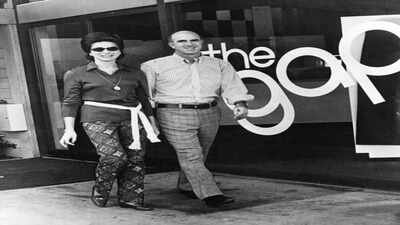
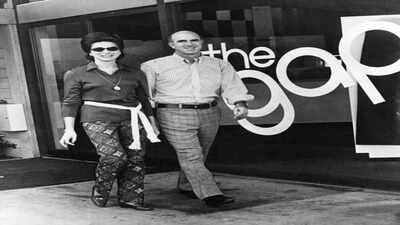
There have been times when we have found ourselves in a department store fitting room, trying on a pair we really like, but which is too loose around the waist or too long. Most people just shrug their shoulders, discard the heap of jeans they brought to try on, and exit the store without buying anything. However, way back in 1969, there was an American real estate developer by the name of Donald Fisher who had his light bulb moment after spending what seemed like ages in San Francisco looking for a perfect fitting pair of Levi’s.At that time, clothing stores had no particular design or layout and offered few choices concerning sizing. Fisher’s basic but uncompromising philosophy was: if an adult male with money cannot find quality jeans, something must be missing from the market. Therefore, along with his wife, Doris, they aimed to improve the shopping experience and eliminate the problem by establishing a shop where men could purchase pants without much hassle. What seemed like an individual frustration for the couple became the foundation of the global fashion industry.Why it is important to fill a market voidOne of the key reasons behind the success of the Fishers’ venture was that they targeted a genuine customer need instead of following a trend. During a revealing interview with Sonia Syngal, former Chief Executive Officer of Gap Inc. with the Stanford Graduate School of Business, it is clearly evident that the roots of the Gap brand are firmly planted in the generation gap of the late sixties. Don and Doris realised that a new type of consumer, the youth, had emerged due to the generation gap, and no stores were catering specifically to the new generation.The first store that was set up on Ocean Avenue in San Francisco was quite different from the normal boutiques. It was very bright and cleanly organised, with all sizes of Levi’s jeans lined next to a mountain of music records meant to attract the youth market. The combination of “records and retail” would prove to be quite clever in narrowing the culture gap. One of the things that came out clearly during the interview was that from the onset, the company had been committed to ensuring convenience for its customers. They were committed to making sure that if a person entered the store with a particular size in mind, they would get it.

Their focus on solving the “fit issue” and offering convenience democratized fashion, evolving from selling other brands to creating their own philosophy of accessible style for everyone.
This concentration on the need that the customer had allowed the brand to grow at a tremendous rate. They were not simply selling the jeans anymore, but providing the relief of being able to find a pair that stayed up without the help of a belt or a tailor to hem. This is because by focusing on solving the “fit issue,” the Fishers provided a base of trust for the firm to expand from being a local store to becoming a nationwide household name.Fashion democratised by simplificationWith the growth came evolution in more ways than just size. According to Forbes, Gap developed from simply selling other clothing brands to forming its own brand philosophy. The theme remained the same, and that was the idea of providing the freedom of fashion to everyone, regardless of who they are or what their body type is. With this theme, they made sure to cater to jeans, khakis, white t-shirts, and even hoodies.Democratisation was very appealing, as it removed the elitism associated with clothes stores. It can be noted that through focusing on simple and elegant designs, Gap became an empty canvas for individual expression. Whether you were a technology magnate or a university student, there would always be something in Gap that would suit your lifestyle. This is the highest level of evolution that Donald Fisher had envisioned when he first became frustrated with his shopping experience.These days, we do not bat an eyelid at a “big box” apparel retailer. Still, going as far back as 1969, the very concept of allocating a space to one single type of product, denim, was revolutionary. For Donald Fisher, it seemed impossible to find a pair of jeans that would suit him, and out of this little difficulty grew not only a different wardrobe but also an entirely new attitude towards shopping. This case demonstrates that some of the most successful enterprises on earth start with a fitting room experience of looking at yourself in the mirror and thinking that there must have been a better way.