






Here’s a number that might make you put down that second donut: In the United States, around 40 percent of all adults are considered obese. In Japan, the obesity rate is only one-tenth of that.
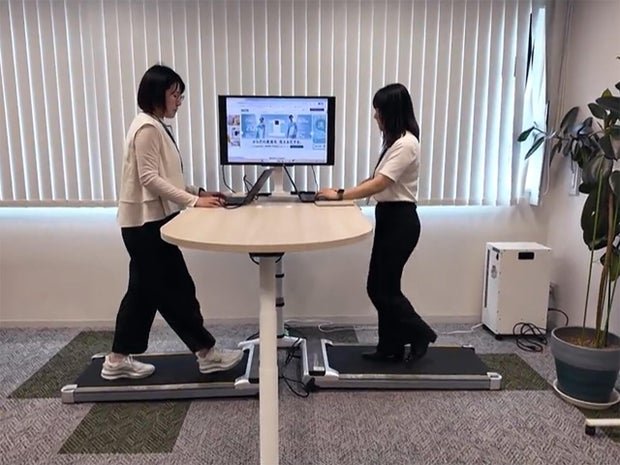
We’re not saying you’ll never see a heavy person in Japan; you’ll just need to look really hard. But compared to Americans, few Japanese ever go to a gym. They just move more in everyday life. In Tokyo, where fewer people own cars, they average at least 10,000 steps a day.
And it continues when they get to work. Like a lot of other Japanese companies, Tokyo’s Tanita Corporation is all-in on personal fitness. Even a routine business meeting can be a chance to get your steps in.
CBS News 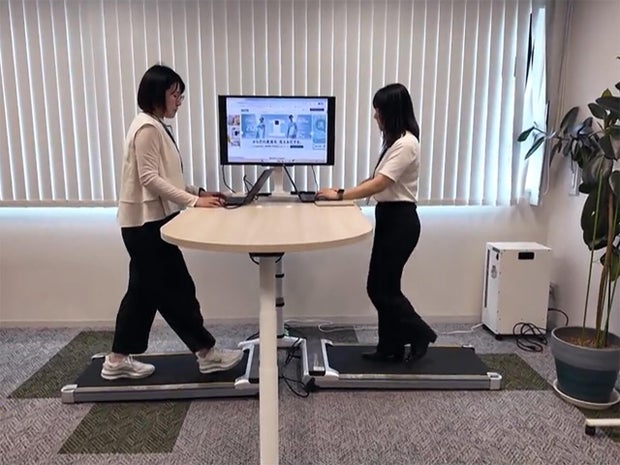
Tanita makes scales, and employees like Ito Takeshi are required to use them at least once a month. It’s a new level of accountability, but it seems to work. Takeshi says he lost 15 kilograms (about 35 pounds) after starting at Tanita. “That weight loss came from eating better and walking every day,” he said.
It’s just part of the job, according to CEO Senri Tanida. Unlike in America, where people might not want to share their weight or BMI with anyone (let alone their employer), Tanida said, “In Japan, sharing your weight or the number of steps you’ve taken isn’t something that people necessarily want to hide. So, the hurdles to getting the Japanese to agree are pretty, pretty low.”
It might seem extreme, but if Tanita doesn’t weigh and measure employees over 40, their national health insurance payments go up, so it is mandatory for anyone who wears the Tanita badge.
And that company ID isn’t your standard employee badge; it measures how many steps you’ve taken in any given day. It also knows if you haven’t weighed yourself on the scale for the last month. If you haven’t done so, you will get locked out of the building.
Hara hachi bu
And then, there’s the matter of what Japanese eat. The traditional Japanese diet is pretty basic: rice, miso soup, and pickled vegetables. The fermentation in the miso and pickles is good for a healthy gut.
Legendary Japanese culinary expert Yoshiharu Doi cooked us up a classic Japanese meal that included all three. “It’s through this simplicity and accessibility that we’re all able to remain healthy,” said Doi.
CBS News 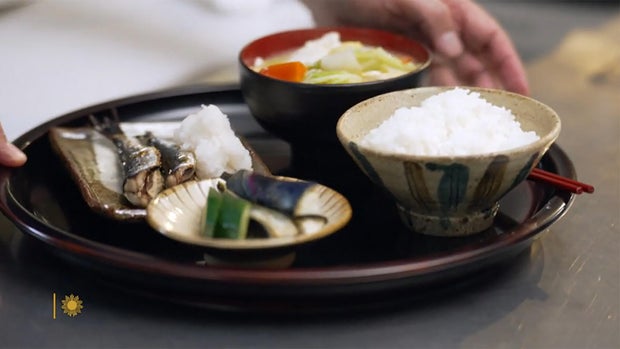
But the Japanese eat a lot more than this. In Tokyo alone, there’s plenty of fast food, and junk food. (Trust me: the donuts alone are exceptional.) Pizza is getting more popular, and so are hamburgers, made with high-grade wagyu beef.
But the Japanese tend to eat a lot less of these things. And the Japanese practice something called hara hachi bu – eating until they’re only 80 percent full.
“They love vegetables at school”
There is also an effort to teach young people healthy eating habits right from the start.
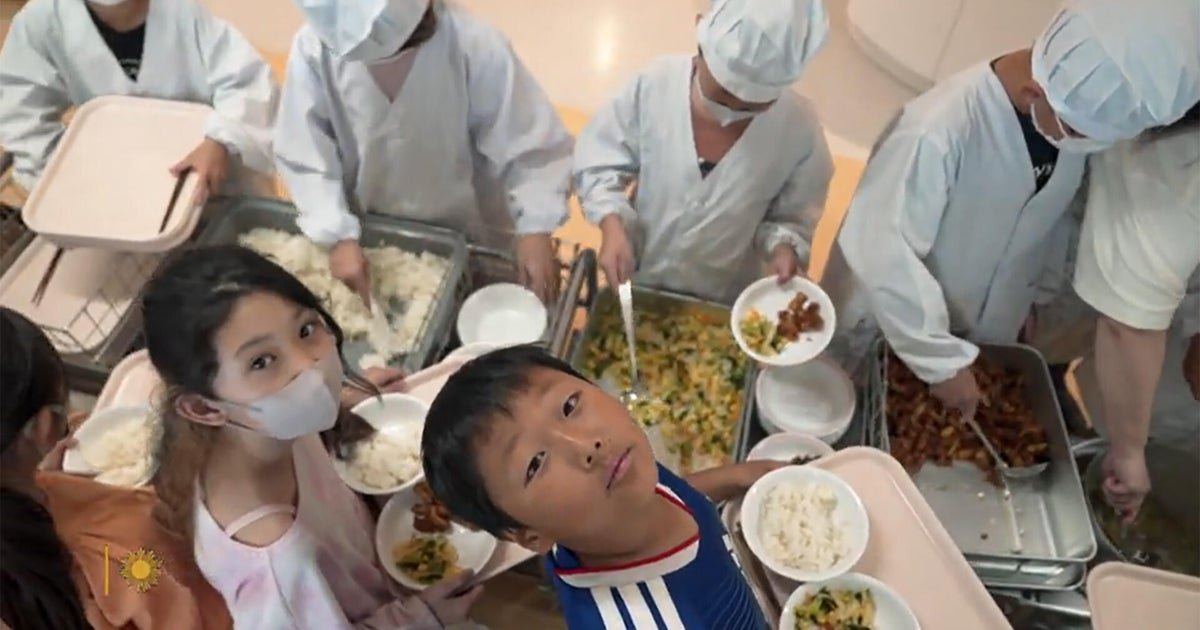
At Shikahamamirai Elementary School, by the time classes begin at 8 a.m., the staff is already making lunch in a spotless kitchen, run by people dressed like they work in a sterile microchip factory. Around here, school lunch is a big deal, and it has been for years.
Japan’s school lunch program was actually started after World War II, when the country was shattered and food was scarce. The occupying U.S. authority ordered that all schoolchildren get one good free meal a day, and when the Americans pulled out, the Japanese government kept the policy in place. So, today no kid goes hungry at school.
Most of the food is sourced locally, and delivered daily. Vegetables are always a big part of the menu, maybe the biggest. The food is cooked and tasted, and tasted again.
CBS News 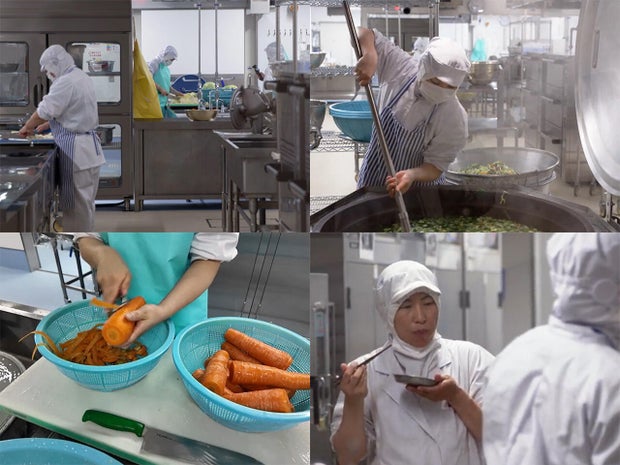
There’s a full-time, on-site nutritionist on every school campus. Shikahamamirai’s nutritionist, Kawano Komiko, said parents have told her they can’t get kids to eat vegetables at home, but they love vegetables at school.
There’s no cafeteria here; the lunch ladies cart the food up, and deliver it to the classrooms. The principal and vice principal get the first taste, and once they sign off, the feeding ballet begins.
CBS News 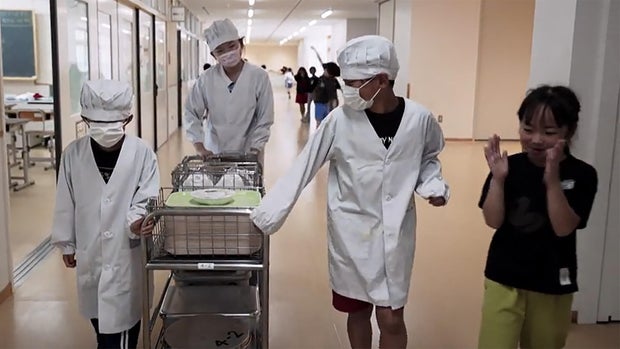
Kids suit up in sterile white smocks and collect the food carts, then wheel them back to the individual classrooms and set up a lunch line.
On the menu the day we were there: rice, blanched vegetables, soup, and a special treat, fried squid.
The school says the kids only get fried foods about twice a month. For dessert: quarter of an orange.
No one eats until everyone is served. They briefly give thanks, and then douzo meshiagare – bon appetit!
Everyone eats the same meal, including the teachers, and the guests, who may be surprised that the children have cleared their plates of these vegetables.
CBS News 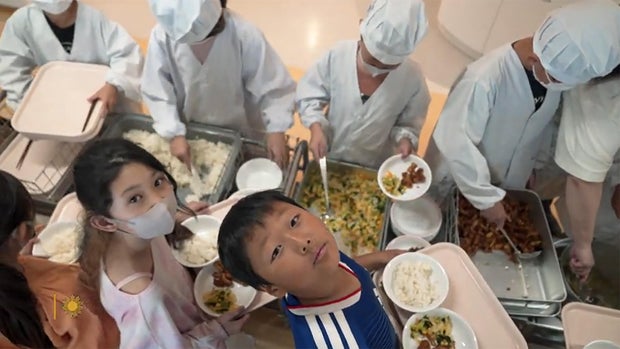
But getting kids to eat healthy is more than a skill; it’s a mission, says Komiko: “The main principle is, we want to teach kids from an early age to know how to eat so that they can carry on those life lessons through adulthood.”
In other words, she says, they just want to give their children – and Japan’s future – a taste of a healthy life.
For more info:
Story produced by John D’Amelio. Editor: Lauren Barnello.
See also: