







Washington — Every night that Congress is in session, dozens of workers inside a hulking red-brick building blocks away from the Capitol pull off an unheralded feat, laying down the first draft of the history of Congress.
At the heart of the building is a wide-open expanse, with tall ceilings and exposed ducts and rafters. Bright, industrial-strength lights illuminate printers the size of minivans, with enormous rolls of paper flying through them. The constant din of the machines is punctuated by electronic chirps and whirs.
The building houses the Government Publishing Office, the agency responsible for producing the Congressional Record. Since 1873, the Record has served as the most complete daily account of what the people’s representatives on Capitol Hill accomplished, or didn’t, chronicling the monologues and the mundanities of the legislative process with precise formatting and meticulous editing.
Its production is one of the unseen cogs in the congressional machine — known by few, but depended upon by many. The process begins with the words spoken on the floor of the House and Senate. The work to compile it largely happens as the rest of Washington sleeps. It arrives, with little fanfare, like a newspaper on the Capitol’s doorstep every day.
This is how it comes together.
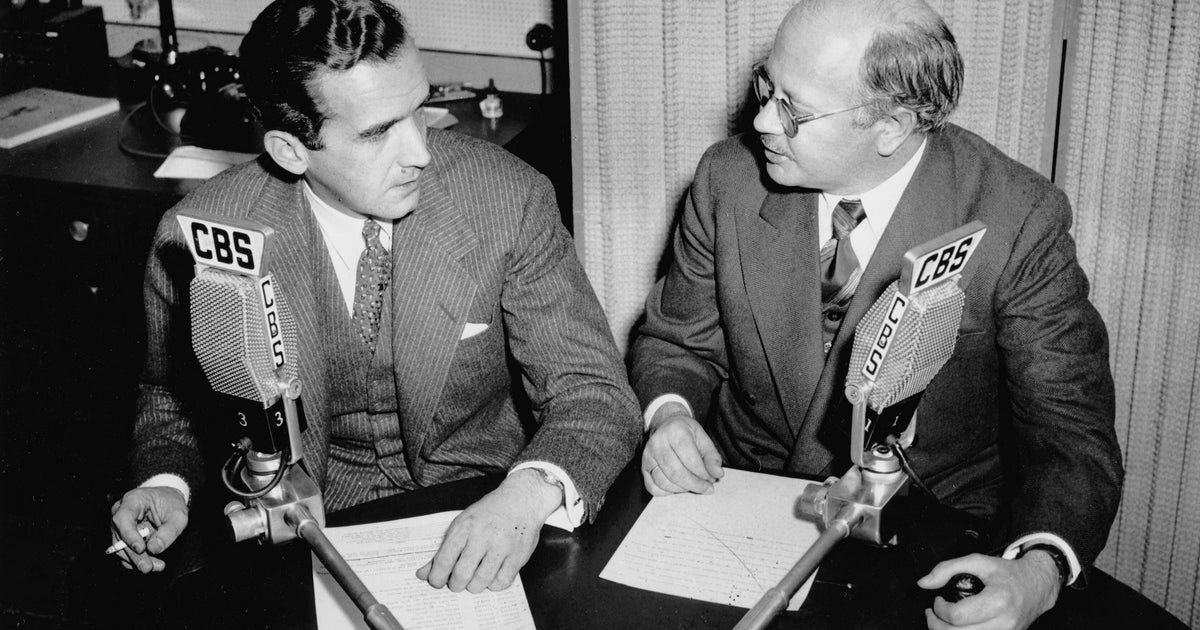
A “substantially verbatim” account of Congress
Kaia Hubbard / CBS News 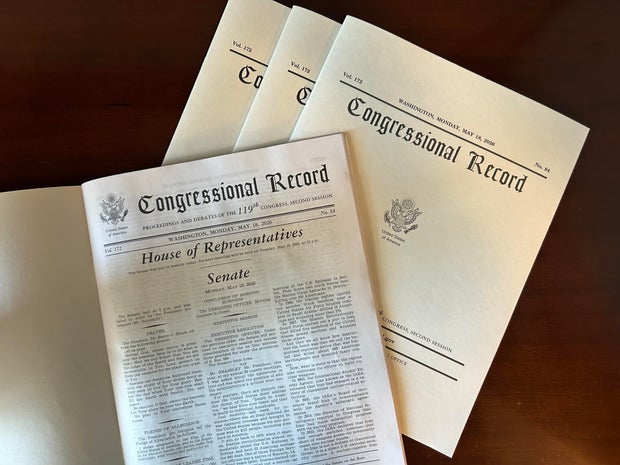
Between the first Congress in 1789 and the lead-up to the Congressional Record’s first publication in 1873, information on the internal workings of the legislative branch was sparse. A smattering of coverage by newspaper reporters made up a piecemeal account of the floor proceedings.
“There was definitely a demand for what was going on on the floor of Congress,” said Daniel Holt, an associate Senate historian. “The problem was that there wasn’t a mechanism in place.”
A number of publications sought to fill that void, operating with a notably different dynamic than is shared between reporters and lawmakers today. One prominent newsman shared a snuff box with the vice president on the Senate floor.
Ultimately, frustration with incomplete and partisan accounts of what happened in the Capitol fueled a push for a more formal operation. On March 5, 1873, the Government Publishing Office produced the first copy of the Congressional Record, dedicated to chronicling what happened in the House and Senate.
There are “few documents more important than the Congressional Record,” Lyndon B. Johnson, then the Senate majority leader, said in 1956.
“Locked in its pages are the debate, the resolutions, the bills, the memorials, the petitions, and the legislative actions that are the reason for the existence of the Senate [and the House],” Johnson said. “It is a document which affects our laws, our precedents, and our judicial decisions.”
FPG / Getty Images 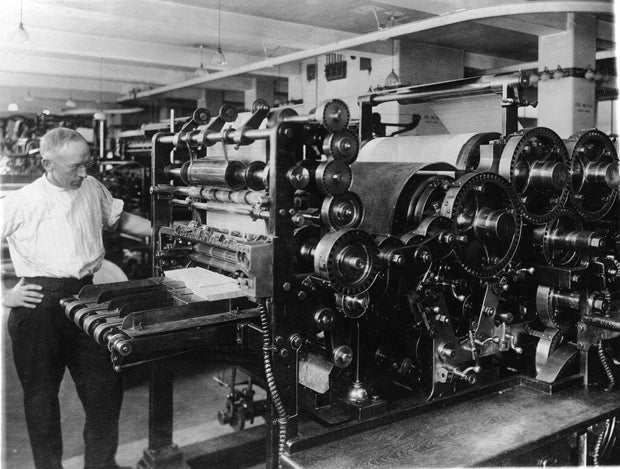
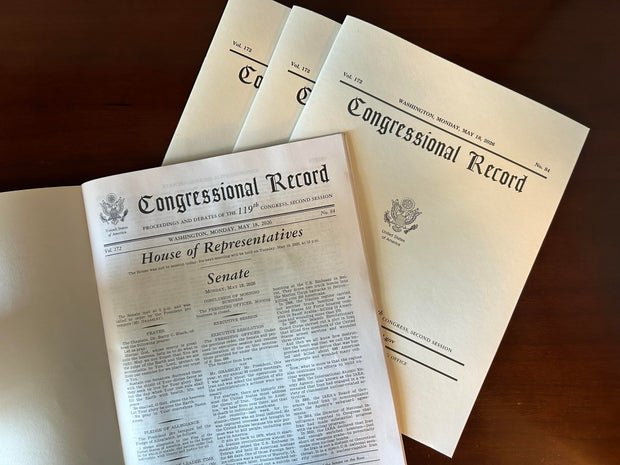
It does not beg to be read. It’s printed on 11 x 8.5 inch paper, with a formal cover affixed with the U.S. seal. Its thickness depends on how active Congress was the day before. On April 29, when both chambers were in session, the Record ran for 233 pages. On May 4, when both chambers were on recess and met in pro forma sessions, the Record was 22 pages.
Across its four sections, it offers a “substantially verbatim” account of the happenings on Capitol Hill, with everything said and done on the floor of each chamber, divided into three columns per page. It has a “Daily Digest” of chamber action and committee meetings, and a section for extensions of remarks, which allows House members to submit words they never spoke aloud on the floor — tributes to high school sports teams, their favorite recipes, the marking of anniversaries and so on.
The inclusion of words that were not spoken on the floor has served as the source of controversy for decades, underscoring the importance of what gets in the Record and what does not. In 1972, Rep. Hale Boggs of Louisiana died in a plane crash. Two days later, a speech attributed to him appeared in the Record.
“He obviously didn’t do that two days after he had passed. He did the arrangements before he was leaving town,” Holt said. “But this led to that question of, ‘OK, what is in the Record, and how is it related to what is actually said on the floor of Congress?'”
The chambers implemented formatting changes to indicate when a speech had been added to the Record. But lawmakers could work around those by simply delivering the beginning of their remarks on the floor and submitting the rest for inclusion later. Further reforms followed in the 1980s.
“The rules were essentially put in place that said speeches can still be edited for clarity and things of that sort, but they ought to not be edited for substance,” Holt said.
When cameras were introduced in the House in 1979 and in the Senate in 1986, the Congressional Record was no longer the sole account of the chambers’ inner workings. But it continued to give readers a fuller picture of the proceedings.
“Ultimately, the point of it is still what it’s always been, which is to provide readers with as comprehensive as possible record of the issues and debates about them and the different viewpoints that go into the lawmaking process,” Holt said.
The making of the Congressional Record
These days, the process of creating the Record begins in the Capitol, where every floor speech and action in each chamber is logged from gavel to gavel.
When a lawmaker speaks, a rotating team of floor reporters take down every word in shorthand. On the Senate floor, they can be seen maneuvering skillfully around lawmakers with stenotype machines hanging from their necks. Working in 15-minute shifts, they can tap 225 words per minute.
Off the floor, the reporters work with editors, called scopists, to convert their stenographic notes into polished documents. For every 15 minutes of floor time, the process takes about an hour and a half in the House, and between two and three hours in the Senate. Additional rounds of editing follow, and the transcripts are ultimately compiled with vote tallies, committee reports and other materials.
The process then moves up North Capitol Street, to the headquarters of the Government Publishing Office, where some 70 employees are involved in getting the final product out the door. Once the world’s largest printing plant, the GPO is housed in a seven-story red-brick Romanesque Revival building constructed in 1903. The building sits on the same spot that housed the GPO when it was established on the day of Abraham Lincoln’s inauguration in 1861.
Ajay Suresh / Flickr 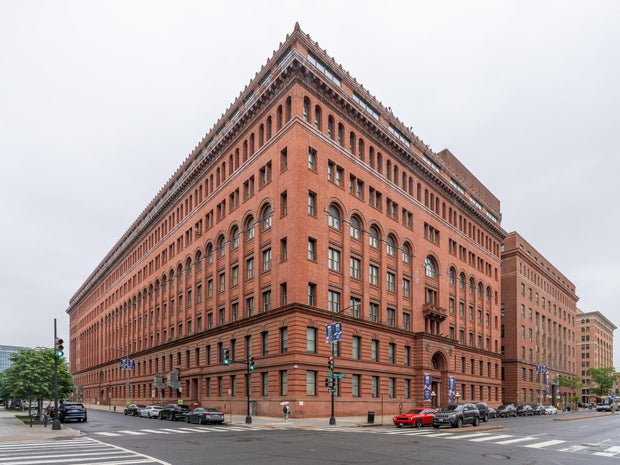
Once editing is finished on the Hill, the team of specialists sends the material to the GPO, both digitally and in paper form. Messengers carry stacks of paper from the Capitol to the GPO over the course of the afternoon and evening.
It’s not unusual for the copies to arrive with additions scrawled in the margins or on sticky notes directing a change. If there’s a discrepancy, it’s the paper copy that wins out.
“The document of record is paper,” GPO Director Hugh Halpern told CBS News on a recent tour of the facilities. “They invest over there in a lot of computers and software and all of that kind of stuff. But ultimately, if you were looking for the source of truth, it is paper.”
The GPO’s congressional customer service office serves as the intake point for material from the Hill. It’s an unassuming office space. A board hanging below a clock on the wall notes when the chambers gaveled out of session, when copy has been received and how many pages came in. Most importantly, it specifies when the House and Senate convene next. The GPO aims to complete the Record before lawmakers come in the following morning.
Kaia Hubbard / CBS News 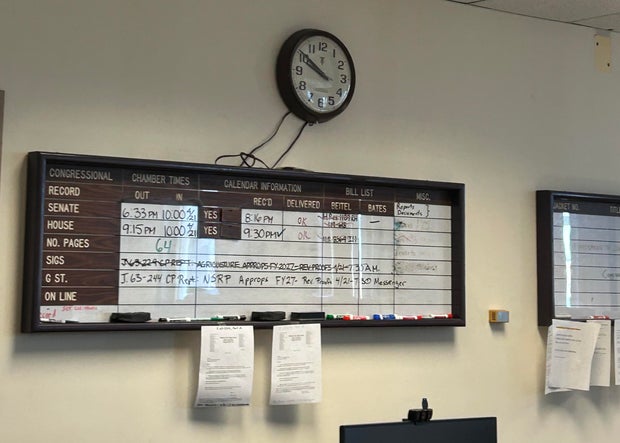
“We want to make sure that the Congressional Record is on time — that’s our number one priority,” said Natalya Panyan, who works in the customer service office.
The staffers communicate with official reporters and legislative clerks and check that all the documents are accounted for. The documents are then taken into the proof room, where workers are tasked with making sense of the stacks of pages sent up from the Hill. They compare the pages to digital files and mark them up with formatting instructions before a new round of corrections.
Stepping into the proof room is like entering a newsroom from a bygone era, with mountains of papers riddled with red markings and eyes poring meticulously over every page. It runs 24 hours a day, five or six days out of the week.
Work on the Congressional Record in the proof room starts late. Most of it is done between 3:30 p.m. and 6 a.m. The workers receive a number of “drops” of copy from each chamber throughout the evening. They get to work, grabbing copy from the “takeout counter” and beginning their mark-up process. The proofreaders use a series of red stamps to denote all the stylistic elements of the page, following intricate formatting rules for each section of the Congressional Record.
On a bulletin board labeled “improvement opportunities,” printouts remind the proofreaders to avoid common pitfalls: “Rep. Brittany Pettersen NOT Petterson,” one page says. Another reminds proofreaders to watch out for the capitalization in Rep. Chip Roy’s first name when it stands alone. Buckets labeled for the Record’s sections — “Senate,” “House” and “Digest” — hang from the sides of desks to collect pages.
Kaia Hubbard / CBS News 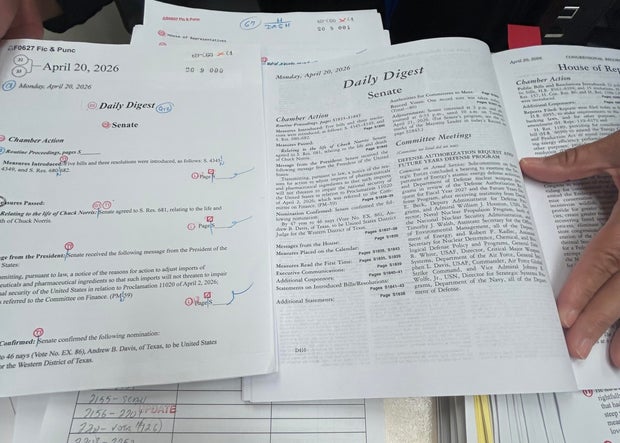
“It takes a particular type of person who’s got both the skill, attention to detail and, frankly, disposition to do this kind of really detail-oriented work,” Halpern said.
By the time the third shift comes in for the night, “it’s like an orchestra,” one proofreader, Darlene Rios-Bay, said. “Everybody is doing their part.”
Workers elsewhere in the proof room enter the formatting information into the electronic files to ensure they match, before they’re posted online and sent to the printers.
Another floor of the GPO building houses the printing operation. It’s a massive space where voices must ascend to new levels to overcome the whir of the machines. The scents of warm paper and ink swirl together. And despite the modern machines, the history of the space — lined in faded brick and tile — is palpable. The room was built to accommodate rows of heavy, metal rotary printing presses of another era. Soaring windows were needed to let in light and illuminate the space.
Kaia Hubbard / CBS News 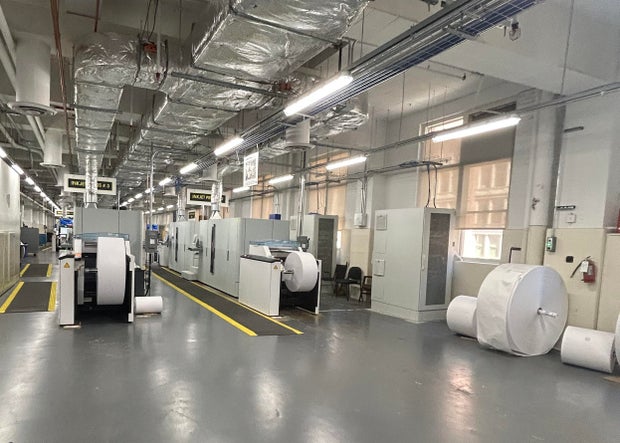
Three different kinds of machines are responsible for printing the Congressional Record. While one printer spits out the thick, off-white covers, another feeds a massive roll of lightweight paper through a printer to create the Record’s double-sided pages. It’s capable of producing thousands of pages per minute. A third machine cuts, folds and staples each copy together to create the magazine-like Record, spitting out each copy in a satisfying line, ready to be delivered.
Kaia Hubbard / CBS News 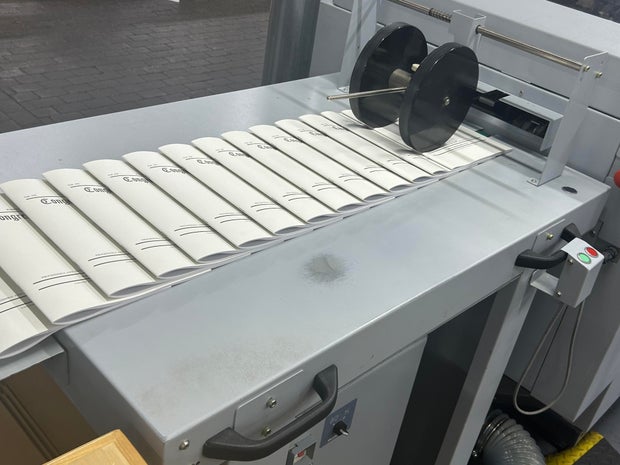
The printing process changed within the last decade from traditional presses that took eight or nine people to run, complete with metal plates and tons of waste. Now, the digital inkjet technology requires just two workers. Halpern said the process has “grown up over time.”
“It started from the beginnings of GPO in the 1860s — when we started on this very spot, where we were setting type by hand — and then to today, where the process is largely digital,” he said.
“Not going away”
In 1970, the GPO was printing nearly 50,000 copies per day, using 36 rolls of paper weighing more than 20 tons. Halpern said the number of copies fell in the 1980s and 90s to closer to 25,000 copies per day. Now, it’s about 1,500.
Most of those copies go to libraries and other institutions. But Halpern said “our primary customer is Capitol Hill — Congress.”
“There’s some folks who are still working in paper up there, but most of it is, they’re working off of our digital files,” he said.
The GPO has a major digital presence with govinfo.gov, which serves as a digital repository for all three branches of the federal government. Halpern said while many people tend to think that the agency is focused on producing paper products, most of their work is firmly situated in the 21st century.
“We do document conversion. So Congress gives us documents, whether it’s a bill or a piece of the Congressional Record or whatever, and we transform that into a digital file,” he said. “And then ultimately we output that digital file one of two ways. We either put it on the web or we create a print.”
Along with the Congressional Record, the GPO also produces a number of other products, including U.S. passports, the Federal Register, the president’s budget and the official pocket Constitution.
Looking forward, Halpern acknowledged that the Congressional Record may need to change to meet the times.
“It is an intricate process. It’s something that’s been evolving over time, and frankly, it’s something that’s not going away, and we need to sort of envision what that next generation, what that new Congressional Record looks like,” Halpern said. “We’re not there yet, that’s sort of the kind of thing that’s whispered about as we go along, but we’ve been making the investments.”
Chip Somodevilla / Getty Images 
The GPO takes its cues from Congress. Halpern said they’ve made the investments to ensure they’re ready to execute when Capitol Hill comes calling. The agency is working on modernizing its publishing system to streamline the document conversion process and move away from a software that Halpern said came out when he was 12.
“I am a long way from 12,” he said. “So we are in the process of replacing that piece of software.”
Halpern said he gets a lot of questions about AI, but “we have not yet found a technology that can replace one of our trained proofreaders.”
“Eventually, I would love to see a tool that’s sort of like Grammarly on steroids, that can cut out some of the more routine work for our proofreaders,” he said. “But we still haven’t found a good substitute for having these highly trained human beings in the loop.”
Standing in the massive expanse of the printing space, his voice competing with the din of the machines, Halpern said the operation’s evolution “has been a journey.”
“We’re still on that journey,” he said. “But it’s going in the right direction.”