







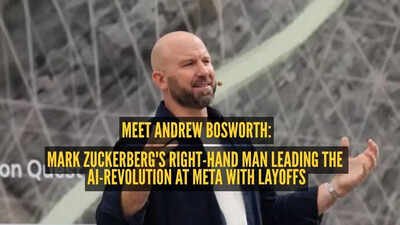
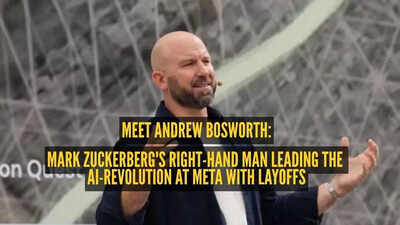
He is here to lead the AI revolution at Meta and as Mark Zuckerberg‘s strongest soldier, he is ready to slash jobs and invade professional privacy, essentially, do all it takes.At Meta, tensions have been high. The company has recently laid off 8,000 employees, roughly 10% of its global workforce. Before this, employees were told their keystrokes and mouse clicks would be recorded to help train AI agents to use computers, more like humans training their own replacements. While some baulked at the data collection, others initiated a petition asking the company to drop it.But when Chief Technology Officer, Andrew Bosworth stepped in, offering no apologies, not many could protest. He refused those who asked to opt out and asked people to stop opening personal emails on company devices if they were worried about privacy invasion. Who is he and what is he here for?
Leading Meta
“Boz” as they call him, has been the top lieutenant of Chief Executive Mark Zuckerberg for more than 20 years. His outspokenness and style have made him a controversy magnet along with becoming a useful heat shield for his boss.When Zuckerberg was convinced that a virtual reality “metaverse” was Facebook‘s future, Bosworth was put in charge of the initiative. When Meta said it was developing battlefield technology for American soldiers, Bosworth joined the Army Reserve. Thus, when the billionaire wanted to transform Meta into a global AI giant, Bosworth was given the reins.As of now, the 6-foot-2 executive stands to make nearly $1 billion if he is able to increase the company’s market capitalisation by 500% in the next five years. Under his new role, he has created large teams with virtually no managers and swapping out planning documents swapped out planning documents for working prototypes. “We’re already seeing some tasks that used to take hours now take minutes and soon we won’t need to be in the loop on some tasks at all,” Bosworth wrote to WSJ.
Who is Andrew Bosworth?
Andrew Bosworth was raised on his family’s horse ranch in Saratoga, California and grew up alongside agriculture and the state’s 4-H youth program.At 10, he knew how to code and went on to attend Harvard University to become a teaching assistant in a computer science course. In what one could call a happy fate or a successful AI prompt, one of the students assigned to his section was a young Mark Zuckerberg, with the class being Intro to AI.Two weeks after the class’s finals, Facebook was launched. While most early employees at Facebook dropped out, Bosworth stayed around and finished his degree. He went on to work at Microsoft as a software design engineer before joining Facebook in 2006.Within months, Bosworth was at the helm of News Feed, the scroll of posts that now defined social-media sites. Its introduction provoked an outcry among users who felt their privacy had been violated but sent engagement soaring.When Zuckerberg wanted to transition Facebook from desktop to phones, Bosworth was approached for the advertising. Bosworth knew little about digital advertising at the time, recalled Alex Himel, one of Bosworth’s direct reports and now Meta’s vice president of wearables. “He did this big listening tour, and then he came back and said, ‘All right, here’s the plan we’re going to do,’” Himel said.
Be aware: Bosworth inside
Over the years, Bosworth has developed a reputation as a blunt, outspoken provocateur. He is the one controlling Zuckerberg’s communication with the public and the Meta employees. He pens internal corporate strategy memos, answers questions from Meta users in his weekly ask-me-anything sessions and also hosts episodes of his podcast called “Boz to the Future.”While most appreciate Bosworth’s no-nonsense personality, his abrasiveness has also landed him in trouble at times. In 2016, as the company was coming under increasing scrutiny for its growth-at-all-costs mindset, he posted an internal memo titled “The Ugly,” in which he defended its relentless pursuit, even if it made Facebook a more useful tool for cyberbullies or terrorists. “The ugly truth,” Bosworth wrote, “is that we believe in connecting people so deeply that anything that allows us to connect more people more often is *de facto* good.”The memo sparked internal backlash while also leading to online trolling when it leaked two years later. In 2016, he also wrote an anti-Trump post on his Facebook page, which was later deleted as Trump voters within the company said it made them feel unsafe.
Metaverse at the top
In 2017, Bosworth left the ads division and became head of Facebook’s augmented-reality and virtual-reality efforts—a division that would take center stage when Facebook rebranded itself as Meta in 2021. Soon, Zuckerberg was appointed as the chief technology officer. While Meta planned to launch a flagship metaverse product, a virtual-reality app for consumers called Horizon Worlds, it suffered from glitches and struggled to add and retain users.Five years later, Meta has shifted resources away from the Metaverse and focused on other bets such as AI smartglasses. As of now, Bosworth is focusing on embedding AI into Meta’s fabric. He is getting workers to use AI in more of their work and if possible, hand over tasks to it entirely. Among his new roles is overseeing an entirely new “applied AI engineering” organisation whose role is to supercharge the efforts of the researchers working to develop AI models that can compete with those from OpenAI and Anthropic.