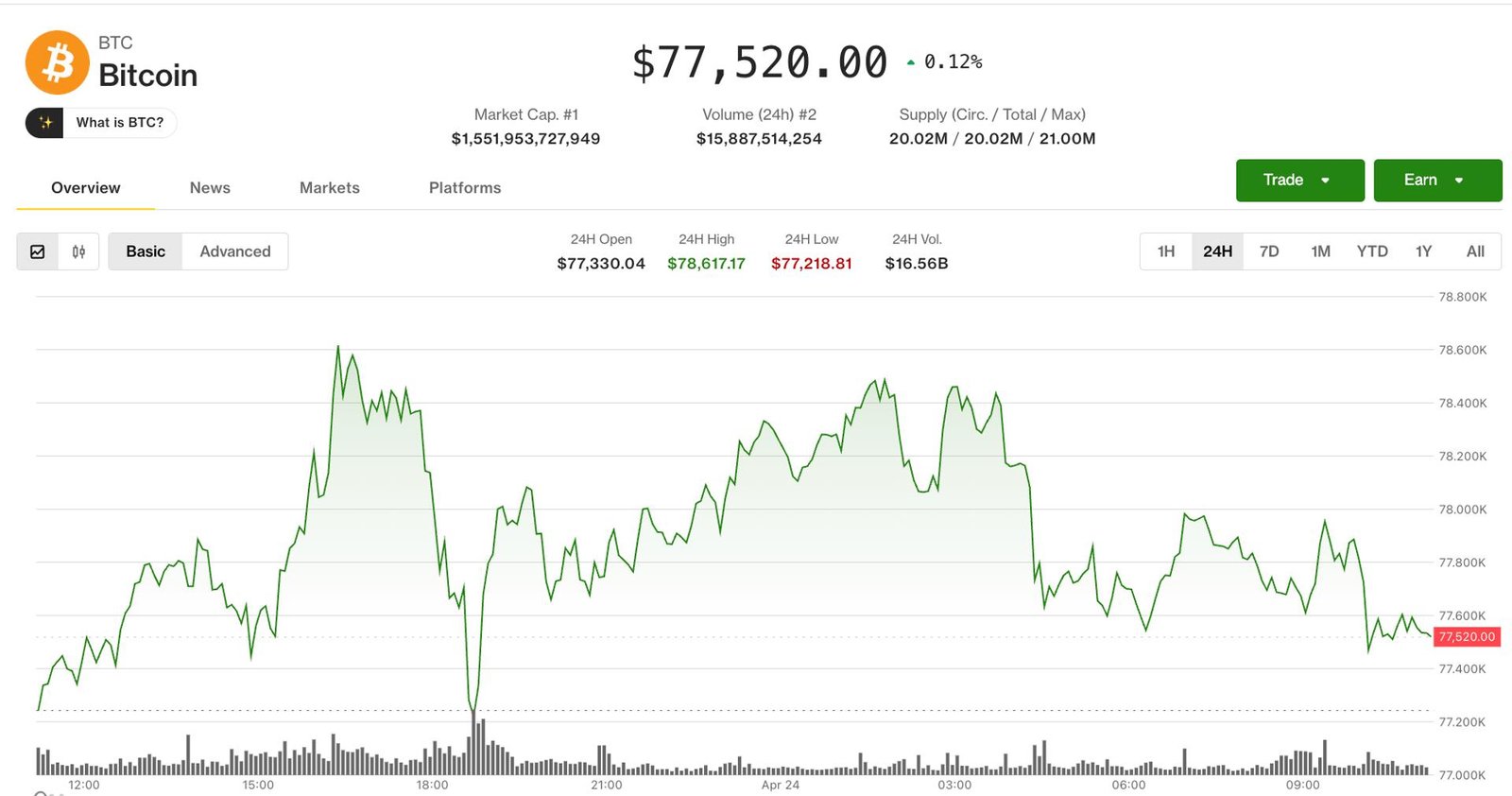










Michael Saylor, executive chairman of Strategy (MSTR), the largest publicly traded holder of bitcoin , said Thursday on X that the crypto winter is over as bitcoin held above $78,000, a price level first reached early on April 22, according to CoinDesk data.
In a Game of Thrones-style image, dressed in a fur coat, a garment not particularly suited for when the winter is over, and mounted on a horse, Saylor, whose firm recently added 13,927 bitcoin, bringing its treasury’s total BTC holdings to 780,897, said “Winter’s over”, a statement not all crypto analysts agree with.
“Even if the winter is over for bitcoin, which I don’t agree with, it is still very cold for altcoins,” said Jason Fernandes, a market analyst and AdLunam co-founder.
For Mati Greenspan, a former senior market analyst at eToro and founder of Quantum Economics, what bitcoin and the broader crypto market have experienced since the Oct. 10 “flash crash”, which triggered roughly $19 billion in forced liquidations within 24 hours, does not even qualify as a crypto winter.
“I’m not sure I would classify what we just saw as a crypto winter exactly,” Greenspan said, it was “more of a large pullback within a broader bull market.”
Greenspan agrees, however, with what Saylor appears to be suggesting: Bitcoin has reached its bottom and is likely to head higher from here. “Yes, I think it is very likely that we have seen the bottom,” he said.
Greenspan and other experts say that Saylor’s comments, along with his firm’s ongoing bitcoin purchases, suggest a transition into a more permanent institutional bitcoin era. A new cycle characterized by market dominance of corporate bitcoin treasuries and a shift in institutional sentiment.
Nation-state adoption
Even so, institutional adoption is just one piece of the puzzle.
“Yes, increased institutional adoption will kick off this next leg, but what Saylor is missing is the nation-state adoption, which is undoubtedly right around the corner,” Greenspan said.
The crypto founder and market analyst said that, to date, the crypto industry has experienced three distinct adoption cycles.
The first, he said, was driven by early adopters in 2013. And then came the “mass retail awakening of 2017,” and, now, institutional adoption in 2021.
“The fourth and final major driver is nation-state adoption, which I believe will happen very soon, especially with the U.S. abruptly flipping course during U.S. President Donald Trump’s second term,” Greenspan said.
“Imagine central banks adding bitcoin to their balance sheets to maintain price stability, similar to how they’ve added gold in the past,” he added.
To Greenspan’s point, nation-state adoption is already moving beyond theory and onto government balance sheets. Under Trump, for example, the U.S. plans for a strategic bitcoin reserve, though it is neither formalized nor operational; the government already holds roughly 300,000 BTC. El Salvador continues its daily purchase program toward a 7,500 BTC treasury, while China and the U.K. hold roughly 190,000 BTC and 61,000 BTC, respectively. Activity is also emerging at the sub-sovereign level, with entities such as Wisconsin and New Jersey introducing bitcoin exposure within public pension allocations.