





When Donald Trump lands in Beijing on May 14, the choreography will look familiar. Red carpets. Military bands. Carefully staged handshakes beneath the chandeliers of the Great Hall of the People. Washington will present the summit as another test of great-power diplomacy, a high-stakes negotiation between two rivals trying to manage a dangerous world. But by the time Trump’s aircraft touches the runway, Xi Jinping may already have secured the most important outcomes without signing a single agreement.Because the real story of the Iran war is not who fired the missiles or who claimed victory on television. It is who quietly benefited while everyone else was distracted. The United States entered the conflict promising to reassert deterrence through overwhelming force. Israel sought to cripple Iran’s military and nuclear infrastructure. Tehran fought for regime survival. Yet the country that emerged with expanding influence across Asia, fresh leverage in the Gulf, and a weakened American strategic position in the Indo-Pacific was China.
Beijing achieved this not through dramatic intervention, but through patience. While Washington burned through missile stockpiles and diplomatic capital, China positioned itself as the calm alternative: condemning escalation, talking peace, stabilising energy supplies, and deepening ties with states suddenly uncertain about American reliability.The question hanging over the summit is no longer whether China won anything from the Iran war, but how much of the emerging world order it quietly managed to win without firing a single shot.
The war China did not start
For Beijing, the US-Israeli strikes on Iran were a remarkable gift delivered without any requirement of reciprocity. Washington had been conducting negotiations with Tehran over its nuclear programme when the military option was exercised. Chinese foreign minister Wang Yi was swift and pointed in his condemnation: it was, Beijing declared, unacceptable for the US and Israel to launch attacks against Iran while negotiations were under way. The language was calibrated for the international gallery as much as for Washington. In a single statement, China had positioned itself as the defender of diplomacy against a superpower that had chosen bombs over bargaining.What followed demonstrated Beijing’s capacity for managed ambiguity. China declared itself neutral and abstained, alongside Russia, from UN Security Council resolutions targeting Iran, while simultaneously condemning Iranian attacks on Gulf states. It dispatched peace envoys, called for the reopening of the Strait of Hormuz, and hosted Iranian Foreign Minister Abbas Araghchi in Beijing just days before the Trump-Xi summit. Beijing was, in the words of one Chinese scholar, keeping good relations with the US, Israel, Iran, and the Gulf Arab states simultaneously. This is not hypocrisy. It is the foreign policy of a rising power that has learnt, from decades of observation, that moral clarity is a luxury only declining empires can afford.Beneath the diplomatic surface, the picture was more complex. US intelligence assessments indicated that Chinese dual-use technologies, including radar systems and navigation equipment exported before the war, had enhanced Iran’s electronic warfare capabilities. There were reports, denied by Beijing, of preparations to supply man-portable air-defence systems to Iran through third countries, and of BeiDou satellite navigation being used by Iranian forces. The Financial Times, citing leaked Iranian military documents, reported that the Islamic Revolutionary Guard Corps had covertly acquired a high-resolution Chinese reconnaissance satellite in late 2024. In each case, Beijing denied all and paid no significant price. Plausible deniability deployed as strategic instrument: sustaining an ally without being seen to do so.
The arithmetic of depletion
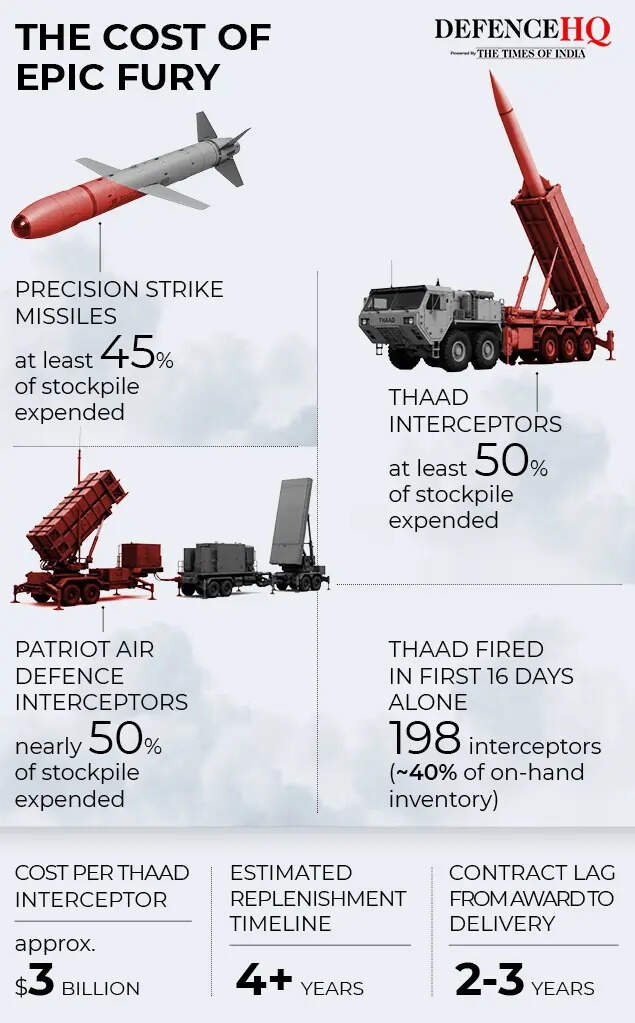
To understand China’s position at this summit, one must understand what the Iran war has done to American military credibility in the Indo-Pacific. According to analysis by the Centre for Strategic and International Studies (CSIS), over the first seven weeks of Operation Epic Fury the United States expended at least 45 per cent of its Precision Strike Missile stockpile, around half of its THAAD interceptors, and nearly 50 per cent of its Patriot air defence interceptors. In the first sixteen days alone, the US fired 198 THAAD interceptors at a unit cost of approximately $13 million each.
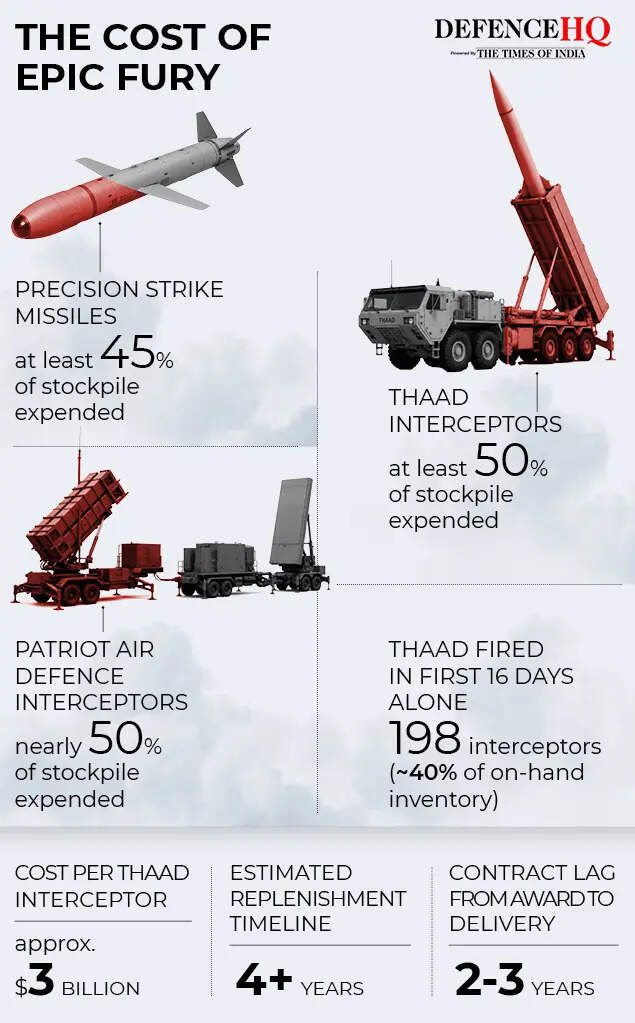
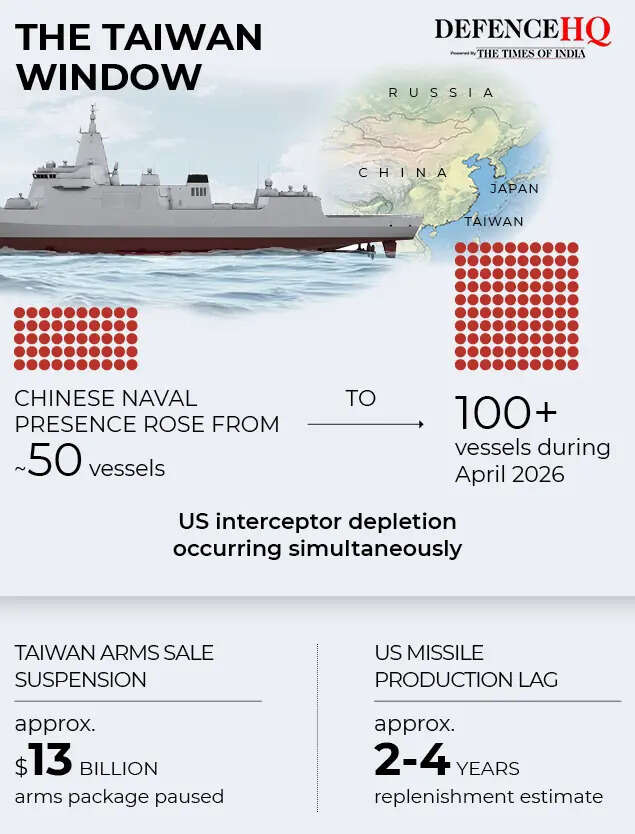
The implications for Taiwan are not theoretical. Mark Cancian, a retired Marine colonel and senior adviser at CSIS, has stated plainly that the major risk is not running out of weapons in this war, but that inventories are now inadequate for a possible conflict with China. Existing contracts show a two-to-three-year lag between award and delivery; even if Trump’s call to quadruple production of advanced weaponry is acted on immediately, the Pentagon’s own experts estimate it will take three to four years before additional volume arrives. Former congressional staffer Brandon Weichert put the timeline bluntly: if the war stopped tomorrow, it would take four or more years to replenish the depleted systems.Chinese state media has reported extensively on these stockpile numbers. During April, Chinese naval assets surrounding Taiwan nearly doubled their typical presence, rising from around 50 vessels to more than 100, while China quietly seized a small sandbank in the South China Sea. Beijing was not necessarily rehearsing an invasion. It was taking careful measure of a window. As Dr Ashok Sharma, Visiting Fellow at UNSW Canberra at the Australian Defence Force Academy, observed, “Beijing has certainly benefited from perceptions of a less predictable and less confident United States. At the same time, Beijing is deeply uncomfortable with prolonged global instability. China’s economic model depends heavily on stable trade flows, secure maritime routes, and predictable energy supplies. In that sense, Beijing wants a weakened American dominance, but not a chaotic international order that undermines global economic stability itself.”
The energy pivot
If the military dimension of the war has eroded American deterrent credibility, the energy dimension has handed China a platform for regional influence that no Belt and Road Initiative project could have manufactured. When the Strait of Hormuz was effectively closed, Beijing temporarily banned oil-product exports, squeezing Asian neighbours that depend on its refineries for jet fuel, gasoline, and diesel. Governments from Hanoi to Dhaka found themselves petitioning Beijing to blunt the war’s impact.China responded with assurances and commitments, extracting diplomatic goodwill and, in some cases, agreements to advance future renewable energy cooperation. Shipments of jet fuel from China to Vietnam increased 34 per cent in March compared with the previous month; diesel exports to the Philippines surged 187 per cent. China was not merely filling a gap. It was building dependency.Beijing has cast itself, with considerable success, as the leader of a future powered by renewable and domestically sourced energy, in sharp contrast to Trump’s embrace of oil and gas, which leaves much of the world exposed to precisely the kind of volatility the Iran war has produced. Dan Wang of the Eurasia Group has noted that Chinese officials see clean energy as a remedy to the reputational damage caused by some Belt and Road projects. Since the war began, Beijing has held high-level energy and diplomatic talks with officials from the Philippines, Australia, Vietnam, Cambodia, Laos, Thailand, Myanmar, and Bangladesh. The message has been consistent: China did not start this war, it does not want the Strait closed, and it offers an alternative. Dr Ashok Sharma argues that “China’s rise has been accelerated not only by its own discipline, but also by the diffusion of American strategic focus. The United States today is simultaneously managing conflicts across Europe, the Middle East, and the Indo-Pacific while facing domestic political polarisation and fiscal pressures. Beijing has capitalised on moments where American foreign policy appeared reactive, fragmented, or overstretched.”
The power gambit
The Iran war has been, for Beijing’s global image, a masterclass in doing well by doing relatively little. In Washington’s reading, the assault on Iran was a demonstration of resolve. In the reading of much of the Global South, it was an act of aggression against a sovereign state during active negotiations, carried out in defiance of international law. China has, with some justification, positioned itself on the latter side of that divide.Gulf states, long America’s most reliable regional partners, have begun quietly re-evaluating the security guarantees Washington offers. American bases in Gulf monarchies had come to be seen as magnets for retaliation rather than reliable shields. The old oil-for-security formula that underpinned American regional dominance for half a century has been badly shaken, and Beijing is the natural beneficiary of the resulting hedging. China brokered the restoration of diplomatic relations between Saudi Arabia and Iran in 2023 and is simultaneously finalising a free-trade agreement with the Gulf Co-operation Council. Iran has increasingly promoted the use of the yuan in oil transactions, supporting Beijing’s long-running effort to dilute dollar dominance in global energy markets. As Dr Ashok Sharma noted, “The growing use of the yuan in Iranian and regional energy trade is symbolically and strategically significant, though it does not yet represent the collapse of dollar dominance. What we are witnessing is not an immediate replacement of the dollar, but the gradual emergence of parallel financial mechanisms that reduce dependence on Western-controlled systems.”
The Taiwan trap: What Xi really wants
Taiwan is, in the words of Chinese Foreign Minister Wang Yi, the biggest risk in China-US relations and China’s core of core interests. Before Trump’s aircraft even landed, the results of Beijing’s pre-summit pressure had already been significant. Trump suspended a $13 billion arms sale to Taiwan, agreed to sell Nvidia’s advanced AI chips to China, and stated publicly in February that he would discuss Taiwan arms sales with Xi Jinping. According to Dr Ashok Sharma, “The suspension of the Taiwan arms package, relaxation on Nvidia chip exports, and Trump’s willingness to openly discuss Taiwan-related concessions with Xi Jinping all contribute to an atmosphere that Beijing can interpret as diplomatic leverage in its favour. From China’s perspective, this signals that Washington may be increasingly willing to negotiate on issues Beijing considers part of its core sovereignty concerns.”
Zack Cooper of the American Enterprise Institute has warned that even discussion of a pause on arms sales could damage confidence in the US among the Taiwanese population and prove detrimental to cross-strait stability. Taiwan’s ruling Democratic Progressive Party is experiencing low approval ratings and political deadlock, while the China-friendly Kuomintang is gaining ground, fed in part by doubts about American reliability. This plays directly into what Dr Ashok Sharma describes as Beijing’s longer-term strategy. As he explains, “China’s approach toward Taiwan is fundamentally gradualist and long-term in nature. Beijing appears to prefer a strategy of sustained pressure through diplomatic isolation, economic dependence, cyber operations, information warfare, and grey-zone coercion rather than rushing toward an immediate full-scale invasion. China’s strategy appears designed to shape the environment gradually until reunification becomes strategically easier or politically unavoidable.”Beijing does not need to invade Taiwan to win. It needs only to make the cost of American protection seem uncertain, the price of accommodation seem reasonable, and the gap between Washington’s promises and its follow-through seem wide. The Iran war has done more to advance each of those objectives than any number of military exercises in the Taiwan Strait.
The grand paradox
China has not won the Iran war. It has not needed to. It has gained energy leverage across Asia, diplomatic mileage across the Global South, a tighter grip on the yuan’s international role, a demonstrably weakened American weapons stockpile, and an increasingly hesitant Taiwanese political class. It also has a US president arriving in Beijing not from a position of strength, but from one of strategic need. Trump wants cooperation on Iran. He wants the Strait reopened. He wants a win he can sell at home.Yet the paradox is genuine. As Foreign Affairs observed, Xi has obtained both what he most desired, a United States that is less reliable, less confident, and less capable, and what he most feared: a more volatile international system. The disruption to the Strait of Hormuz, through which half of China’s oil and nearly a third of its liquefied natural gas imports pass, imposed its own costs. Chinese crude imports from the Gulf fell 25 per cent in March. Beijing’s influence with Iran remains limited; it was Pakistan, not China, that provided the practical channel for the fragile April ceasefire. Even so, Dr Ashok Sharma argues that “the Trump-Xi summit also reflects the emergence of a new phase in China-US relations defined less by outright Cold War ideology and more by competitive coexistence. The Taiwan question is no longer only about Taiwan itself. It has become connected to technology competition, semiconductor supply chains, artificial intelligence, maritime security, critical minerals, and the future balance of power in the Indo-Pacific.”
What’s next
History often remembers wars through the images of destruction they leave behind: burning cities, missile trails, toppled leaders. But the real winners are not always the ones standing on the battlefield when the smoke clears. Sometimes they are the powers sitting just beyond it, watching rivals exhaust themselves while quietly expanding their own room to manoeuvre.That is the uncomfortable truth shadowing Trump’s arrival in Beijing. China did not defeat the United States in the Iran war. It did something potentially more significant. It allowed Washington to weaken itself. Every depleted interceptor battery, every nervous Gulf ally, every fresh doubt in Taipei about American reliability widened opportunities Beijing did not need to create itself.