







There’s a moment about five seconds into Michael when the artist’s familiar “hee-hee” blares and the Michael Jackson Estate logo flashes on screen. It’s a small thing, but it tells you a lot. Before the film even begins, it quietly draws a line around what this story will and won’t be.
I kept thinking about that as the movie moved along, not because I expected some kind of exposé (I didn’t), but because even within its own carefully chosen boundaries, the film feels strangely uninterested in exploring the psyche of the man at its center.
A Childhood Sketched But Not Understood
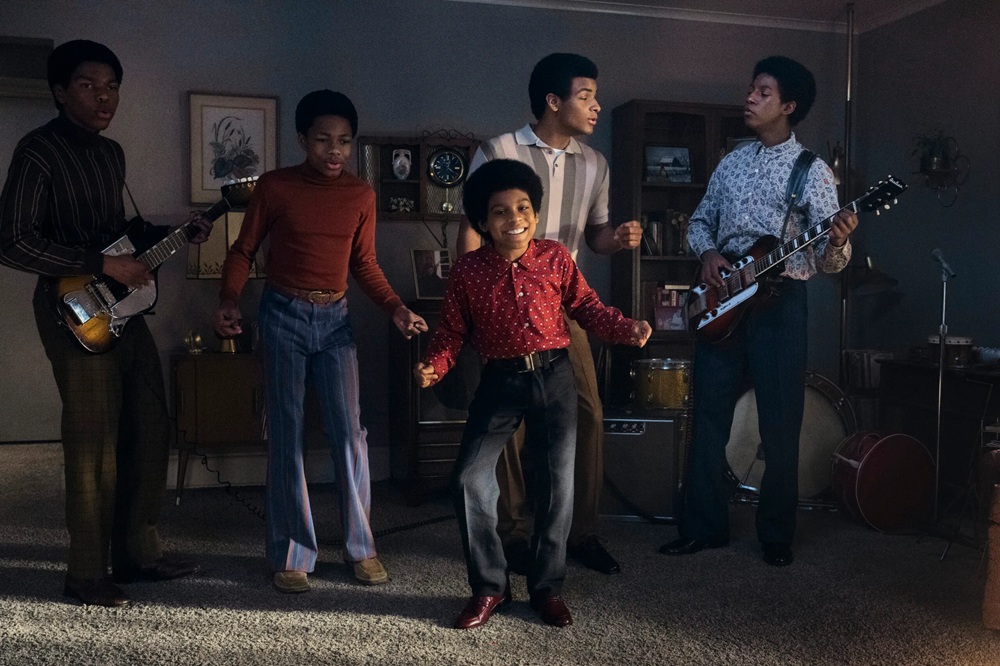
The film opens in 1966, in Gary, Indiana, with a young Michael Jackson already set apart. He watches from the window as kids his age play with snow outside, while he stays in rehearsing with his brothers under the strict eye of their father Joseph. It’s a strong image. You immediately get what director Antoine Fuqua is going for: Michael as the odd one out, the prodigy who doesn’t quite belong.
But the film stops there. It doesn’t push into the “why” of that isolation. His mother Katherine’s faith as a devout Jehovah’s Witness, which could have deepened that sense of distance, barely factors in. What we get instead is something simpler, and thinner: he’s special, no one understands him apart from his family, so he’s alone.
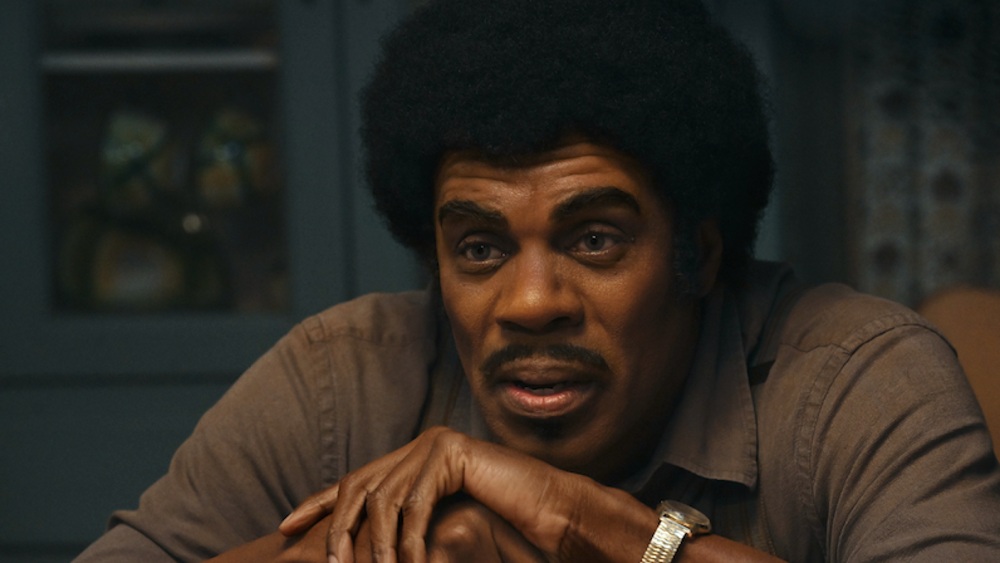
Granted, there are flashes of something more grounded. Colman Domingo’s Joseph Jackson is harsh, sometimes frightening, defined by the belt, the insults, the constant pressure to win. The abuse is not hidden, and you can see how it might shape Michael’s sense of self—the fixation on his appearance, the need for control, the fear of failure. But even here, the film reduces Joseph into something blunt. He’s less a person than an agreed-upon villain. Domingo tries to find something human in him, but the writing doesn’t meet him halfway.
The quieter moments with Nia Long as matriarch Katherine come closer to landing. There’s a softness in those scenes, a sense of someone trying to hold a family together without fully confronting what’s happening inside it. For a few minutes, the film breathes. Then it moves on.
A By-the-Numbers Biopic That Plays Like a Checklist
And boy, does it really keep moving. Years pass in what feels like minutes. The Jackson 5 finally break through. Motown comes calling. Berry Gordy especially sees the potential in young Michael, whom he claims sings “Who’s Lovin’ You” better than Smokey Robinson ever did. Suddenly we’re in Encino, then into the solo years, then into Off the Wall, then Thriller. It becomes a blur of milestones, each one ticking by before it has time to land. The structure is chronological, but it doesn’t build. It just piles one moment on top of another.
That pace might have worked if the film had a strong point of view. Instead, it often feels like it’s assembling a highlight reel than a proper story. The music carries it, as expected. You can’t deny the pull of those songs—those songs still hit. The problem, however, is everything around them. John Logan’s screenplay features scenes that feel like filler between performances, something even Quincy Jones would likely have taken issue with.
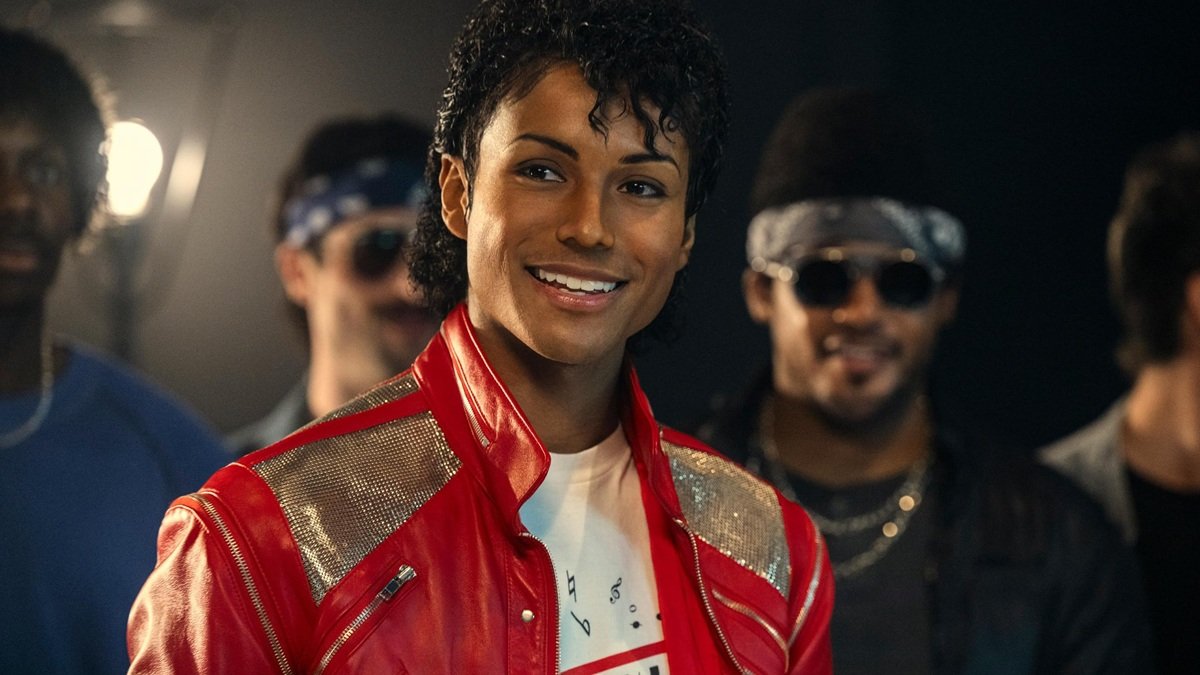
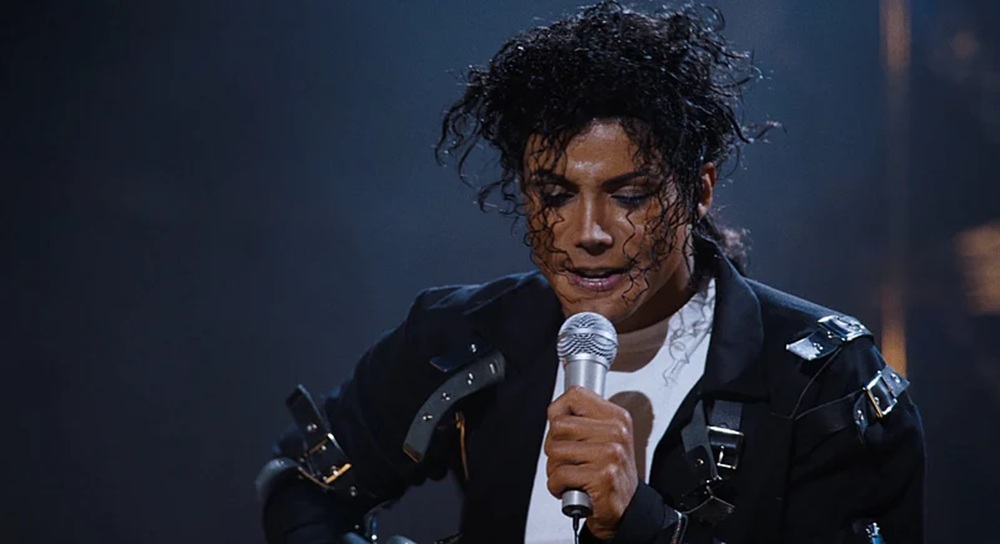
Jaafar Jackson, playing his uncle as an adult, is one of the few reasons the film stays watchable at all. He has the physicality down—the movements, the voice, the small gestures—and there are moments where something flickers through, especially in quieter beats where he isn’t asked to simply replicate what we already know. You get a sense of the vulnerability, the fragility beneath the performance. Juliano Krue Valdi does solid work as the younger Michael, too. But both performances feel contained. There’s only so far they can go when the film refuses to dig any deeper.
The movie gestures at Michael’s arrested development—his closeness to animals, his reliance on his bodyguard, the sense that his world becomes smaller even as his fame grows—but it never stays long enough to explore it. There’s a sadness there, or at least the outline of one. Then the film cuts away.
The Music Is There. The Meaning Isn’t
The same thing happens with the music, and this is where the film really started to lose me.
For a film about one of the most detail-oriented artists in pop history, there’s surprisingly little interest in how that music was actually made. Songs are used to signal emotional or artistic growth, but the choices don’t always hold up. “Human Nature” plays over a moment meant to reflect his deepening perspective seeing gang violence dominate the local news, even though he didn’t write it. “I Can’t Help It” is used in a similar way. These might be details that are tolerable for most, but for me these aren’t just minor nitpicks. They flatten the distinction between performer and creator, which matters when you’re telling the story of someone as involved in his work as Michael Jackson was.
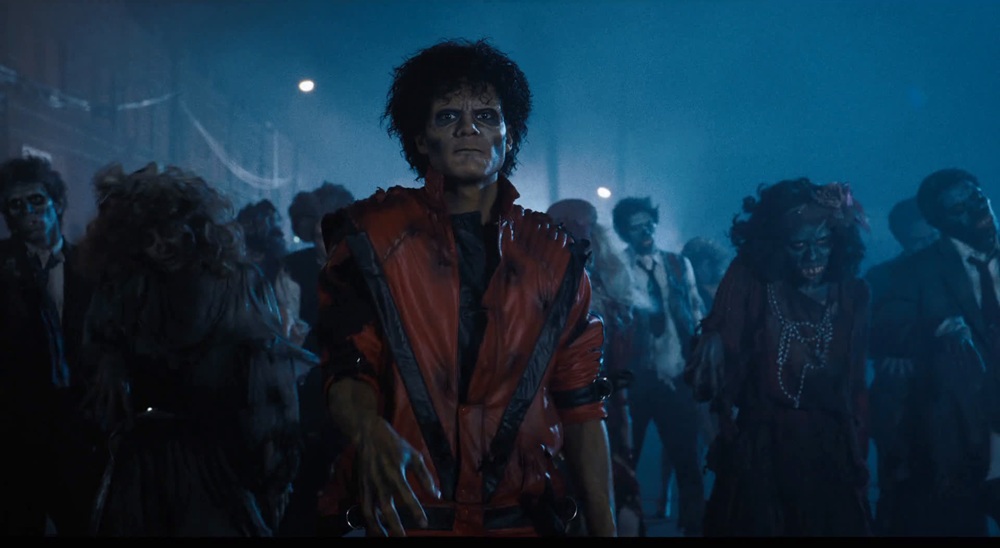
Then there’s Thriller. The film builds toward it, celebrates it…and just moves on. Rod Temperton, who wrote the title track and who also featured prominently in Off the Wall, is barely acknowledged beyond a passing mention. The musicians who helped shape the album’s sound—members of Toto, Eddie Van Halen—don’t register at all. It turns a collaborative process into something that feels oddly solitary, which runs against the reality of how that music came together.
At a certain point, it becomes clear what the film is more comfortable doing: recreating moments we already recognize. The Motown 25 performance. The making of “Beat It.” The Pepsi commercial accident. They’re all here, staged cleanly, sometimes energetically. But there’s little sense of discovery in how they’re presented.
‘Michael’: A Concert Film in Disguise
That extends to the film’s overall shape, too. Too often, Michael feels like a concert film trying to pass itself off as a biopic. The performance sequences have energy, but the rest of it drags. John Ottman, who worked on Bohemian Rhapsody, is part of the editing team here, and you can feel that same push-and-pull. When the music is playing, the film snaps into motion. When it isn’t, the pacing slackens, and scenes start to feel like placeholders.
The casting choices don’t always help either. Miles Teller shows up as a John Cusack-looking John Branca for a handful of scenes, delivers some basic exposition, and disappears. It’s the kind of role that could have been played by anyone. Bringing in a recognizable actor for something that thin ends up feeling less like a creative decision and more like a marketing one.
None of this feels careless, exactly. If anything, it feels overly careful. You can sense that Fuqua holds Michael Jackson in high regard. Truth be told, I felt that the film is made with affection. It wants to honor a man’s legacy. But that respect turns into caution, and that caution keeps the film from taking any real risks.
The Importance of Visual Language Befitting the Central Character
Which raises a bigger question: was Fuqua the right filmmaker for this? Maybe that’s subjective. But when you think about someone like Baz Luhrmann and what he brought to Elvis—the style, the excess, the sense of scale—it’s hard not to feel that this story needed a stronger visual voice. Michael Jackson wasn’t just a performer. He was an architect of image and sound. A film about him should reflect that. This one just doesn’t.
Finally, there’s the absence that hangs over everything, which guarantees to generate heavy discourse. The film ends in the late ’80s, before the most difficult chapters of Jackson’s life begin. I understand the legal realities. I also understand the argument that a film can choose its scope. But this doesn’t feel like a deliberate framing choice. It feels like avoidance, not just of the allegations, but of anything that might complicate the image the film is trying to preserve.
I can see the argument that maybe we should see the film where it stands, that it’s meant to be a streamlined, accessible version of the story, something closer to a celebration than an interrogation. Fair enough. But even by that standard, it comes up short. A film like I’m Not There (Bob Dylan) or Love & Mercy (Brian Wilson) doesn’t just present an artist’s life; it finds a way into it, either technically or emotionally. Unfortunately, Michael never quite gets there.
A Serviceable, But Ultimately Disappointing, Middle-of-the-Road Biopic
As a musical experience, Michael works in bursts. Hearing those songs again, seeing them staged on a big screen, there’s still a rush. It’s hard to resist that. But once the music fades, there isn’t much left to hold onto.
And maybe that’s what makes it frustrating. This is a story that could have gone in any number of directions: messy, contradictory, unresolved. Instead, it settles for something safe and pre-approved, something that keeps you at a distance from the very person it’s about.
I grew up with this music. A lot of people did. Which makes my disappointment with Michael land a little harder. Not because the film avoids certain things, but because it barely seems interested in saying anything new at all.


A self-described cinephile who can’t stop talking—and writing—about films. Paul also moonlights as ghostwriter and editor for a few memoirs. He currently resides in the Philippines.