








Sometimes history isn’t rewritten by war, or revolution, or policies hammered out over years. Sometimes, all it takes is a poet turning down a royal medal. Or a king saying love means more than being king. Or someone simply stepping out of a spaceship and realizing they’re floating above Earth.June 3 is one of those dates where all sorts of memorable things, from different corners of human experience, seem to collide. Politics, music, science, sports, heartbreak — it’s all here.Over the past century, June 3 has witnessed some of the world’s most consequential moments. It was the day Rabindranath Tagore received a British knighthood, which he would later renounce in protest. It saw racial tensions explode in Los Angeles during the Zoot Suit Riots. It marked the announcement of the Partition Plan that would redraw South Asia’s map forever. It was the day an American astronaut walked in space, proving humanity could survive outside a spacecraft. It also brought cultural milestones, including the release of Bob Marley’s iconic ‘Exodus’ album, and moments of profound loss, such as the passing away of boxing legend Muhammad Ali.Let’s travel through time for a look at some of the moments that put June 3 on the map.
1915: Rabindranath Tagore receives a Knighthood
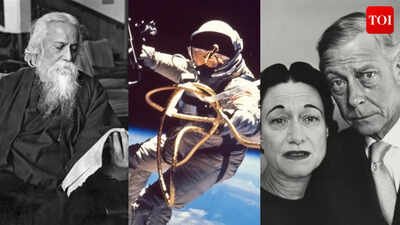
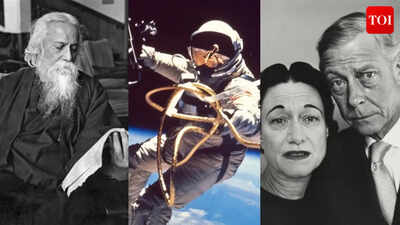
Back in 1915, on June 3, Rabindranath Tagore, the poet who had just captured the attention of the whole world as the first non-European to take home the Nobel Prize for Literature, landed himself a knighthood from King George V on the occasion of the King’s Birthday Honours. The British Empire famously loved honoring its world-renowned subjects, especially someone as widely admired as Tagore.But this wasn’t just the story of a poet getting an award. In 1919, after British troops killed hundreds of unarmed Indians in Amritsar, Tagore rejected his knighthood in protest. That moment became a legend, which still remains a symbol of saying “no” to colonial rule, and a quiet sort of rebellion that mattered just as much, if not more, than any speech or slogan.
1937: A King gives up his throne for love
If you ask people about love stories that changed history, many might mention the story of Edward VIII and Wallis Simpson — especially if you’ve watched ‘The Crown’ and gotten a peek into it. On June 3, 1937, Edward finally married Wallis, who was an American and a divorcee, six months after abdicating the British throne. Britain wasn’t ready for a divorced woman as queen, and so, faced with a choice, Edward chose Wallis. It was a war between love and the Crown, and love won!His abdication in 1936 threw British politics into tricky chaos and eventually led to Elizabeth II taking the throne through his father, King George VI. In a way, Edward’s abdication paved the way for the longest reign of a monarch in the history of Britain. And even now, almost 90 years later, people still fiddle around with the question: What if Edward hadn’t given up the throne for love? Then again, what would you not give up for love!
1943: The Zoot Suit Riots expose America’s racial tensions
June 3, 1943, wasn’t just about clothing. The Zoot Suit Riots broke out in Los Angeles, and violence erupted as US servicemen clashed with Mexican American youth, most wearing those flashy, oversized zoot suits. Black and Filipino youths also got caught up in the assault. The riots weren’t just about clothes; they exposed the deep, ugly roots of racism in wartime America and forced the country to confront what was happening in its own backyard. Historians today view the zoot riots as an important chapter in the struggle for civil rights, highlighting how prejudice, discrimination, and media stereotyping contributed to violence against minority communities.
1947: Lord Mountbatten’s announcement of partition
Out of all June 3 moments, none hit South Asia like what happened in 1947. On this day, British Viceroy Lord Louis Mountbatten formally announced the plan for the Partition of British India. The proposal laid the groundwork for the creation of two independent nations: India and Pakistan. Mountbatten also visited what would soon become Pakistan as part of the final negotiations surrounding the end of British rule. What followed was one of the biggest migrations in history. Nearly 14 million people moved. Families lost homes overnight. Hundreds of thousands died in the violence that followed.Decades later, that line drawn on the map still shapes lives and geopolitics in the region, echoing every June 3.
1965: America spacewalks for the first time
On June 3, 1965, NASA astronaut Ed White opened his spacecraft, Gemini 4’s hatch, and, for 23 minutes, floated in space, becoming the first American to do so. Ed drifted, guided by a small maneuvering gun, and watched the Earth turn below.Using a handheld maneuvering device, White drifted above Earth while tethered to the spacecraft. The achievement came during the intense Cold War Space Race between the United States and the Soviet Union.He was so thrilled, the folks at Mission Control had to pretty much beg him to come back inside. After his spacewalk, White reportedly called it “the saddest moment” of his life, and it’s hard to blame him.
1977: Bob Marley releases ‘Exodus’
If you love music, especially revolutionary music that leaves its imprints behind, June 3, 1977, matters a great deal. On that day, Bob Marley and the Wailers released ‘Exodus’. Marley was living in London, recovering from an assassination attempt. Out of all that pain (and hope), he gave the world classics like ‘Jamming’, ‘Three Little Birds’, and ‘One Love’. The album blended reggae rhythms with themes of spirituality, resilience, exile, and hope.Nearly fifty years on, people still play those tracks. Reggae and Marley’s message ripple around the globe, tying June 3 to a sound and spirit that refuses to fade.
1985: India introduces the five-day workweek
June 3, 1985, for India wasn’t dramatic, but it changed everyday life for millions. On June 3, 1985, the Government of India introduced a five-day workweek for civil administrative offices. The reform gave government employees Saturdays and Sundays off, bringing public-sector work schedules closer to international norms. The decision affected millions of workers and helped shape modern workplace culture in India.For generations of government employees, it fundamentally changed the rhythm of professional and family life.
1989: Tiananmen Square crackdown begins
The night of June 3, 1989, Beijing’s Tiananmen Square turned violent and deadly. For weeks, students and citizens had gathered in Beijing demanding political reforms, greater accountability, and democratic freedoms. As troops moved into the city, protests that had captivated international attention ended in violence. The exact death toll remains disputed, but the crackdown became one of the most significant and controversial events in modern Chinese history.Today, the world remembers the image of the unidentified ‘Tank Man’ — a lone man blocking a line of tanks. That single act became a lasting image of courage, and a warning about the risks of speaking out.
2016: Muhammad Ali passes away
On June 3, 2016, Muhammad Ali died at 74 in Scottsdale, Arizona. Ali wasn’t just a champion boxer. The globally known American Olympic champion, a civil rights advocate, and a cultural icon fought for civil rights, refused to serve in the Vietnam War, and spent decades inspiring and infuriating the world in equal measure. With his cultural influence and political resistance, Ali became one of the defining figures of the twentieth century. The three-time heavyweight champion of the world’s influence transcended boxing. Even today, his famous declaration, “I am the greatest,” feels less like a boast and more like a statement of historical fact.