









Ethereum co-founder Vitalik Buterin on Wednesday outlined near-term steps the network is taking to bring privacy onchain, a feature institutions highlighted at Consensus Hong Kong as necessary for widespread institutional adoption of the blockchain technology.
Buterin’s X post was technically dense but pointed to a simple fact: the world’s largest smart contract blockchain is moving to make private transactions a feature of the network, not a workaround provided by third-party tools.
The post comes as the Ethereum Foundation, the non-profit organization that supports the blockchain’s network and ecosystem, faces a wave of high-profile departures amid an internal transition tied to a new organizational mandate to redefine its role within Ethereum.
The three new short-term initiatives are: Account abstraction (AA) and FOCIL, Keyed nonces and access layer work. Each of the three adds a different layer of privacy to Ethereum.
Here is what each one actually does:
Uncensorable private transactions
As of now, if a user sends a private transaction on Ethereum via crypto mixers such as Tornado Cash, it first goes into the public memory pool (mempool), a sort of waiting area visible to everyone on the network. Imagine dropping a letter into a post office where every worker can read the address before finalizing which one to move for delivery.
Similarly, Ethereum entities that decide which transactions make it into each block can see those transactions and exclude them, which amounts to censorship.
FOCIL, or fork-choice enforced inclusion lists, makes censorship harder by allowing a committee of validators to propose a list of transactions that block builders are expected to include. Ignoring these transactions can lead to the block being rejected by the network. This way, it becomes difficult to censor transactions.
Meanwhile, account abstraction upgrades how Ethereum accounts work. Today, most Ethereum users rely on externally owned accounts (EOAs) via apps like a basic MetaMask, Trust Wallet, or Coinbase Wallet, each controlled by a single private key. If a user loses that key, they lose access to their funds.
Account abstraction enables all accounts to behave like programmable smart contracts, providing features such as multi-signature approvals and social recovery. It also lets apps or friends pay a user’s transaction fees.
Keyed ‘nonces’
Every Ethereum account has a nonce, a number used once. It acts as a running tally of all proposed transactions, increasing by 1 with each new transaction sent. This setup helps prevent the same transaction from being repeated on the network.
It’s like getting a sequentially numbered ticket at a food counter. But it comes with a problem. Even if an order is private, anyone watching can see that ticket #5 and ticket #6 came from the same person. On Ethereum, this sequential nonce allows observers to link transactions to the same account, even if the transactions are private and their contents are hidden.
The fix for that is keyed nonces. This replaces the single counter with a structure that comprises a nonce key and a nonce sequence, giving each account multiple separate ticket counters for different types of activities. This makes it harder to track the transaction trail and correlate them onchain.
“This replaces the single sender nonce with (nonce_key, nonce_seq), giving frame transactions independent replay domains,” pseudonymous researcher soispoke.eth said.
Access-layer work: private reads and Kohaku
The third proposed measure addresses the issue that even if transactions are private, users’ browsing behavior on the network is not. Imagine making a private phone call. Nobody heard the conversation, but the telecommunications firm knows who made the call and to whom.
Similarly, every time a user queries the blockchain to check a balance or read a smart contract, their wallet relies on third-party RPC node providers, exposing their IP address, physical location, and complete wallet identity to corporate servers that log this data.
Central to this effort is Kohaku, an open-source privacy toolkit introduced in 2025. Rather than eliminating reliance on RPC node providers entirely, Kohaku gives wallet developers tools to query blockchain data privately, using techniques such as private information retrieval, so nodes can answer queries without learning which specific data the user requested.
‘ETH’s utility value’
Ethereum has long had privacy as a goal, but it has not been a native feature. The new initiatives, if they go live, could serve as a positive catalyst for ether (ETH), the native token of Ethereum.
The plan for the new privacy initiatives isn’t just a narrative; the market is validating it too.
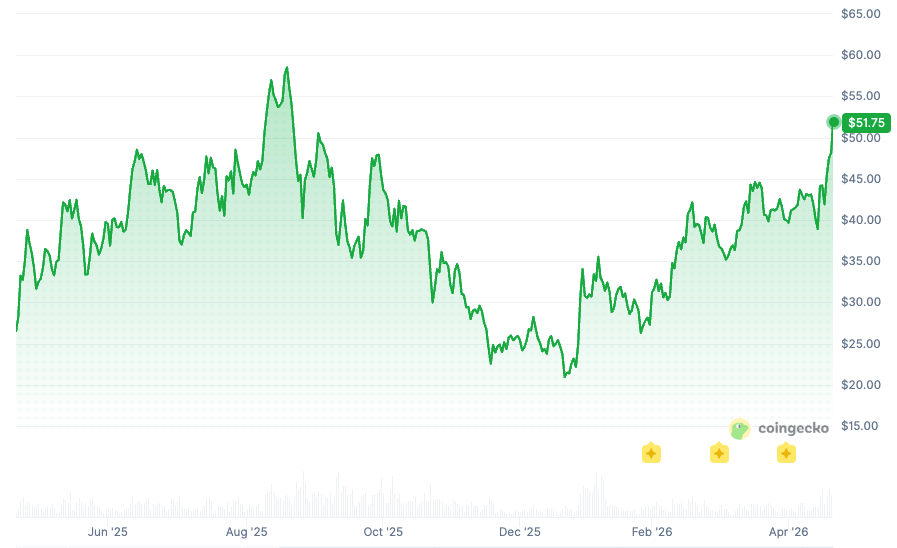
Valuations of established privacy-focused projects have surged, reflecting genuine demand. For example, Zcash (ZEC) has rallied more than 800% since early last year, pushing its market capitalization to roughly $9.85 billion. Meanwhile, Monero (XMR), despite frequent criticism for its use by bad actors on darknet markets and for terror funding, has also rallied by more than 100% in the same timeframe.
Bitcoin , the market leader, has declined by more than 5% over the same period.
One X user explained Ethereum’s need for privacy best: “Ethereum’s missing component at this point is some form of native privacy. ETH’s utility value would literally jump overnight. Privacy is the type of feature that can give an asset true moneyness qualities. L1 privacy could also drive a surge in mainnet fees.”
None of these changes is live yet, but Tuesday’s post is a meaningful signal about where things are headed next.