






Polish cryptocurrency exchange Zondacrypto’s problems just keep mounting.
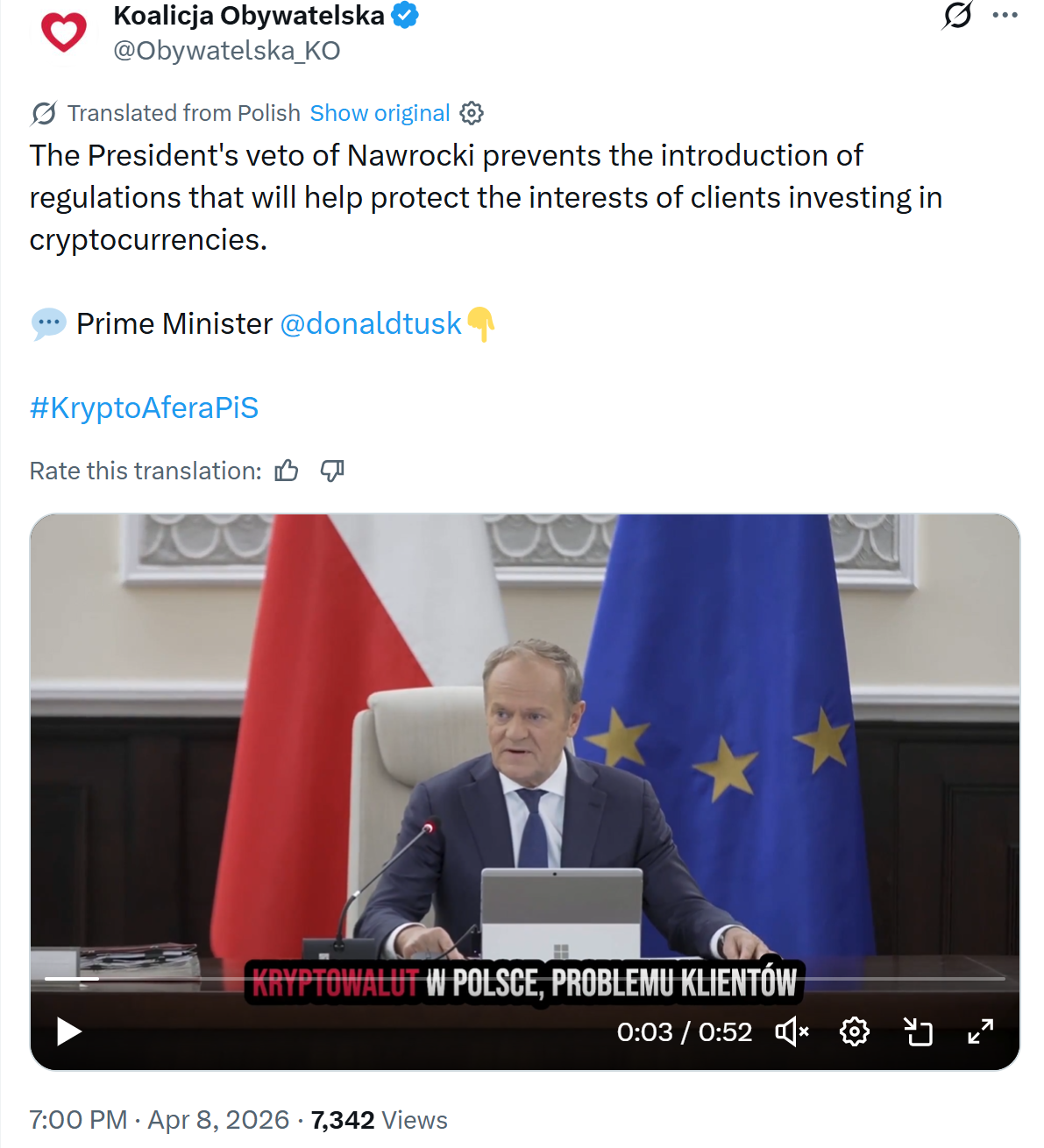
Already under fire following reports of frozen or delayed customer withdrawals, the company on Friday drew the ire of Prime Minister Donald Tusk, who told parliament the company had sponsored some politicians who opposed crypto market regulation.
Blocking the legislation by some politicians showed they were toeing Zondacrypto’s line, Tusk said before a vote to overturn President Karol Nawrocki’s veto of the law, according to a report by AP. The exchange has links to Russia and had previously provided the lawmakers with financial support, he said.
Tusk’s comments came a day after Zondacrypto CEO Przemysław Kral turned to X to defuse allegations the company was helping itself to investors’ funds to bulk up its declining reserves.
In a statement and video published on the platform, Kral said the exchange had sufficient reserves, and owns a bitcoin wallet holding about 4,500 BTC, about $330 million. There is a problem, though: It can’t access the funds because the previous owner didn’t hand over the private key and has now disappeared.
Delayed withdrawals
Kral said he revealed the wallet address to “cut short the unfounded accusations of alleged misappropriation of funds.” The key was not handed over by former CEO Sylwester Suszek in 2021, when ownership of the exchange, then known as BitBay, transferred and Kral took over. Suszek has been missing for four years.
Zondacrypto has faced reports of frozen or delayed customer withdrawals since late March, according to local news reports. Kral denied any misuse of client funds and said the exchange remains profitable. He publicized the inaccessible wallet to prove the exchange has reserves, he said.
Kral framed the situation as part of a broader campaign against the company, according to an AI translation of his Polish video. He pointed to supposed political pressure, regulatory interference and coordinated media coverage that contributed to a surge in withdrawal requests.
Analysis conducted by blockchain intelligence firm Recoveris and cited by local news outlets found that bitcoin balances in hot wallets tied to Zonda have dropped by about 99% since mid-2024. At one point, Kral threatened legal action against Polish news outlets covering the situation.
The furor revives the long-running controversy surrounding the company.
Polish investigative reporting, led by broadcaster TVN, in 2024 identified shareholder Marek K., who held a 35% stake, as a criminal sentenced to eight years in prison for complicity in a 1995 gangland murder and fined 45 million zlotys ($12.5 million) for VAT fraud.
In 2019, Poland’s Financial Supervision Authority (KNF) placed BitBay on its public warning list for unauthorized financial activities.
In January 2025, the Office of Competition and Consumer Protection, Poland’s consumer protection agency, started an investigation — still in progress — into BB Trade Estonia, Zonda’s owner, for “violating the collective interests of consumers,” Fakt reported earlier this month.
“Fundamental error”
In an April 6 post on X, Kral said reports of the reported decline in reserves stemmed from a “fundamental analytical error” by focusing solely on hot wallets. At the time, Zonda stood as a “stable, solvent, and secure entity.”
As for withdrawal delays, he said that at one point the platform processed tens of thousands of requests in a short period, far above normal levels. That, plus “the implementation of new, advanced security and transaction monitoring systems,” forced manual withdrawal verifications.
The wallet presented as proof of reserves following customer demand has seen little recent activity. Onchain data shows no outgoing movements whatsoever, and a total of 32 receiving transactions.
As for the veto vote, 191 MPs voted in favor of Nawrocki’s veto and 243 against it, 20 mandates too few to overturn the block, TVP World reported.